

Puppets on a String: The Muzzling of Los Angeles
Johanna Smith, a California-based children’s theater/puppetry scholar, on how stories got told, how they’re now being told, and what remains possible
When it comes to the voices of resistance against federal over-reach, Los Angeles has become an epicenter. The narrative coming out of L.A. is almost completely at odds with what the Trump administrations is trying to sell.
On June 13, California’s Democratic Senator Alex Padilla was taken down, literally, driven to his knees and to the floor, in handcuffs, by people wearing F.B.I. logos on their jackets. This occurred at the Westwood Federal Building (where Padilla’s local office is situated) because, from the back of the room, he deigned to try to ask a question of Homeland Security Director Kristi Noem — during her press conference, no less. True to form, Noem was castigating immigrants (whom Padilla represents) as violent criminals who must be deported, even without due process. (Crime rates stats from the Cato Institute refute this allegation — from Noem and Trump adviser Stephen Miller — of disproportionally high criminality among immigrants.) Padilla’s takedown is not about protocol. He made no attempt to physically attack Noem (as the government argued). This is entirely about muzzling political and cultural voices, because those voices annoy federal authorities and their fan base. To be hyperbolic, they want to transform the population into puppets who recite their masters’ mantras, or who don’t speak at all.
(Yesterday, on the other side of the country, Brad Lander, New York’s city’s comptroller and Democratic mayoral candidate was similarly taken down and cuffed in a federal courthouse, where a judge had dropped charges against an immigrant. ICE agents swooped in to arrest the court-vindicated immigrant, whom Lander was physically protecting.)
Handcuffs, tear gas and bullets may be the means of muzzling voices, but money is the enforcer. To attack Harvard, the government tries to cut its funds. To muzzle law firms and news networks, the government blackmails them with threats of contrived but expensive litigation. Long-established legal and journalistic principles fall away like autumn leaves.
This brings us to the arts, to the issue of funding, and to the opportunities for voices offering alternatives to the federal government dogma about criminals, and about American history.
It’s not hyperbole to say that a generation ago, the voices of Los Angeles playwrights were heard around the country and beyond. Today they’re not. L.A. playwrights have not moved back to New York, Chicago, and points beyond. They’re still here, but the programs that helped place them in national and international pipelines, the kinds of programs largely instituted and administrated by Gordon Davidson, Bob Egan, Madeline Puzzo, and Cory Beth Madden at Center Theatre Group, have been shuttered by subsequent administrations at CTG, ostensibly for reasons of funding, but mainly for reasons of shifting priorities.
On June 3, I posted an essay castigating Center Theatre Group, which has anointed itself as “L.A.’s Theater.” CTG is the region’s centerpiece theater organization, with two mid-size and one large venue, from downtown to Culver City. My critique was of the dearth of voices from Los Angeles in CTG’s upcoming 2025-2026 season.
The essay didn’t get by without backlash. Some people on social media feeds pointed out that there is at least one L.A.-based production in the season for three venues, an improv show slated for CTG’s Kirk Douglas Theatre, Puppet Up! in partnership with the Jim Henson Company. Yet that show was conceived and premiered almost 20 years ago, so my question remains, why this show, and why now? — particularly in a theater (the smallest in CTG’s triptych) conceived by Davidson as a home for new works by Los Angeles artists. Still, sometimes a production from a very different era offers a mirror onto our own, and the show is improvised, leaving room to address contemporary developments. The answer to my question may well be addressed by the production itself, which its supporters hail.
The first complaint against my use of the condescending phrase “puppet shows” (subsequently removed from that essay) was posted by Johanna Smith, a friend and colleague at California State University, San Bernardino. I figured it might be helpful to get her point of view as a children’s theater/puppetry expert to weigh in on issues of youth arts, puppetry, and opportunities for local artists.
In addition to being a Professor of Theater Education at CSUSB since 2000, Smith has served as guest puppetry professional at the Royal Central School of Drama, London; Education Consultant at Buni Media (Nairobi, Kenya). She’s been the theater and puppetry specialist for the California Arts Project since 2001. She was also the Puppet Movement Coach for The Nightingale at La Jolla Playhouse; “puppeturg” for Mariposa/Butterfly at NYU New Plays for Young Audiences. She directed The Odyssey at the National Puppetry Festival of Bulgaria and Chongqing Children’s Theatre Season in China, and Rapunzel and Other Hair Tales at the Smithsonian Institute. Smith is the author of Puppetry in Theatre and Arts Education: Head, Hands and Heart (Methuen Drama [Bloomsbury]) and winner of UNIMA’s Nancy Staub Publications Award.
Though Smith has a deep knowledge of L.A.’s theater scene for the past 30 years, she says her framework is mostly national, and partly international.
What Was, What Is, and What Can Be
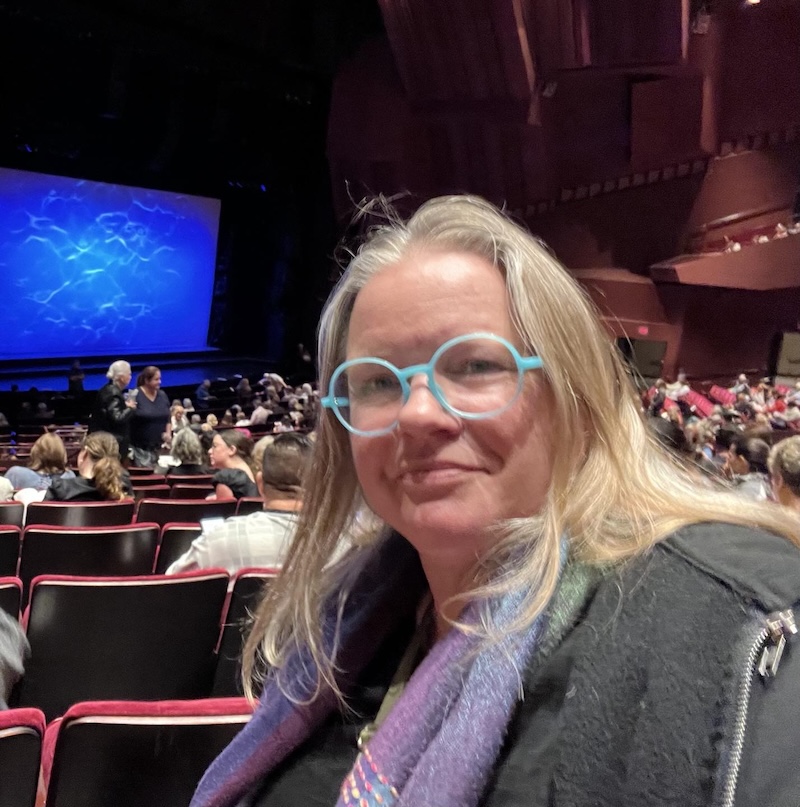
Johanna Smith at the CTG’s Ahmanson Theatre, during a production of “Life of Pi”
Johanna Smith: I’d like to address the mindset of scarcity and helplessness in a landscape that those of us oldies are feeling, that Los Angeles is where stories happen, and that Los Angeles stories are worthy of going global, and they have in the past. Just to be very specific about my lens, I’m focused on children’s theater and puppetry. Even within that lens, I keep thinking of P.L.A.Y. [the Mark Taper Forum’s now defunct children’s theater initiative], because Los Angeles used to be a leader of generating stories, and not just a consumer of stories imported from elsewhere. It used to be understood that the stories here are worth telling, and that the talent here can tell them extremely well.
When I was a young professional starting out, I saw [L.A. playwright] Luis Alfaro’s Black Butterfly in Washington, D.C., at a major national children’s theater conference. I can’t remember when it was, but it was at the Kennedy Center, back when the Kennedy Center was an important space that we were drawn to, rather than, you know, a place to run away from. As a young woman I saw this story about 12-year-old girls from East L.A., and it was everything theater is supposed to be. There were women my age crying because we finally felt seen. And this is going to sound so weird because it’s like . . . it was all these people from all over the Midwest, and all these people were sobbing at these stories of Hispanic girls from East L.A.. It was just, I mean it was just truth and beauty and simplicity and it was all because Alfaro’s a brilliant playwright and the acting was spectacular. It was one of those things that’s like – that’s L.A. And I just didn’t understand that part until I moved here. I hope that makes sense because I don’t think I had even lived in L.A. when I saw that show for the first time, and now that I’ve been out here awhile, I’ve met people like Rose Portillo who was in Zoot Suit at the Taper.
Stage Raw: Twice.
Johanna Smith: Yes, twice! And I’ve had martinis with Rose, and when she’s not being this incredibly brilliant Disney voiceover actress and everything else that Rose does, she’s, like Luis Alfaro, she’s a local treasure. But here’s the reason I know Rose; we know each other because she works with children, she understands that children’s stories in this area are worth telling. She understands this deeply, working to develop the next generation of theater-makers and audiences, and when you’re someone like me and someone like Rose, you understand the importance of investing in our audiences, investing in our community, investing in our children. And we’re having this whole conversation about people feeling like they’re not being invested in. I would go even further and just say, why aren’t we up in arms about the lack of investment in our children? Why aren’t we up in arms about the fact that there used to be such a powerhouse of children’s theater? The last local professional children’s theater I’m aware of was in Rancho Cucamonga. It was the Lewis Family Playhouse creating beautiful original works. I got to work with that team there, with people like Mireya (Murray) Hepner. She’s still in town, trying to create high quality children’s theater in a different way, she’s trying to reframe this lens of scarcity. She started a group called In Other People’s Shoes, which I’ve been involved in. Their approach is like, we’ll produce the work and we’ll come to your stage. She’s been getting some inroads on that, but it’s been very slow-going, and what I’m wondering as a theater maker, I just wonder what it will take for us to flip what we think is evidence of success.
Because my evidence of success is a beautiful play written by José Casas that I got to direct this past year. We performed this play that was written literally for toddlers by a playwright from Moreno Valley. Thousands of kids saw it. And it had puppets, and it was just this beautiful little show that helped a bunch of beautiful kids believe in magic again. That was extraordinary but the reason I bring up José Casas is that José is one of the most dynamic playwrights we have, he’s an L.A. dude. If you saw him you’d be like, he looks like an L.A. dude, now working (as a playwriting professor) at the University of Michigan, because he couldn’t get hired in L.A. He’s been trying to get back to Los Angeles for as long as I can remember. So from Michigan, he just got commissioned to have playwrights-of-color write about superheroes. It’s called the BIPOC Superhero Project, and Murray Hepner [In Other People’s Shoes] is trying to produce one of them. This is an example of [an L.A. exile in Michigan] trying to celebrate L.A., trying to create things, trying to involve children and young people, and trying to be who he is, which is an L.A. dude! And in Michigan, I’m sure they love him and he’s doing incredible work there, but at the same time, why is it so hard for us to find a space for our playwrights?
You and I both love to travel. We’re theater people and we’re curious and we want to know how things work elsewhere, like, literally, every other civilized country invests in the arts. I talked to my friends in London and they’re like, “Oh yeah, we’re working on this dance we got a development grant for, so we have another two years to develop this piece,” and my jaw falls on the ground and it’s. . . Do people here even realize that other people around the world are doing this and that’s why we’re bringing in people from London? Of course I’m going to talk about it as a college professor, which you are as well. I’ve seen what you do with young people in the classroom, a playwriting classroom, I’ve seen the nurturing and the energy and I feel like I’m doing the same thing, trying so desperately with so few resources to do things like produce José Casa’s work. What keeps me going is this understanding that investment is meaningful, that investment is especially important when my students see themselves represented, and here we are not investing in local talent so it’s kind of like, yeah, what are they thinking theater is for?
Stage Raw: I’ve heard the argument that when theaters in L.A. do experimental work, brave work, nobody comes. Then I think about the work that got developed at the Taper: Zoot Suit; Angels in America; Kentucky Cycle; Stand-Up Tragedy; Twilight Los Angeles, 1992; and I imagine that the L.A. audience hasn’t changed that much. When I posted that, I read the retort that L.A. audiences have changed — shorter attention spans, shallower. But I think what’s changed is what you’ve been talking about, the investment.
Johanna Smith: The investment, thank you.
Stage Raw: Gordon Davidson was a showman. He was out there every preview shmoozing his audience, creating the ethos that new work is exciting and it’s necessary. He was generating electricity around the adventure of doing new work and having audiences along for that adventure. How many in-house labs did they have, each dedicated to new play development? It was like a research and development facility. All those labs were gutted the minute he left. So I believe that the difference between then and now is that people understood what the Taper represented because staff there worked so hard to send the message that this theater was on an adventure, generating works that would travel. It was hard work: educating their audience. They did it by deed, not just words. That old phrase: they put their money where their mouth is. Before Gordon took the job at the Taper [in 1967], L.A. theater was a desert. It was all touring productions and imports. And here we are again. I’m not convinced that’s a change in the audience, which, at worst, has grown more fickle but is always ready for an adventure. It’s more about a shift in the priorities of our keystone institutions, largely propelled by their funding pressures and woes. Now it’s up to the smaller theaters to trumpet L.A.’s voices, theaters that didn’t exist in days of yore, but they’re barely attached to the national pipeline. Still, they’re doing the work, as you said, maybe we just need to flip the definition of success.
Johanna Smith: If we could be facilitating another Culture Clash. They’d open at the Taper and then tour the country. We need to be rewarding these artists who are being warriors for us. I’m particularly sensitive to being a children’s theater person. It’s risky to go to bat for children’s theater because of the bias that it’s less worthy.
Stage Raw: The pecking order. You know about 24th Street Theatre. They tell truly probing stories for young audiences.
Johanna Smith: Oh, I’ve worked with them. Yeah, I love them. I think their programming is cutting edge. I think they’re spot on in developing their local audience. They get it. They get including young people in the process and being a space where young people are welcome. I’m not saying that’s going to solve everything, but I am saying that when we’re making these grandiose assumptions about Los Angeles, I don’t think the people making executive decisions in our larger institutions are necessarily seeing the whole picture. And I think it’s now a fear-based environment. Theater has always been an art form where there’s a reevaluation but fundamentally it hasn’t changed. Great stories will always be important, and Los Angeles has stories that could go out into the world and add to the global discussion of who people really are.
Stage Raw: If we’d only let them.
Pulling Strings

“Life of Pi” at The Ahmanson Theatre (Los Angeles): Taha Mandviwala, Anna Leigh Gortner, Shiloh Goodin, and Toussaint Jeanlouis (Photo by “Life oEvan Zimmerman for MurphyMade 2024)
Stage Raw: Let’s transition into the art of puppetry which is . . . well, you’re the scholar on this, but my impression is that it’s timeless, it’s international, it’s beautiful and it’s important because it’s so primal. It’s animating inanimate objects, like the kid taking a pencil and turning it into a character. Let’s start there.
Johanna Smith: Yes, that would be correct. It’s childlike imagination on steroids, whatever the age group you’re working with. Elsewhere, I’ve seen some of the most incredible advancements in theater making and a lot of has to do with the embrace of puppetry. What I saw with the Life of Pi with the moving set pieces and the transformations and the . . . Let me just acknowledge in that show the simplicity and the bravery to trust your audience to accept it, to trust your audience to accept abstraction and to not have to have spell things out for them. [That restraint] turned out to be almost a relief for audience members. Does that make sense? That’s why we go to the theater. We don’t want to see cinema recreated. We want to have a theatrical experience and that’s what puppetry is. Professionally, I’ve been having a discussion for a long time about how to work with puppets.
Stage Raw: You were the first “puppeturg” to work for the Tisch School of the Arts New Play Development series at NYU.
Johanna Smith: We worked on it during COVID so we were all on Zoom, but I was hired as the puppeteer to figure out how the language of the puppets would fit into the writing and development of a play by José Casas and Sandra Fenischel Asher. Because the playwrights were, like, we don’t understand how puppets speak. We need you there to translate, and I basically was like the puppeteer. They put together an A-Team, and now they workshop these new plays and some of the best new children’s theater has come out of that.
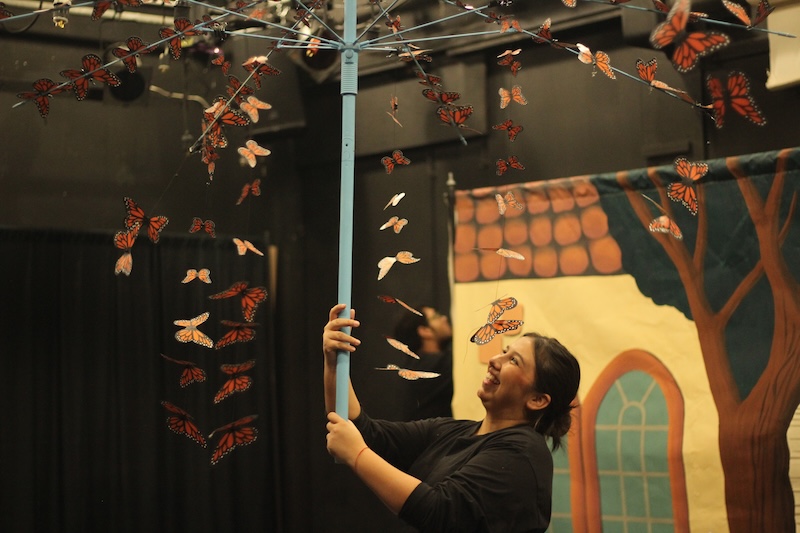
“Mariposa Butterfly” was developed by the Tisch School at NYU’s New Plays for Young Audiences Program. Smith was the program’s “puppeturg”
Some of the most phenomenal new work I’ve ever seen is by a group called Alex and Olmsted. They’re out of Maryland. They’re a couple and they do two-person public shows that are so beautiful and silly and magical. Their show I saw is called Marooned! A Space Comedy and it’s about a space explorer getting stuck and a little robot comes and helps her. It’s like the most simple, gorgeous little nonverbal story, and you could take that story and you could send it around the world, and it would be up there with so much of the best puppetry I’ve seen.
Stage Raw: Do we still have puppetry in L.A.?
Johanna Smith: Yes. Rogue Artists Ensemble. I would put them way up there, prioritizing puppetry fully as an art form. Cornerstone Theatre Company has a puppeteer on staff, Lynne Jeffries. There is the L.A. Puppetry Guild that puts programming together. The Bob Baker Marionette Theater has education programs. They’re basically doing, what’s the word? They’re kind of a window into Bob Baker’s shows of the past, but you can go and see them and be taken back to that time, which is very nostalgic. There was a time when if you said “puppetry in L.A.,” you would hear Bob Baker Marionette Theater. I also want to throw out like something L.A. has that I don’t know if it’s properly appreciated, but it’s the history of puppets in the film industry, like George Pal and his puppet animations, and like all these other really interesting artists, some of them, you know, like the Rankin and Bass films [Rudolf the Red Nosed Reindeer, Here Comes Peter Cottontail, The Hobbit]. L.A. has some really cool people working in those spheres that also do puppet work. There’s also Viva La Puppet, which Michelle Zamora started while getting her B.A. at Cal State L.A. And Cal Arts seems to be a hub for puppetry work. And there’s some really cool puppetry work still going on at Disney, with people who also do work for The Jim Henson Company.
I would say that major international festivals are where the field assesses where it is and how to move forward, and the biggest one in the United States right now is the Chicago International Puppet Festival. Also east of here, there’s the O’Neill Puppetry Conference in Connecticut, which is where a lot of the New York puppetry is generated.
A Shining Land in Some Imagined Future

Los Angeles: LAPD Barrier Tape at a Protest Rally Against President Donald J. Trump, June 2025
Johanna Smith: If you haven’t been criticized by Bulgarian puppeteers, you have not experienced the gauntlet. When I was there, they ran me through a pasta maker, ate me, and crapped me out. And after that whole experience of having my work ripped apart, I’m still here, and I am better for it because I survived. But I also took some things really, really to heart about how to make my life better.
Speaking of taking things really to heart, I think it was, I can’t remember what year this was, but I saw in a public festival the very famous Canadian puppeteer, Ronnie Burkett.
He did the keynote speech and everybody was expecting him to come in with his marionettes, which are these stunning works of art, but he didn’t. He came in and sat in a chair and looked at this audience full of puppeteers and he just said, “Clean your studio.” And he basically went on a rant saying you’re doing tired old stuff. Clean your studio. Clean it out to make room for new ideas that inspire you. It was the most wonderful way of saying, stop imitating, find your own voice. It was a loving call. It was almost a call to arms: We need to be making the most exciting, original art that we can.
So this idea of a call to be better: I would make that clear, when we’re talking about stuff like what you wrote about: Why can’t the Taper be better? Why can’t it be an advocate for the people and the artists in its own city? Going back to being like, yes we can do this, we should do this, and finally then the leadership is finally going to demand that we do this. That, for me, is the trajectory, and it comes from that critical awareness of what’s possible. I don’t mean to sound Pollyannish.
Stage Raw: No, you sound eloquent, and earnest, and truthful. In another era, when investments were made, we got results, and when investments are not made, we don’t. And it’s all just as basic as that: The investments of energy and of care, and of money.
Johanna Smith: Maybe this will resonate with people who doubt us: You can further back than our short lifetimes, further back than just L.A. in the past 30 years. Go back to the Federal Theater Project [1935], go back to look at what the government did during the Great Depression, look at what they invested in and look at the results, look especially at the Black theater project.
Stage Raw: Yep, yep. The WPA’s Negro Theatre Project.
Johanna Smith: Thank you. It’s like we have evidence in this country of it working. I can shout from the rooftops about how the Bulgarians have a puppet theater in every major city, but if we’re talking to Americans, I think Americans need a more concrete example of when America believed in the government, and the government believed in the arts, and it elevated everyone.
Stage Raw: Perhaps one day, when all the bile that divides us dissipates, perhaps with some collective exhaustion from tearing each other to pieces, from arresting and blowing each other up, with enough fatigue from all the lies and double-speak and duplicity, and the chaos they engender, if we can one day arrive at that destination, perhaps then, if that ever happens, your proposal for something humane is something Americans might be capable of considering. It’s possible, I suppose.