
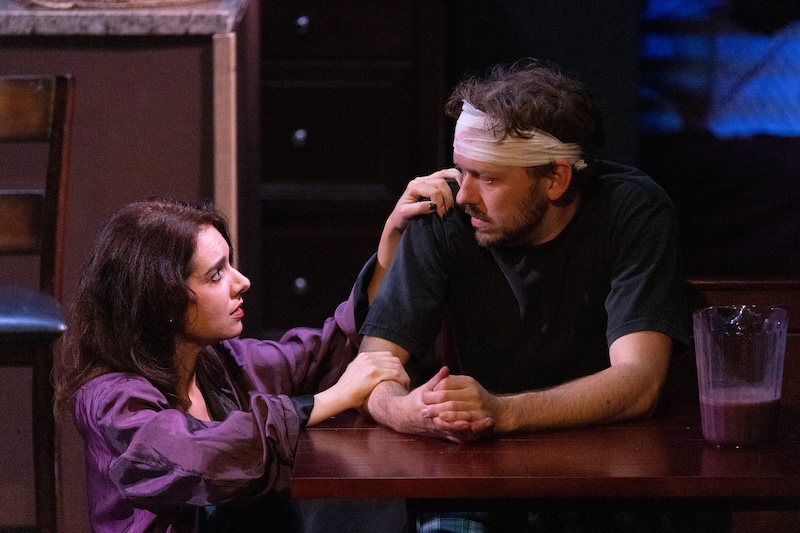
Bethany Koulias and Brock Birkner (Photo by Jeremy D. Thompson)
Reviewed by Steven Leigh Morris
Theatre Extempore and Santa Clarita Shakespeare at The Main
Through August 10
There’s nothing in the world that you can do,
You gotta come on up to the house.
And you been whipped by the forces that are inside you,
Gotta come on up to the house.
Well, you’re high on top of your mountain of woe,
Gotta come on up to the house.
Well, you know you should surrender, but you can’t let it go,
You gotta come on up to the house, yeah.
These are lyrics from Tom Waits’s “Come on Up to the House.” A recording of the jazz/spiritual song, performed by the gravel-voiced Waits, plays in and underscores the aesthetic of Theatre Extempore and Santa Clarita Shakespeare’s rendition of Stupid F*cking Bird, Aaron Posner’s much heralded contemporary adaption of Anton Chekhov’s The Seagull. (It premiered in 2013 at Woolly Mammoth Theatre in Washington, D.C. to such acclaim that Posner went on to create a kind of cottage industry of contemporary adaptations of plays by Chekhov, in an attempt to bring the Russian master’s voice into the 21st century. Like movie remakes, however, nothing quite lands like the original.)
Los Angeles theater moved swiftly to get the play. The year after its premiere, Circle X Theatre Company and the Boston Court Theatre teamed up to present it at the latter’s Pasadena venue. Long Beach’s Garage Theatre got to it in 2017. Earlier this year, a new company Blue Pen Theatre, staged it at MiViDa in Frogtown.
Posner’s adaptation, like Chekhov’s original, is a testament to the idealism and insufferable egotism of theater artists, and closes with a kind of anthem — what’s it all for? This is why director Jeremy D. Thompson’s choice of the Tom Waits song is so on target (“You been whipped by forces that are inside you.”). Posner’s spin on Chekhov’s young playwright, Konstantin Treplev, here renamed Conrad and referred to as Connie (the capable Brock Birkner) is akin to every CalArts graduate out to transform the culture with their art. By the time Conrad has a play being produced in some small theater years later, he simply doesn’t care anymore. He won’t even attend the production. His revolutionary artistic spirit has been crushed by his growing indifference to life, compounded by his unrequited love for an actress, his peer Nina (the mercurial Natalie Valentine, whose emotions flick off her like sparks). Conrad’s chronic disappointment in life is exacerbated by the “success” of his competitor, novelist Doyle Trigorin (Peter Schiavelli, blithe, world-weary and completely plausible), fully cognizant of his mediocrity that’s nonetheless led to a fame for which he has no regard. Connie’s egomaniacal actress mother, Emma Arkadina (Bethany Koulias) is possessed by a serpentine attachment to the handsome novelist, who himself falls victim to the blatant seductions of Connie’s muse, young Nina. Meanwhile, Nina can’t understand why Trigorin doesn’t treasure his fame (as she clearly worships it and says so), even as he cannot understand why Nina doesn’t treasure her own physical beauty. None of them understands much of anything, which doesn’t prevent them all from pontificating on themes beyond their emotional grasp. And therein lies the play’s comedy, despite one metaphorical, pointless killing of a beautiful seagull, and one equally pointless suicide attempt. The grandiose and the petty live side by side.
Apparently, some support tech staff were AWOL for the performance I attended, so I have no way of discerning whether the three-hours-plus running time was an aberration or intentional. (Almost every other production of this play clocks in at about two and half hours.) There were original songs by James Sugg performed by platinum-hair/goth “in mourning for my life” Mash (Caroline Buddendorf), who settles into a comfortable, passionless marriage to a sweet, doltish schoolteacher (Ángel Miguel López).
The production itself takes on the tone of Connie’s performance art piece that opens both this play and Chekhov’s. Not sure this a great idea, when the author, Posner, references his own play in a line that says it’s nothing inventive, just standard fare. Perhaps that’s why this production’s punk-ish search for “new forms” (an early ambition of young playwright Connie), with added music and audience interaction, and some very slow pacing, results in more length than insight. This problem is compounded by the miscasting of “aging” actress Emma Arkadina, who appears on this stage to be the same age as her artistic and sexual rival, young Nina. One could easily take them for fraternal twins. So Emma’s anxiety over aging out, on stage and in the eyes of her younger lover, requires a suspension of disbelief that’s too much to ask. (Are older actresses really so hard to find in the Los Angeles area?)
All that said, there’s something about the spirit behind this production that underscores the author’s attempt to bring Chekhov’s whimsy and wisdom, his hope and hopelessness, into our era. To me, it all leads back to its use of Tom Waits, who really is a poet, and a storyteller, and whose songs, with their jazzy, bluesy, spiritual gruffness, have deep connections to the comparatively buttoned-down (buttoned-up?) Anton Chekhov. In that regard, this production’s aims are noble. Its execution, however, could use some rigor. It would also probably help if the running crew would stick around to run the show.
Theatre Extempore and Santa Clarita Shakespeare at The MAIN, 24266 Main St., Santa Clarita. Fri.-Sat., 8 pm, Sun., 3 pm; thru Aug. 10. https://www.eventbrite.com/e/stupid-fking-bird-presented-by-theatre-extempore-tickets-1318024118619?aff=oddtdtcreator