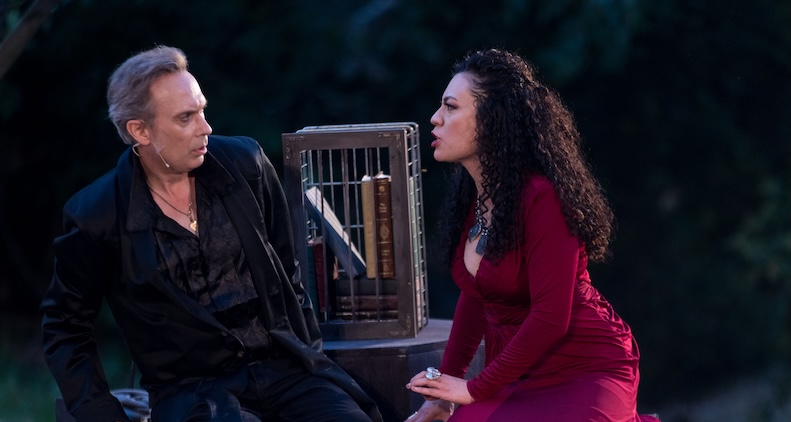
David Melville and Kalean Ung (Photo by Grettel Cortes)
Reviewed by Steven Leigh Morris
Independent Shakespeare Company in Griffith Park
Through August 31
There’s really no need to opine on the pertinence to the 21st century of Englishman Christopher Marlowe’s 16th century drama about a man who sells his soul to Lucifer. So let’s just skip that part with the caveat that the urgings of those who enable what they know is evil but accommodate that evil in order to keep their seats of power — well, let’s just say that the Faust myth is timeless for a good reason. In the case of Dr. Faustus of Wittenburg, his bargain is to have a rollicking, if short-lived, 24-years lark, time-traveling and commandeering the elements.
There are two folios of this play, and one late-18th century revision by German Johann Wolfgang von Goethe – itself a play in two parts.
Melissa Chalsma’s adaptation, staged under the stars in Griffith Park, incorporates all of these works, while adding original songs by David Beukers, Chalsma, and David Melville (who plays the title role).
The play’s theology – a cautionary tale about abandoning the edicts of Christianity in order to dabble in the forbidden mysteries and delights of the occult – comes ripped from the pages of Medieval morality plays. These are the most bookish and least relevant aspects of the myth to our times. Marlowe’s contemporary, William Shakespeare, frolicked with those same ideas, filling his stages with similar ether-dwelling spirits in plays such as A Midsummer Night’s Dream and The Tempest, but he did so in a manner more playful and less strident than Marlowe. Though who doesn’t enjoy seeing a sinner sucked into the jaws of eternal hell for his power trips and other misdeeds?
That closing scene in Dr. Faustus is particularly potent in Chalsma’s staging, when the stage floor opens up to reveal a cauldron of orange and blood-hued smoke billowing from the underworld, while Faust — because of a contract drafted by Lucifer that Faust signed with his own blood — is inexorably pulled into the pit by some gravitational force, while screaming throughout. That’s what you get for messing around. Curiosity killed the cad. Next time, behave. If only there were a next time. Can we admit that this is a somewhat authoritarian fable?
The National Guard on the streets of Washington, D.C.. The U.S Marines backing up ICE raids in Los Angeles. If you don’t obey the rules, off to the gulag with you! Though Dr. Faustus offers diabolical pleasures, the question of what rules we’re supposed to obey cuts to the heart of whether this play is a plea for social civility or for a theological chokehold. And what if the rules change or are re-interpreted after you’ve obeyed them? What if they’re made up on the fly, as the U.S. Supreme Court did with presidential immunity? That’s what we’re dealing with in 21st century America.
There’s much to admire in Chalsma’s staging: The use of David Beukers’ sound design that provides rumbles and percussion and some jocular music to underscore scenes. Costume designer Yasamin Sarabipour’s use of boots on every actor, and vestments and cloaks in hues of black and earth-tone – and yes, a smidgen of red. This is all played out on an almost bare, earthen platform stage streaked with symbols of the occult. Brent Charles is terrific in multiple roles, but particularly as Lucifer (yes, he dons red for that) and the Pope, who gets mocked by the invisible, impertinent Faust, just for the fun of it, like a screenwriter on South Park. Bad boy! He’ll pay for that.
Kalean Ung’s commanding, bejeweled Mephistopheles, in a body-clinging gown, gets everything right with his/her regal imperiousness and fits of holy terror whenever Faust appeals to Christ.
The presentation of The Seven Deadly Sins comes in rap, a diverting and entertaining approach.
And yet, as Dr. Faustus was wrestling with his decision to sign up with the Devil, for some metaphysical perks, I found myself wrestling with why this production doesn’t fully add up. David Melville is indisputably a fine actor. That’s been demonstrated countless times on this company’s stages in Griffith Park and in the intimate, indoor confines of the troupe’s Atwater Village studio space. His one-man Hamlet, performed in that latter space, demonstrated his musical gifts playing guitar, ukelele, and piano, and sometimes singing with a vaudevillian buoyancy that he’s mastered.
Though he isn’t a musician in this production of Dr. Faustus, he brings his gifts of comic timing and sly, understated quips, and a wobbling gravitas to bear. I still don’t understand how these qualities can be so interestingly marbled in Hamlet and feel so wispy in Faust. Perhaps it’s because their respective torments are at odds: One is seeking the truth, the other seeks atonement. They can’t both look the same, which they do here. All performance is artifice, a bag of tricks, but Doctor Faustus seems to need a bag containing some different instruments.
And so I found myself curious and detached, enchanted by the spectacle as though watching a fireworks display, though ultimately unchanged by it.
Griffith Park Free Shakespeare Festival, The Dell at the Old Zoo, Griffith Park. Opens Sat., Aug. 9; Wed.-Sun., 7 pm; thru Aug 31. FREE.