
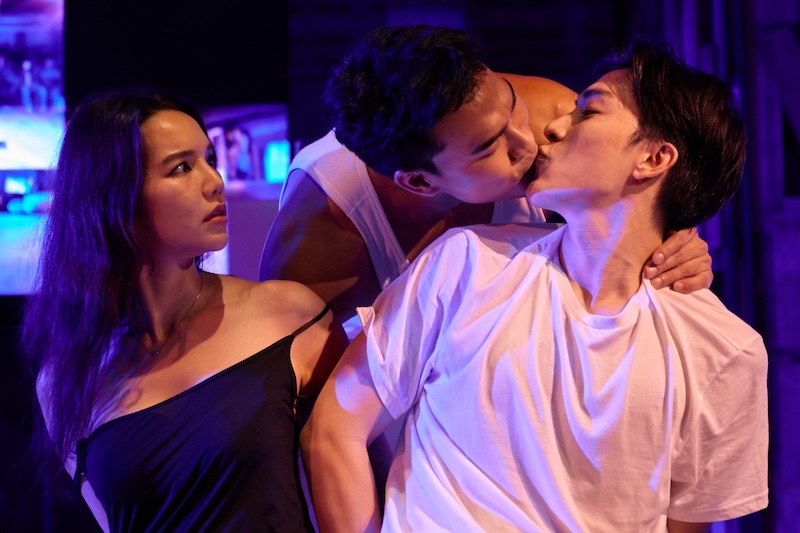
“A Midsummer Night’s Dream” in Bangkok (photo by Chayut Sunthornsiri)
Bangkok: City of Angels (Yes, That’s Its Ceremonial Name)
From “Rashomon” and “Midsummer,” to “Scarface” and Christopher Durang
By Amanda L. Andrei
“Rashomon” at Bangkok’s GalileOasis (photo by Panmas Rodjasil)
Passing by carts of dragonfruit and mangoes, treading alongside motorbikes and cars, and wiping away sweat from air scented with grilled meat, traffic fumes, temple incense, and canal water, I walked through Bangkok in search of theater. These are my two favorite ways to get to know a city: walking through it and watching plays. And for one long weekend in early summer, I sweated my way through this metropolis – coincidentally also known from its shortened ceremonial name as the “City of Angels” – to see three plays that left me thinking about the nature of neighbors, karma, and the exultant weirdness of theater.
My first night brought me to the charming GalileOasis in the Ratchathewi neighorhood to see the English-surtitled, Thai-language Rashomon Condominium, adapted and directed by Damkerng Thitapiyasak from Akira Kurosawa’s classic 1950 Rashomon film. Instead of a woodcutter, priest, and commoner discussing a sexual assault and the murder of a samurai, the play featured a plucky hairdresser (Ratchanon Kotmanee), secretive Grab deliveryman (Pawit Mahasarinand), and nervous house cleaner (Molywon Phantarak) discussing the violent crime with a handsome, high-profile film actor (Chawitkan Vorarojyothin) implicated in the heart of the scandal.
The GalileOasis theater is quaint, intimate yet spacious, given its two floors and columns, allowing director Thitapiyasak to evoke the spookiness of a Southeast Asian condo. Characters squeezing together through liminal spaces of hallways, staircases, and doorframes rendered a sense of estrangement: Who are our neighbors, really? How well do we know the people who live next to us? And if we can’t trust people, can we instead trust places? After all, declared the hairdresser as the three working class witnesses pieced together what happened in the condo, “Truth needs to be proven where it happened.”
Additional cameras and screens (designed by Karan Limparattanakiree) with moody ice-blue neo-noir lighting (designed by Tawit Keitprapai) heightened the role of technology in this estrangement, how surveillance and sousveillance provide conflicting perspectives to the search for “objective” truth. At times, the efforts to immerse the whole audience in the world – including a surprise actor planted in the audience and the cameras also pointed at the playgoers – felt stretched too thin. More in-depth exploration of an element could have provided more clarity and contemplation to the scandalous story. Despite the flurry of techniques, Thitapiyasak’s grandiose vision still offered a chilling insight into human behavior, as the hairdresser asserted to her comrades, “I believe your account more than the others because it sounds more realistic.”

GalileOasis in Bangkok’s Ratchathewi neighborhood: home of “Rashomon” (Photo by Amanda L. Andrei)
My next theatrical outing took me to 2499: The Musical at the Muangthai Rachadalai Theatre on the top floor of the Esplanade Ratchadaphisek mall complex. This musical is an adaptation of the seminal 1997 film 2499 Antapan Krong Muang by Nonzee Nimibutr, also known in English as Dang Bireley’s and Young Gangsters, focusing on the titular character’s tragic life in the 1950s as a young gang leader in Bangkok. (2499 is in B.E., or Buddhist Era, which translates to 1956 in the Gregorian calendar.)
I wondered what an American equivalent might look like. Scarface: The Musical? Michael Corleone: The Musical? But I needed to do away with those Hollywood frameworks. As a film and a musical, 2499 exists within a kind of masculinity that is sharp and ruthless, yet with glimmers of an adonic delicacy.
An audience member need not see the movie to appreciate the musical, but it certainly helps. Within the film, Piak, a former friend of Dang and now an elder, narrates his memories of the teen gangster and their hardships. Nimibutr’s direction creates a portrait of young, beautiful Thai men caught in a violent era of global transformation when Thailand was dealing with political upheaval from the Cold War, as well as American allyship and military presence. James Dean and Elvis Presley are their idols; live fast and die young is not an uncommon ethos. The insertion of archival footage into the narrative creates a disruptive confluence between cinematic fiction and real-world inspiration. Powerful critique of the U.S. comes in visuals such as recurring poster of Presley becoming splattered in blood. So much for smooth, glamorous masculinity promised by America.
Produced and directed by Takokiet Viravan, the musical adaptation pivots to focus more closely on Dang (performed by a soulful Naphat Siangsomboon). Now narrator, he becomes entangled with his childhood best friend Pu (a volatile and fiery Narakorn Nichkulthanachot), whose theatrical character becomes a more fleshed-out friend and villain than the film.
The brutality of Daeng’s world is powerfully portrayed with smoky blasts from the middle of the stage and spinning newspaper projections, hearkening to the explosions and archival footage in the film. Some brawls resembled an erotic ballet with the shirtless male ensemble somersaulting and dancing in duets, Panchiva Kosolprapa’s choreography heightening the original camera gaze that lingered on these doomed men’s beauty and youth.
Justifying his descent into revenge, one gangster intoned, “Life is brutal, we can’t be soft.” I was attending this musical while Los Angeles was on the brink of the National Guard rolling through the city, and the translated words made my heart ache. Watching the clashes onstage, I worried about the clashes at home. I felt the helplessness of distance. Perhaps this show would give me some insight, some optimistic ending that I could project onto what was happening in L.A., but then Dang sang his lament to his family: “There’s no way to protect you.”
My experience became another opportunity to check my Western biases and desire for a redemptive ending. With the film and musical’s emphasis on Dang’s mother desiring him to give up a life of violence for the life of a Buddhist monk, I found myself thinking about the characters’ karma of the characters, their choices with how to deal with suffering, and in turn, with actions. I walked into the humid afternoon and wondered how, during times of crisis, we can choose actions that are not rooted in delusion, greed, and aversion.

“A Midsummer Night’s Dream” (photo by Chayut Sunthornsiri)
After 2499, I trekked west to the quiet and coffee shop-dotted Ari neighborhood to catch writer-director Parnrut Kirtchanchai’s A Midsummer’s Nightmare at the Lanna Ari Theater. I knew this show would be a challenge: no English translations and no plus one to help me interpret what I would see onstage, so I would be depending entirely on visuals, gestures, and other theatergoers’ reactions to make sense of the performance. However, I had hope that I would glean insights into theater, especially since the piece referenced Shakespeare multiple times and is based on Christopher Durang’s one-act, The Actor’s Nightmare, in which an accountant enigmatically finds himself cast as an understudy in a play.
I took off my shoes with the other audience members as we walked up the wooden stairs into the open-air theater, flanked to the left by a wall with built-in cabinets filled with figurines and knickknacks. Slatted folding doors and columns divided the stage before us, conveying a sense of multiple rooms. The swooping pink draperies, fogged air, and rainbow of sparkling costumes (each actor in a different color) felt like a curious blend of David Lynch and Lisa Frank, a luxe mystery mixed with hyper-whimsy. With this set design by Pornpan Arayaveerasid and costuming by Pin Nicha, I was ready for the absurd.
And indeed, the play did not disappoint. Under Kirtchanchai’s nimble direction, the ensemble danced, clowned, chanted, chased each other, did pull-ups on the doorframe, sang, scolded, cajoled, rolled around on bubblegum-pink exercise balls, all to the uproarious laughter of the audience. Macbeth, Romeo and Juliet, and A Midsummer Night’s Dream were all invoked and poked fun at, and a mini-attempt at Hamlet turned into a repetition of “to be or not to be,” which eventually transformed into a belting boyband serenade.
Although the jokes and humor were lost on me, the image of this play that lingers with me is that of the emptied stage, the actors running on and off, shouting and clambering on the staircase, the lights half-dimmed and shadows elongated. Percussion. Chants. For all the giddy acrobatics and absurd tactics, the stage without humans on it but rather around it evoked memories of my first experiences of theater. The precious moments of being backstage, in the tech booth, in the green room. The voices coming through the audio system, distance and emptiness bridged by sound.
And despite not understanding the Thai (or frankly, making much sense of the English bits), I felt this production conveying to me something I often hope theater to be: joyfully weird yet inexplicably, a home.