Reviewed by G. Bruce Smith
theatre dybbuk at First Congregational Church of Los Angeles
Through Oct. 12
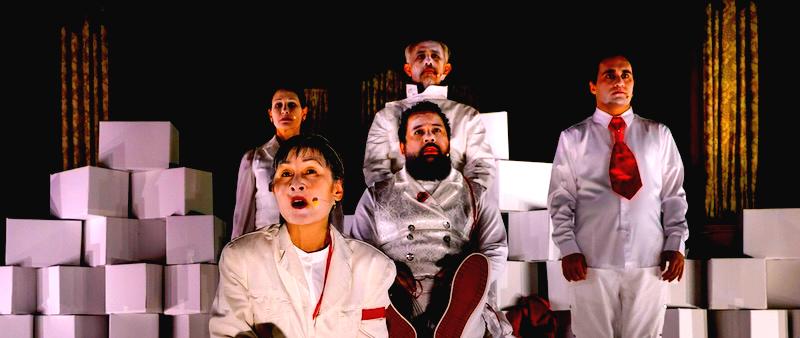
Upon entering the beautiful and architecturally striking Shatto Chapel of the First Congregational Church of Los Angeles — the setting for theatre dybbuk’s Dracula (Annotated) — we see five actors dressed in white staring into white boxes that seem to contain screens of some kind. (Stacked white boxes also surround the stage on three sides.) And we hear what sounds like clips from TV news shows with random topics, ranging from HIV to illegal aliens to “Dungeons & Dragons.” The haphazardness of these audio clips hints at what is to come once the play actually begins — but more on that later.
It’s a tableau whose elements will continue throughout the performance as the piece combines movement, the creative use of blood-red cloth and the boxes themselves, and spoken word (monologues more than dialogues) to create a visually arresting representation of Bram Stoker’s acclaimed 1897 vampire novel.
However, satisfying visuals do not, by themselves, translate into an overall satisfying theatrical experience.Dracula (Annotated), as written and directed by Aaron Henne, is so randomly information—heavy — even muddled — that it’s a major challenge to stay engaged with the narrative.
The basic outline of the plot of Irish author Stoker’s gothic horror novel is well known. The story is told through letters, diary entries, and newspaper articles and thus has no single protagonist. British solicitor Jonathan Harker takes a trip to stay at the castle of Transylvanian nobleman Count Dracula, but flees after learning that his host is a vampire. Dracula then moves to England, plaguing the seaside town of Whitby before returning to Transylvania. Eventually, a small group of British men tracks down the Count and hunts and kills him.
theatre dybbuk bills the play as “weaving together Victorian history with the text and characters of Stoker’s novel” and exploring “the influence of colonialism, antisemitism, xenophobia, and gender inequality on the book and its audience.”
But how this is presented is a problem. The narrative jumps around in time from the mid—19th century to the early 20th—century. Topics covered include British colonialism in India, the portrayal of Jews in England as sinister blood—thirsty figures, railway accidents, various diseases, homosexuality, the Romani people (commonly known as gypsies), “female hysteria,” Jack the Ripper and more. Interspersed throughout are pieces of Stoker’s novel; the major plot points are covered, though if you are not familiar with the book, it might be problematic just to figure out who the characters are. There is no connecting thread — or if there is one, it’s difficult, or even impossible, to follow.
It’s one thing to annotate a book you are reading. You can go back and look at your explanatory or critical notes to provide context, clarification, or deeper understanding. A theater audience cannot do the same.
It is certainly admirable that Henne spent two years painstakingly developing the piece both with the ensemble and with scholars of Victorian history and gothic literature.
It is also praiseworthy that the production itself is not only visually engaging (particularly given its haunting location in the chapel), but also includes an original music score, performed live by Jeremy Michael Robinson (also credited with sound design).
And the actors themselves — Edgar Landa, Adam Lebowitz—Lockard, Julie A. Lockhart, Diana Tanaka and Jonathan C.K. Williams, each of whom plays multiple roles — are clearly talented and dedicated to what must be a demanding performance.
It’s just unfortunate that the compelling story of Count Dracula and its historical context are lost in annotations that are best left on the page, not on the stage.
theatre dybbuk at First Congregational Church of Los Angeles, 540 S. Commonwealth Ave., Los Angeles. 8 pm Friday and Saturday, 7 pm Sunday. theatredybbuk.org/dracula—annotated. Running time, Three hours, including a 15—minute intermission.