
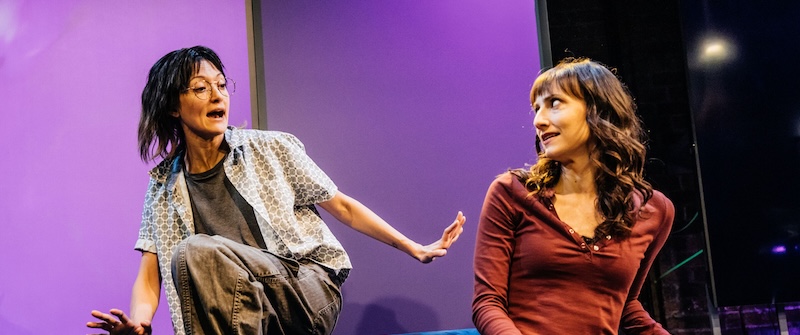
Alexandra Hellquist and Julia Manis (Photo by Jeff Lorch)
Reviewed by Amanda L. Andrei
Rogue Machine Theatre
Through November 9
Here’s a riddle for the modern era: What do artificial intelligence and grief have in common?
An answer: they’re both black boxes—opaque systems that the users don’t fully understand.
And in the North American premiere of Lauren Gunderson’s highly imaginative yet uneven new sci-fi thriller, they’re black boxes that tend to be admired from the outside, but not so much examined and contemplated for their inner workings. As a result, human choices and behavior are glossed over while AI transforms into an uncanny, unchecked spectacle.
In the 13 months after her sister’s abduction and assumed death, programmer Merril (Alexandra Hellquist) has dealt with her pain by creating a large language model (LLM) based on her sister Angie (Kaylee Kaneshiro; AI and video direction by Michelle Hanzelova-Bierbauer). While initially built to comfort Merril, LLM-Angie transforms from generative to agentic: the program begins to act independently, making decisions without Merril’s direct prompts. To achieve Merril’s encoded objectives, digital little sister interprets “to comfort” as fun-yet-horrifying decisions, such as guessing Merril’s passwords to access the internet and deceptively texting Merril’s ex, Raquel (Julia Manis). This interpretation eventually expands, and the virtual Angie suggests that the original Angie may not be dead after all.
The decisions are fun because they sow chaos, but horrifying because the capricious AI choices are given little pushback by the humans as their behaviors shift, seemingly out of nowhere. Director John Perrin Flynn manages the shifts adequately, with Merril’s austere home office and oversized screens (sleekly designed by Stephanie Kerley Schwartz) contrasting against heated arguments, wry humor, and the occasional philosophical one-liner that the humans tend to absorb without question. Hellquist skillfully vacillates between frantic mourning family member and tunnel-visioned lover, though the glitches from virtual Angie—distracting when surtitles and sound are out of synch, powerful when purposefully dissonant—sometimes drown out her intensity. The human-machine interaction becomes less overwhelming by the time flesh-and-blood Angie comes face to screen with her doppelganger, heightened instead by Kaneshiro’s vivid, seething presence.
The issues lie mainly in the script. For instance, with Merril’s brilliance as a programmer, it is not unreasonable to expect that she would show more concern — panic, even — that the entity she has created has jailbroken itself from its contained environment and can now access the vast sea of information that is the Internet. But the play bypasses this security breach by quickly moving onto the next action. Similarly, when AI Angie’s misleading text causes Raquel to show up at Merril’s door in mere minutes, Merril’s emotions jump from shocked anger with her creation to an immediate seduction of her ex-girlfriend. The juxtaposition is jarring, and similar radical shifts happen often.
These erratic behaviors could very well be attributed to grief—that obscure, unpredictable process that breaks daily human patterns. But in a play that stresses that humans are pattern-based and posits love as the default pattern, the portrayal of grief is given short shrift. It becomes a catch-all reason to justify character choices that lead to immense irresponsibility and vulnerability, both in human and artificial intelligence. Such anguish is worthy of more time and examination.
Rogue Machine at the Matrix Theatre, 7657 Melrose Ave., W. Hollywood. Fri.-Sat., 8 pm, Sun., 2 pm, Mon., 8 pm; thru Nov. 9. Runtime: 90 minutes with no intermission.