The Age of Dracula
theatre dybbuk’s take on Bram Stoker’s novel
When I was a child, we were living in the Age of Aquarius: the age of political and social transformation (“The Times They Are-A-Changing”) and of an enlightenment straddling the theological and the cosmic. The musical Hair in the late 1960s was that era’s Hamilton. It told and sang of a nation riven by the war in Vietnam, and of a flickering hope, that interpersonal and international relations might rise above the prevailing edicts of “might makes right,” and that savagery and vengeance are legitimate means to a loftier end. Enlightenment.
There’s little virtue in being nostalgic for that era, or for any era. Our government was committing war crimes then, as it is now. We’re among the pantheon of empires that preceded us, however well-meaning we may have been. Domestically, National Guard troops were on the streets of our cities in the late 1960s, as they are now. Political violence, including assassination attempts of public figures, was as rampant then as now. The issues were different, perhaps even flipped: states’ rights, school segregation and race riots versus today’s issues of executive power, income inequality, and health care. Yet the larger shapes, the corruptions and the ever-fraying comity, are a constant.
The underlying tension stems from the conflicting perceptions of opportunity, and of people’s entitlement to that: the pursuit of life, liberty and happiness. Who is actually permitted that? In the late 1960s, marginalized groups were fighting for the opportunity to share in some of the nation’s bounties, as they still are today. The difference is the extent to which the nation’s bounties have now been seized, the extent of the corruption underlying those seizures, and the capacities of the growing numbers of the impoverished to claw back some of those bounties.
Redistributing some of the nation’s bounties was how President Franklin D. Roosevelt saved American capitalism from itself, beginning in 1933. In our century, Bernie Sanders and Elizabeth Warren have been beating that same drum for decades in an endeavor that’s proven largely pointless. It was always the battle against the greed and entitlement of the oligarchs, the titans of industry and technology. And it always will be. AOC and Zohran Mandani rise from the ashes in New York City. Let’s see what happens with them in the Age of Dracula.
At the time I’m writing this, our federal government is shut down ostensibly from a dispute over the affordability of health insurance. Democrats want over a trillion dollars directed towards healthcare insurance for low-income Americans. They don’t want new money, they want old money restored after being chain-sawed out of the budget by the “Big Beautiful Bill” (Congress’s singular legislative accomplishment this year) that gutted funds for Medicaid and Affordable Health Care tax credits. This was a strategically partisan Republican budget bill passed without even consultation, let alone negotiation, with Democrats.
There’s no clearer illustration of the Age of Dracula than throwing 15 million low-income Americans off their health insurance in order to provide tax breaks for the mega-wealthy. (According to the Center on Budget and Policy Priorities, the legislation that the Democrats are, at last, defiantly trying, (for now), to circumvent removes $1.1 trillion dollars from Medicaid and the Affordable Care Act marketplace, resulting in 10 million Americans losing their health care and becoming uninsured by 2034. An additional 4.2 million will lose marketplace coverage because the law failed to extend the premium tax credit enhancements (this, according to the Congressional Budget Office), plus another 900,000 people will be removed from health care from budget cuts in a prior rule proposed by the Trump Administration which has now become law. Once all those people, with no medical alternative, start using hospital emergency rooms, in the hospitals that still exist, the trickle up effect of rising Medicare premiums (impacting middle- and upper-middle-class Americans) becomes inevitable and inexorable. This is Dracula at work, pure and simple, where sucking out the blood of his neighbors gives the vampire sustenance.
The Democrats do not wield a massive wooden spike to drive through the heart of the vampire. At this point, they are merely holding up a small crucifix in the direction of the vampire with the aim of deterrence while the vampire claims to be a Christian, as though that might help him.

The ensemble of “Dracula (Annotated)” (Photo by Taso Papadakis)
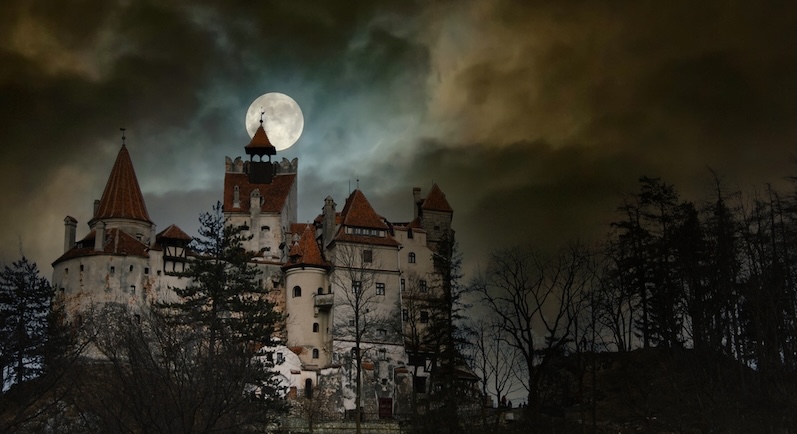
All of which leads to a presentation by theatre dybbuk (a troupe that develops devised theater pieces anchored in themes of anti-Semitism) at the First Congregational Church in the Westlake district of Los Angeles. The piece is called Dracula (Annotated), and uses a game ensemble (Edgar Landa, Adam Lebowitz Lockard, Julie A. Lockhart, Diana Tanaka and Jonathan C.K. Williams) to narrate Irishman Bram Stoker’s 1897 novel about an English solicitor named Jonathan Harker (Lockhart) who visits Transylvania to finalize a land deal, only to realize that there is slightly more to the taciturn Count, whom he is visiting, than first meets the eye. Finding himself imprisoned in his host’s castle does not inspire his confidence in the stability of his situation, or in his ability to negotiate a deal.
I attended opening weekend with a friend. After an hour and 40 minutes, the floor of production designer Leslie K. Gray’s bleached white set (adorned with matching white packing boxes and white-red costumes (by Kathryn Poppen) had become strewn (by the actors) with blood-red ribbons and cloth. The stage lights went down, the house lights went up. My guest and I both presumed a sense of conclusion, though the lack of a curtain call struck us as odd, but not unprecedented. At the venue’s parking lot elevator, a couple of audience members who’d been seated to my right were, like us, headed to their car while chirpily discussing the performance.
When I got home, some 120 miles and two-plus hours from the theater, there was an email waiting for me from the writer-director, Aaron Henne, asking if everything was alright, since I’d left at intermission. This was certainly not my intention. (I later discovered the program note citing the performance as lasting three hours with intermission, which I had not seen.) I did explain that my departure should not be interpreted as a condemnation of the performance. Still, for logistical reasons, I was unable to return.
So I write this, with full disclosure, and without the entitlement to render a comprehensive verdict on the performance. Stage Raw now has a review posted of the entire performance written by G. Bruce Smith. My view (of what I saw) is more sympathetic, though my colleague makes a strong and well-observed case.
Having missed seeing the resolution (though I have now read the entire script), I feel only entitled to write about impressions rather than specifics.
Dracula (Annotated) is a scholarly work that takes a seminal novel, then presents it in narrative (rather than dramatic) form, supplementing the narrative with “annotations” that here take the form of fastidiously researched excerpts from articles and commentaries from Victorian London and beyond. Herein lies the production’s point-of-view.
In his Stage Raw review, G. Bruce Smith writes that such annotations “are best left on the page, not the stage.” Among many points of agreement with that review, this is one where we part ways. I write this having seen the company’s rendition of Shakespeare’s Merchant of Venice (also written and directed by Henne), at this same space two years ago, which also inserted scholarly interjections from a broad swath. Those interjections were not strident, slicing into Shakespeare with allegations of anti-Semitism. Rather, they were historical Elizabethan, pre-Elizabethan, Jacobean, biblical and contemporary anecdotes that jostled perceptions — at least my perceptions — of how this play worked, placing its complex intentions through the prism of centuries prior.
These are the rules by which theatre dybbuk plays. Not only do they have the right to do so, but these rules of engagement are very much part of the reason they create theater. They do with historical annotations what the Wooster Group does with tech. If it’s too scholarly for your enjoyment, the Pantages is right up the street.
I responded to what I saw in Dracula (Annotated) through the prism of current events. But that’s not entirely their purpose in dissecting Stoker’s novel, though it’s certainly an ancillary one.
Henne’s broad array of annotated insertions reference British colonialism in India, Jack the Ripper (whom some in the British press tried to portray as Jewish), female “hysteria,” homosexuality, Roma gypsies, and more. G. Bruce Smith may be right in pointing out that this is all too much, in service of a purpose that remains unclear. I just don’t know. What I gleaned (from the first half) was a mix of Smith’s apprehension and my own intuition that this production was homing in on the idea of scapegoating, which is the first refuge of authoritarians and, yes, blood suckers, who are the same people.
“They’re eating the dogs. They’re eating the cats.” The blood suckers are not the immigrants being defamed, they’re the people doing the defaming. So many immigrants to Victorian England were Jews fleeing pogroms in Eastern Europe who settled into east London districts such as Hackney, now populated with an entirely different band of immigrants, yet facing similar wrath.
Great Britain was at the height of her powers, a global behemoth under Queen Victoria, when Dracula was first published in London. Anti-Semitism was cemented into the place, in the way that anti-Roma prejudice took hold in Southeastern Europe.
“Blood libel” is a term that crops up repeatedly in Henne’s text, including the documented defamation that Jews in Moldova were stealing Christian children and using their blood in their matzo brei breakfasts. Such accusations sparked the violent pogroms that drove Jewish populations to London and New York.
This would, at first glance, appear to be a separate issue from what used to be called colonialism, which has now, globally, evolved into oligarchy. But it’s not separate at all. Across the globe, nearing the end of 2025, race-baiting and anti-Semitism and Islamophobia and their like are all fueled by the politics of grievance and vengeance, dividing and conquering. They always were, and they likely always will be. It’s all a kind of impulse towards slavery, recycled — the notion that some groups are simply not entitled to the kinds of civil or even human rights that our founding documents insist are sacrosanct.
The world’s bounty is reserved for a select and ever-diminishing few. Others need not apply.
To me, these are the ideas that Dracula (Annotated) traffics in so intriguingly and effectively. I find it a rare gift for such probing intelligence, however scholarly, to be on a local stage. I don’t know if it all adds up in this production. I have no right to say. I can say, however, that this company is chasing something worthy. It’s not a commercial enterprise, it’s an artistic and intellectual one. And that they keep premiering their works in a church chapel is kind of perfect.
theatre dybbuk at First Congregational Church of Los Angeles, 540 S. Commonwealth Ave., Los Angeles. 8 pm Friday and Saturday, 7 pm Sunday. theatredybbuk.org/dracula—annotated. Running time, Three hours, including a 15—minute intermission.