
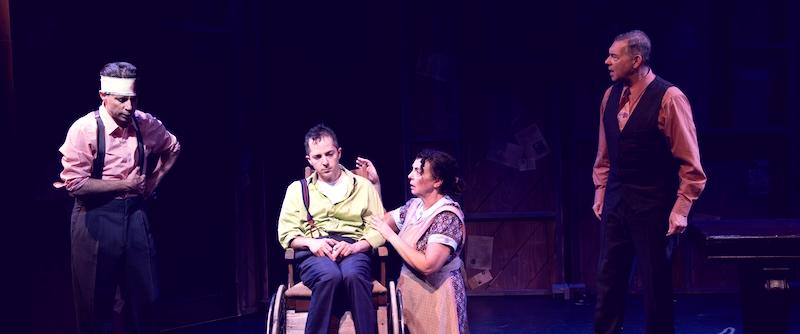
Derek Manson, Casey J. Adler, Dana Schwartz and Warren Davis (Photo by Zoia Wiseman)
Reviewed by Deborah Klugman
The Inkwell Theatre at the Broadwater Main Stage
Through November 9
American poet Emma Lazarus’s famous words, “Give me your tired, your poor, your huddled masses yearning to breathe free,” have always been more of an ideal taught to American schoolchildren than an operative reality for the U.S. government. Putting aside for the moment (if you can) the current heinous abuses of ICE, the most egregious example of statutory racism in American history was the 1882 Chinese Exclusion Act, ironically passed two years before Lady Liberty, a gift from France, was erected in New York harbor. The law prohibited Chinese laborers — who played such a monumental part in building the railroads that brought this nation to industrial greatness — from ever again entering the country. Nor was this discriminatory law repealed until 1943. Meantime, in 1924, yet another law established quotas for immigrants based on national origin, with a distinct lean toward Northern and Western Europeans at the expense of those from Southern and Eastern Europe (and with Asians barred completely).
Fast forward to the late 1930s: As stories of death camps began to seep through American obliviousness, the Roosevelt Administration continue to implement the quota system, along with other rules restricting the entry of desperate Jews fleeing for their lives.
Paper Walls, a world premiere play by Elliot Shoenman, is a fictionalized chronicling of the real-life experience of members of his family, who were Polish Jews who’d been living in Germany for 20 years when Hitler came to power. Comfortably well off, with a flourishing business (here, they sell eggs), the family unit in the play consists of patriarch Herman (Warren Davis), his wife Sara (Dana Schwartz), and their two grown sons, Albert (Derek Manson) — described in the script as a man-about-town — and his more retiring younger brother, Walter (Casey J. Adler), an aspiring artist and the only one among the four who recognizes the fascist threat for the chilling evil it will become. Only after their store is burned to the ground, and Walter himself is beaten and subsequently confined to a wheelchair, is the stubborn Herman, his identity wrapped up with his vocation, persuaded that it is time to flee.
Once that point is reached, the story becomes about the quest for the documentation necessary to transport the family to safety — a quest complicated by the fact that Walter is no longer able-bodied, one of the many qualifications applicants are expected to fulfill. The title Paper Walls refers to these kinds of bureaucratic barricades, obstacles that desperate refugees were forced to try to surmount.
The script — which spans 1934 through 1939 — is a “first, this happened” and “then, that happened” kind of narrative, the drama emerging readily enough from the life and death circumstances the characters are confronted with — far less so, however, from any depth or singularity they, the characters themselves, might possess. This places the onus on the actors to fill in the gaps, not easy given the numerous scene changes and the additional roles that the ensemble members are called on assume. For example, over the five-year period, events take place in Berlin, Danzig, New York City, Liverpool and Vienna. Various secondary characters are introduced: a Gestapo officer on patrol; Sarah’s sister, who lives in Vienna, and her non-Jewish friend who tries to aid Albert as he seeks a way out for his family; an immigration lawyer; a consul bureaucrat; and so on. (These roles are undertaken by Davis, Schwartz and Adler in addition to their main ones, while Manson, whose Albert eventually becomes pivotal, plays only one.)
Directed by Darin Anthony, the performers do their best, but the format of the script hems them in. Its plethora of brief scenes creates a need for frequent set changes, which disrupts the drama. One curious note: as Albert, Manson projects a wry air that seems at odds with the flavor of the play; his resume cites prior appearances in numerous musicals and comedies, and something of that (underscored by the checked and plaid suits he wears, courtesy of costume designer Dara Curran Ice) resonates in his performance here. It’s a drollery paradoxically welcome in the sense that it counterbalances the grimness of the story; yet it distracts because it also seems out of place.
As to tech, director Anthony and his team of designers make a cognizant effort towards a staging that accommodates all of the narrative’s shifts of mood and place. The set, from scenic and production designer, Justin Huen, features a map on the floor that depicts the family’s earlier flight from Poland to Germany to elude the Russian pogroms. A series of brown flats, aptly hued, serve as the backdrop for Ben Rock’s sundry projections; some of them reflect the time period — the famously libertine Berlin of the early 30s, for example, while others add to the mood of the story with rain or snow. A particularly effective visual displays rain dripping down a stone wall.
Marc Antonio Pritchett’s sound design includes classical music and lively popular tunes of that era; occasionally, though, the latter seemed inappropriately placed, juxtaposed with a dire or disappointing event. Lighting by Nita Mendoza serves to complement the re-creation of a stretch in time when for many all hope seemed to dim.
The Inkwell Theater at the Broadwater Main Stage, 1076 Lillian Way, Hollywood. Thurs. and Sat., 8 pm, Sun., 3 pm; thru Nov. 9. http://www.inkwelltheater.com/ Running time: approximately 90 minutes with no intermission.