
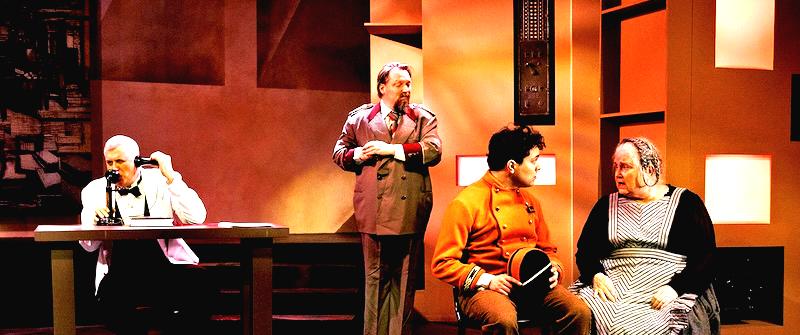


Marc Jablon, Jeremy D. Thompson, Ethan Remez-Cott and Debba Rofheart (Photo by Keats Elliott)
Reviewed by Deborah Klugman
Open Fist Theatre Company at Atwater Village Theatre
Through November 22
RECOMMENDED
Few writers are as closely identified with the torments of a sinister bureaucracy as Franz Kafka. Arguably one of the most influential literary voices of the 20th century, he worked a day job as an insurance adjuster, much as some clerk today might work for Blue Shield or the state’s workman’s comp to determine who got what, if anything, for claims of injury. The job was part and parcel of what made Kafka such a desperately unhappy man — he hated everything about it and longed to devote his life to literature — yet was so unsure of his worth that he requested, at the end of his short life (he died at 40 of TB) that all his writings be burned. Fortunately, for literary posterity, his friend (and eventual biographer) Max Brod could not bring himself to carry out Kafka’s wishes. He published and promoted his works instead.
Among those that Brod preserved was an unfinished novel — Kafka titled it Der Verschollene (The Man Who Disappeared), but Brod retitled it Amerika — about the misadventures of a naïve youth, Karl, who makes his way to America following a sex scandal that had embarrassed his family. Inspired by the novels of Dickens, which Kafka much admired, the book wove a layer of social critique — specifically of capitalism — into Kafka’s signature themes of alienation, angst and despair. That critique was not subtle. As the ship transporting Karl steers into New York harbor, the passengers catch sight of the Statue of Liberty — but unlike the Lady Liberty familiar to us all, this one wields not a torch, but a sword.
That startling image is recaptured in writer/director Dietrich Smith’s impactful and imaginative stage adaptation at Open Fist Theatre Company. Near the top of the play, a flat (stage wall), featuring an outsized drawing of the bellicose statue (one of a number of drawings by Elizabeth Moore ) suddenly descends from the ceiling, smack in the face of the newly arrived immigrants huddling anxiously as the ship nears the shore. Its appearance, swift and unexpected, augurs a cogent theatrical experience to come — one that drives home Kafka’s multitiered message about the experience of humanity in a chilly exploitative world, while keeping one entertained throughout, even as the message it relays remains painfully bleak.
From the opening, it’s clear that the plot’s driving dynamic is the clash between Karl (Ethan Remez-Cott), an honest young fellow who believes in social justice, and the myriad of proofs he encounters that the world is random, illogical and unjust. His first unsettling encounter is with the ship’s stoker (Jeremy D. Thompson), an honest workman whose complaint about the incompetency of his immediate supervisor, reported with Karl’s encouragement to the ship’s head purser, gets him fired. All too soon and throughout his adventures, some of Karl’s own kind and benevolent actions, and efforts to do the right thing, earn him the same cruel backfiring blows of fate.
And absurdities abound. Encountering (by chance) his wealthy industrialist uncle (a crisply pitch-perfect Marc Jablon), Karl declares his ambitions to become an engineer — but his uncle dismisses those hopes — better that Karl should keep on with his piano-playing and cultivate the ways of a privileged scion of the wealthy class than attend to anything so concretely constructive. As an example, he introduces Karl to Mack (Matthew Goodrich), the son of a business associate. Regarded by his own father as an embarrassment, Mack nominally works in the family business, collecting a check while indulging daily in horseback riding and other idle pursuits.
Karl’s time sheltered under his uncle’s wing is brief; he’s soon tricked into bumbling his good fortune and is subsequently thrown, penniless, out on the street. From there he falls prey to a pair of scoundrels, Delamarche (Chima Rok) and Robinson (Goodrich), who rifle through his belongings, steal his food and his precious family photo, all the while declaring their friendship and concern. He finally scores a job as a lift operator in a hotel, where again his efforts to be a nice guy land him in lots more trouble. And Delamarche and Robinson never go away.
One of the problems with the narrative is that it’s discernible from the start that for Karl, life is a no-win deal, and likely will be in perpetuity. Meanness, hypocrisy and deception bushwhack him at every turn; his efforts to lead a good and honest life will not prevail. This repetition of bad stuff happening over and over undercuts the production somewhat by eliminating any element of suspense — but it’s hard to avoid this pattern, since this is an adaptation of Kafka, after all. (Another issue is the length: The piece runs over 3 hours and could be pruned to advantage.)
As director, Smith combats the bleakness by encouraging his ensemble to exploit the dark humor that’s intertwined in the story. Besides Jablon and Thompson, there are sharp, versatile performances from Jade Santana and Tambrie Allsup (and others) in multiple supporting roles. Debba Rofheart nails the essence of the wifty good-hearted women who try to help Karl, then are misled by the naysayers. Goodrich’s Robinson is an unflaggingly satisfying buffoon. Rok projects his character’s pernicious malice with disturbing success.
As Karl, Remez-Cott falls in with the stylized over-the-top presentation suitable for so many other characters in this biting satiric story, expressing Karl’s trepidation and bewilderment with conspicuous hyperbole. But the production might be better served if, instead, he played it straight, fashioning a persona with which we in the audience could immediately identify, devoid of the external theatrics that at present frame his portrayal.
The production design, led by John R. Dilworth’s fabulously entertaining animation (which serves as the connective tissue for a sprawling story) is memorable and altogether among the show’s strongest assets. Scenic designer Frederica Nascimento utilizes a backdrop etched with vaguely cubic shapes, with open cupboards and shelves with baskets, toy cars and other paraphernalia suggestive of the era (props by Shen Heckel). She leaves plenty of room for the projections, for the display of Moore’s drawings, and for Gavan Wyrick’s variable lighting (one scene is memorable for its soft indigo hue), sometimes powered by lights built into the set as well as those overhead. A. Jeffrey Schoenberg’s costumes transport one back to pre-World War 1 New York City, with its hotels filled with uniformed bellhops, its conniving conmen, and its equally conniving barons of wealth and privilege. Gary Rydstrom’s sound design likewise aids in projecting an ambience reflective of the mad illogic of this Kafkaesque world.
Open Fist Theatre Company, Atwater Village Theatre, 3269 Casitas Ave., Atwater. Fri., Sat., 7 pm, Sun., 2 pm. Mon., Oct. 20, 7:30 pm; thru Nov. 22. www.openfist.org Running time: three hours and five minutes with two intermissions.
.