If School Shootings Can’t Change Hearts or Minds, Maybe Theater Can
Reflections on seeing Manuel Oliver’s GUAC
By Keelyn McDermott
This essay is part of the Stage Raw/Unusual Suspects Youth Journalism Fellowship
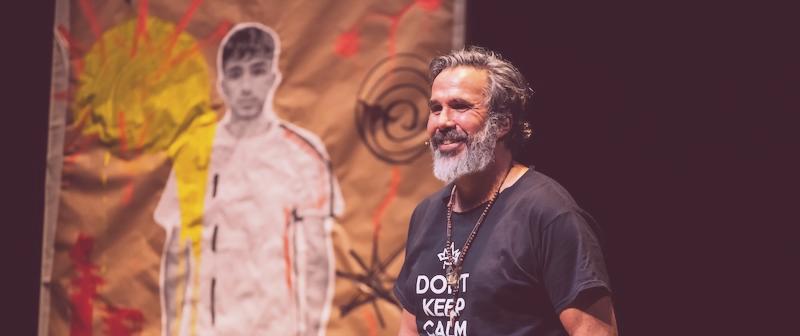
Manuel Oliver in “GUAC” (Photo by Cameron Whitman)
How do you tell someone how to tell their own story? You don’t. This article is not a critique of Manuel Oliver’s Guac (Manuel Oliver’s solo and sometimes comedic, autobiographical portrait of a father’s grief over the death of his son in a shooting at a high school in Parkland, Florida; it’s now closed at the Kirk Douglas Theater), but an exploration of how it redefines theater’s power in activism — by turning performance into relationship, grief into connection, and art into a catalyst for collective change.
While art can be an escape from life, the power of Guac was its refusal to separate those things. Guac is about family, specifically what happened to one family after the loss of their son in the shooting. Written and performed by Manuel Oliver, actual father of Joaquin “Guac” Oliver – and stepping into the lobby, my friend and I were greeted by Guac’s mother. This production didn’t hide behind fiction, but rather we were confronted with the real life people impacted by gun violence. The lobby was adorned with exhibits about school shootings as well as their son, Joaquin “Guac” Oliver; his trophies, his tweets, family photos, and his boxing gloves.
By placing the audience face-to-face with the people most affected by gun violence, Guac made activism intimate — not abstract. The production was a part of their larger organization, Change the Ref, whose origins we discover in the show. Their mission,“used urban art and nonviolent creative confrontation to expose the disastrous effects of the mass shooting pandemic.” Theater is just one of the many mediums they’ve engaged with among murals, statues, and parody postcards dubbed “shamecards” being among them.
Guac showed that even fleeting performances can spark discussion and action when they invite audiences to engage directly with the emotion onstage. If murals or statues can become semi-permanent fixtures of a space and therefore constant reminders of their mission, why use theater and its transitory nature? What is the utility of an art form dependent on the present moment that happens only if people are there to engage in it?
Stories of grief and resistance have always fueled political theater. Sophocles’ Antigone turns private mourning into a public act of defiance, forcing audiences to confront the conflict between law and morality. Guac inherits that legacy — but instead of myth, it offers memory. Where Antigone asked ancient Athens to imagine a moral rebellion, Guac asks modern America to feel it in real time.
Like Sophocles’s heroine, Oliver uses grief as a moral confrontation — demanding that audiences reckon with the difference between what is legal and what is right. As said in the show, the government recognizes school shootings, “as natural disasters when it’s the most unnatural thing.” Even when we all know what is right, still, under the law it may not be recognized as such. According to Pew Research, 61% of Americans say it’s too easy to obtain a firearm and 58% favor stricter gun laws. So why, in a democracy, don’t we have stricter gun laws when a majority of our country wants them? King Creon represents an oppressive government, so why was his mind ultimately changed only after he experienced great personal loss himself? (Spoiler alert, but the play is nearly 2500 years old.)
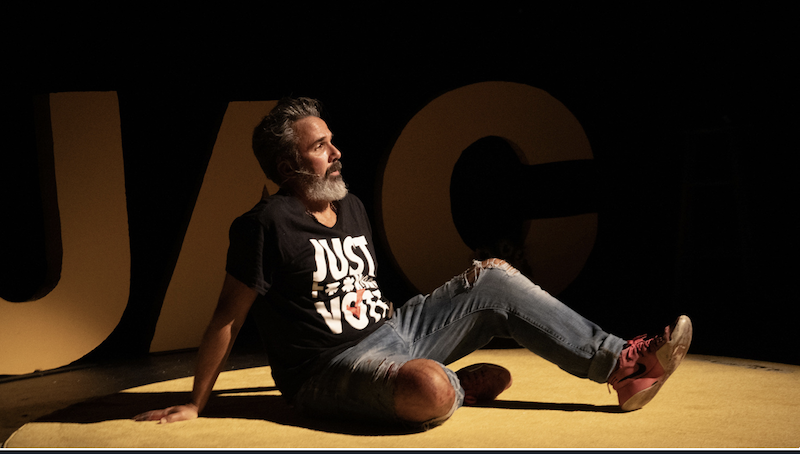
Photo by Cameron Whitman
Perhaps the shared experience of a play like Guac is enough to battle complacency. Perhaps the power of being in the same room, experiencing a father’s retelling of his own son’s loss, is a stand-in for that personal loss that is profound enough to change hearts. Perhaps witnessing Antigone’s peril is enough for people to fight for a rule of law that is morally sound. But what Guac does is what traditional theater has only started to do by finding a way to create an intimate relationship with its audience.
By joking, weeping, and improvising with the audience, Oliver turns the theater into a community rather than a stage; there was no fourth wall. Guac has a conversational, interactive nature. Oliver addressed distractions in the audience; he asked about the Dodger game when someone’s phone went off, and he asked to borrow a pair of reading glasses from the crowd. He prompted the audience to call someone they love during the show. He focused on creating a relationship with the audience – he joked with us, introduced himself and Joaquin, and most refreshingly: he took care of us.
There was crying – but also a lot of laughter. Hearts broke into a million pieces, and then we rocked out on a guitar solo. Joaquin’s mother, Patricia Oliver, expressed that the intent of the play is not for people to just feel sad, but also to feel joyful for all their son was able to achieve and for all the love that he still gives. While emotional pain is necessary, (jabbing audience members in the heart leaves them full of pain) — leaving them with joy and hope after stabbing them in the heart leaves them feeling empowered. Leaving the theater opening night, there were a lot of deep sighs and nods, followed by the beginnings of meaningful conversations.
All of this contributed to what felt like a shared experience more moving than any traditional play, unlike Antigone, which is a fiction and somewhat removed from our modern lives. Still, one question lingers: how much can theater change minds if it’s mostly seen by those who already agree with its message? Even if Guac doesn’t shift opinions, it mobilizes those that have become complacent.
Will Second Amendment defenders see this show to have their minds changed? Short answer: They won’t. In today’s polarized political atmosphere, the last thing people want to do is challenge their own beliefs. The people coming to see the show are most likely people who agree that we need stricter gun laws. So what’s the use in producing a show like this?
Besides giving money to a righteous organization, it raises awareness. If school shootings have begun to be treated like natural disasters and people become complacent, then theater-makers who take the time to support, make, and promote art like this are using art as a form of protest which plays a part in the larger movement. While we cannot take to the streets every day to protest, we can do what Center Theatre Group has done by putting up this show – which is moved the needle that much forward by using art as a political protest. On Guac’s opening night at CTG, Artistic Director Snehal Desai stated, “My hope is that tonight not only honors Joaquin’s life, but also sparks conversation, healing, and the determination to create change.” We cannot stop demanding change in the ways we know how, otherwise these things once considered morally abhorrent become commonplace.
By no means should we abandon practices of traditional theater and embrace only solo shows like these, but rather adopt some of these qualities of modern storytelling in our own work. A production of Antigone can be accompanied by a call to action to fight facism, including tangible ways to do so, or organizations that support the fight. It could include real-life modern testimonies of people currently suffering under fascism. Going forward, however one chooses to put on a show, it should be informed by the same things as Guac: inclusion, community building, care, and grief as both protest and fun!
Guac reminds us that theater’s power lies not just in reflection, but in participation. It invites us to see art as an act of care, activism as community, and storytelling as survival. Let our stages not only mirror the world but move it — one shared breath, one audience, one story at a time.
GUAC, written and performed by Manuel Oliver, Kirk Douglas Theater. Closed.