


Two Peoples Separated by a Common Language
An American studies acting in London
By Katy Kragel
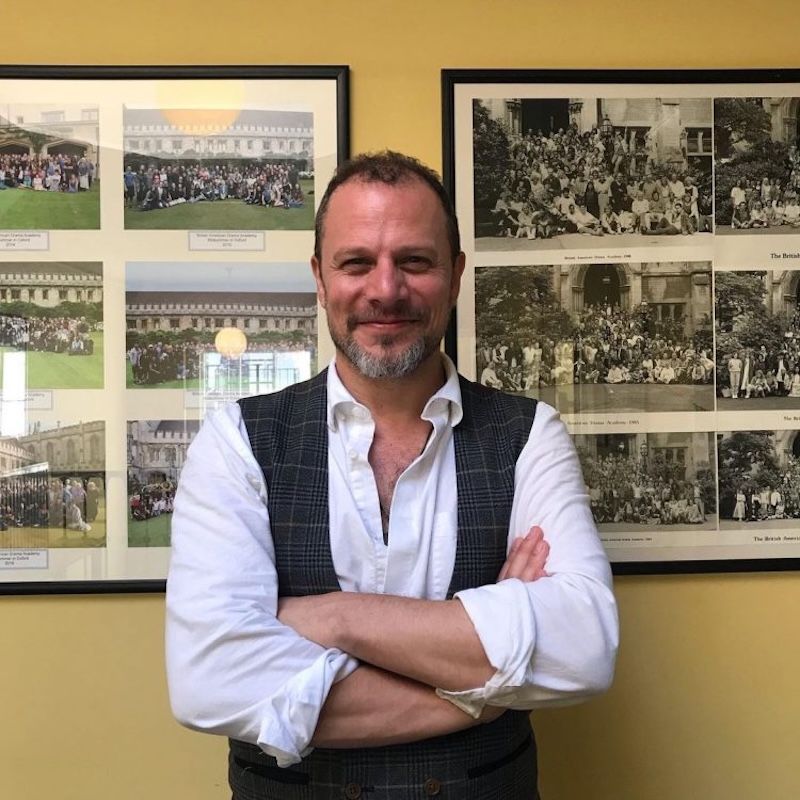
Ben Naylor, Dean of the British American Drama Academy (Photo courtesy of BADA)
This article is part of the Stage Raw/ Unusual Suspects Youth Journalism Program
If you ask my close friends and family, they will all tell you that I never shut up about my time studying abroad at the British American Drama Academy (BADA) in London, spring 2024. (BADA also has an academy at Oxford.) While I could give a whole testimony about the power of studying abroad – particularly for students interested in pursuing a theatrical career – I decided to turn over the mic to the current Dean of BADA, Ben Naylor. I spoke with Naylor in Los Angeles where he was visiting from London. We discussed his career and I focused on some of the biggest questions and moments that have stuck with me from my time in the United Kingdom.
Naylor inspired me to have pride in our American theater culture, but nevertheless, I am always the first to jump to the conclusion that the Brits are better at teaching acting. In fact, I would say my time at BADA heightened my sense of this. Interestingly, this is an observation that seems to be shared amongst many American students after their time abroad.
I walked into London with the preconceived notion that the UK has a level of respect or ownership in the theater world, certainly classical theater, which is why Naylor’s lessons about the power of American theater culture will also always stick with me.
With exposure to theater from a young age, particularly Shakespeare at the Royal Shakespeare Company, Naylor decided to leave behind a steady, academic track at Oxford University, where he was in post-graduate school. Pursuing a career in directing, he bounced around London and found himself directing a production of Macbeth at Cambridge. From there, he was invited to shadow Peter Hall – a prolific, well-respected English theater director at the time – which led to Naylor’s first teaching opportunities. At that point, he met one of the most crucial mentors in his life, Reuven Adiv, who convinced him to study acting at the Drama Centre, where Adiv was teaching. After 18 months there, Naylor realized his calling to the environment of drama school, and he started his work at the Royal Central School of Speech and Drama. He taught, directed, and shaped the classical acting program at Central all while continuing to direct and teach abroad. In 2022, he decided his time at Central had run its course and found BADA.
While hearing about Naylor’s artistic and professional journey, it struck me how much credit he gave to his mentors – especially Reuven Adiv and John Beschizza who were two of his teachers at the Drama Centre. That level of gratitude for the people along the way will certainly stick with me and continue to be a lesson from my time abroad.
Another lesson that Naylor made sure to clear up in this conversation, as he does on the first day of class at BADA, has to do with Shakespeare (of course) and the relationship both Americans and Brits seem to have to it.
STAGE RAW I think from an American perspective, Shakespeare and “British” go hand-in-hand, and it’s perceived that you guys have a sense of reverence for that. What are your thoughts?
BEN NAYLOR We just have more exposure to Shakespeare…But because we have more of it, we are also more irreverent towards it. I think Americans come to the UK with the idea that Shakespeare is like a marble bust on the pedestal…I don’t think the English see Shakespeare in that way anymore . . . The bizarre thing about the job at BADA is, I sort of feel like we’re doing it because of this idea of reverence coming from America. That there’s some kind of yearning for something cultural that relates to Shakespeare or theater that is carrying people over to London and Oxford.
SR: I think there’s a sense of the theater being part of culture in ways that perhaps America doesn’t have as much. Do you agree?
BN: The United States is the dominant cultural force in theater world-wide because the American book musical is the dominant theater form . . . Often, I point out that Shakespeare in the UK now is as much influenced, if not more, by Americans than by Brits. Sam Wanamaker’s Foundation at the Globe has been the paradigm shift in performance values . . . Sam Wanamaker, the production team on that, the money was American, the scholarship underpinning it was American… Incalculable influence on UK Shakespeare from America. Paradoxically, when I see Shakespeare [in the United States,] I think it looks like British Shakespeare of 20 years ago.
A lot of the story of American theater, let’s be honest, is the story of Jews. The Yiddish theater is incredibly influential both in the book musical . . . and all the early writers and many of the writers today of the book musical are Jewish. And it also, of course, gave rise to the Method because the first interpreters of Stanislavsky in America, not exclusively but by and large, were also Jewish . . . One of the things I’m really interested in is Doreen Cannon. We get Stanislavsky in the UK via an American Jew who’s bringing the Method [from Russia via the U.S. to London]
SR: What is some of the feedback that you hear from American students about British vs American training?
BN: One of the things that American students who come to BADA always report . . . about the particular quality of the teaching . . . is that they feel both more pushed than by their American teachers but also that we’re kinder. And I wonder how much of that is just the accent (ha, ha) . . . Because yes of course, we’re all trying to be kind, and yes of course, we’re all pushing the students as far as we can. But I think American teachers are trying to do the same . . . So why is that effort not being read? I think it’s also to do with educational structures [in the United States]. So the marketization of education here [in the United States] means it’s much more difficult to be pushy . . . but also [this has] to do with the narrative of power, I think, that is changing everything in pedagogical culture here. That makes it more difficult perhaps for teachers over [in the US] to be as confrontational as you kind of need to be if what you’re trying to do is shift somebody’s habits — and that’s what actor training is.
Seeking new heights and perspectives in London: The “Eye”
SR: Are there notable differences between primarily British students and American students that you’ve encountered?
BN: I think the students…during my time at BADA have been the narrow generational group most impacted by the pandemic in terms of the years lost of socialization, lost to lockdown, dependence on mobile phones . . . I feel like generational values have shifted very significantly since . . . I do think that is probably compounded by the individualism of American culture . . . There are other things that are true about Americans when they come to BADA which is that they’re less likely than Brits to have been outside of their home country. Your education system specializes less early so there will be more specialist knowledge in the humanities in an equivalent age English group to an American group, on average . . . And to be honest, I find that especially now. I think the lack of historical knowledge in the students that I’m teaching now is dangerous. Because when we forget the mistakes of the past, we’re more likely to commit the same mistakes. That’s also true in the UK, and it’s also to do with methods of teaching history which took away the links —there isn’t a sense of how things relate to each other. That I think is also problematic in teaching acting because connectivity is one of the things you want from an actor. You want to put A to the actor and have their mind go to B, C, D, E, F, G and connectivity is improved by understanding how things fit together.
SR: When I was at BADA, we had a master class Q&A with the English playwright and director, Robert Icke. He spoke with our class about how he never tries to teach his audience a lesson. He wants to pose an uncomfortable but important question that will leave his audience thinking and discussing as they head home from the theater. Icke made the observation that Americans don’t always react well to that.
BN: I think there is certainly a tendency in American life, let alone art, to venerate a certain kind of ease that may lead to what you say about wanting joy and mirth in drama. I think it’s also true, and I think Rob would agree with this, it’s wanting moral certainty. Moral certainty creates comfort . . . It’s really interesting . . . All early modern plays present evil. They don’t shy away from this idea of evil . . . The moment of reaching out to empathize with an evil character, that I think was really challenging generationally, perhaps culturally, and to me is what theater must do. I think maybe that’s what Rob was referring to, that American audiences want to know who’s right and who’s wrong, but great drama is seldom like that.