
The Stages of 2025
Fiction and Friction
It’s no coincidence that the centerpiece of the word history is story.
The point of stories, at least the stories we’re inclined to tell, is friction. Conflict. It gets resolved, and something gets restored, reborn. Not all cultures tell stories this way, but ours certainly does.
But stories change, even national mythologies. The United States, for example, has a storied tradition of standing up to bullies and providing equal opportunity for anyone who legally comes to our shores. That’s one of many American stories now in flux.
In 2025, we saw the battle over stories unfold on late night TV. Which comedians can tell their stories, our story, and which will be cancelled? And if canceled, would that be for reasons of business or ideology? Which CBS 60 Minutes episodes can or cannot be aired? Why was one rigorously vetted episode detailing horrors inside El Salvador’s CECOT prison abruptly “postponed” within hours of its scheduled airing? That episode was pulled following the actions of the station’s new “editor-in chief of CBS News” Bari Weiss, a recent hire at CBS whose parent company, Paramount Skydance, is increasingly nervous about its upcoming battle for Warner Bros. Discovery, and the assistance it will need from the Trump administration. (The episode’s cancellation came so late in the process that it had already been sent to Canadian television, which broadcast it, leading to bootlegged copies gone viral, found on multiple platforms in the U.S.)
All wars, including culture wars, are ultimately fought over stories, narratives. The muskets and rifles and bombs and drones and handcuffs and gag orders and cancellations and shame-posting are merely the enforcers.
The primary impediment to freedom of expression in storytelling in the theater is, unsurprisingly, money. Those who have it, or have access to it, have the liberty to tell their stories on our stages. Those who don’t, don’t. Local theater is facing — brace yourself — an affordability crisis. And who said that theater is not a reflection of the larger culture?
The cost of staging even a semi-professional theater production in a venue holding less than 100 seats in 2026 will be double to quadruple the cost of staging that same play in 2020, depending on the cast size and set requirements. A six-character play performed six years ago could be performed on a budget of about $15k to 20k. The cost today to stage that same play is at least $60,000; with frills, closer to $80,000. And you wonder why so many productions are motivated more by calculation than inspiration?
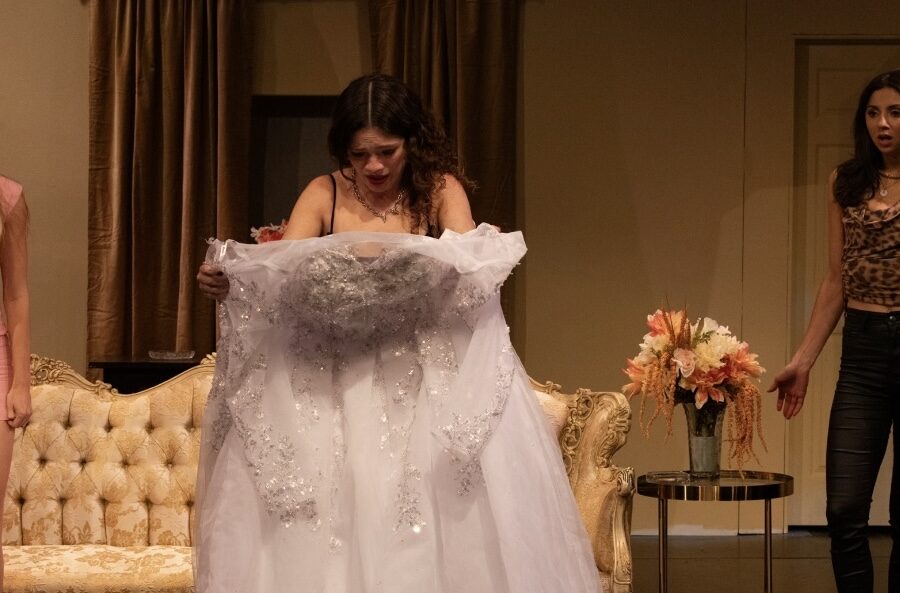
Lacey Buchanan, and Victoria Gluchoski in “Bachelorette” at The Broadwater, 2025
This is the direct consequence of the shift in stage union policy, dating back to 2010, as applied to “mom-and-pop”-run theaters, in tandem with a recent California labor law in 2020 (Assembly Bill 5) that similarly equates the practices of a 50-seat quasi-community theater in Studio City with the abuses of labor imposed by multi-million dollar corporations such as Uber and Lyft. (The latter had the resources to carve out exemptions from these laws and policies. Our money-losing local theaters did not, and thus far have not received much relief.)
Note: There are exemptions from these financial pressures for amateur theaters.
Our mid-size theaters are feeling similar financial pressures, though for different reasons. With government funding drying up and foundation sources harder to come by, regional theaters across Southern California do business increasingly at the mercy of donors with deep pockets. I recently learned through the grapevine that CTG’s Guac, a hit one-man show written, developed and premiered at the Pubic Theater in New York, and performed by Manuel Oliver at the Kirk Douglas Theatre in 2025, is returning to that venue in 2026 for the single reason that one benefactor liked the show and is underwriting its return engagement. (The show is about a father grappling with the death of his young son from a school shooting.) Meanwhile, the artistic director of a company, one that produces all new plays in an intimate venue, told me that the determining factor in staging one of its plays in 2026 was that it came with funding attached. This approach is lifted from the European patronage system of the 16th through the 19th centuries, before almost all of Europe and the UK decided that perhaps one of the purposes of society in general, and of government in particular, is to support the arts from a broader base, and to support the challenging ideas that those arts provoke and contribute. (Don’t get me wrong, state-funded theater is rife with its own corruptions.)
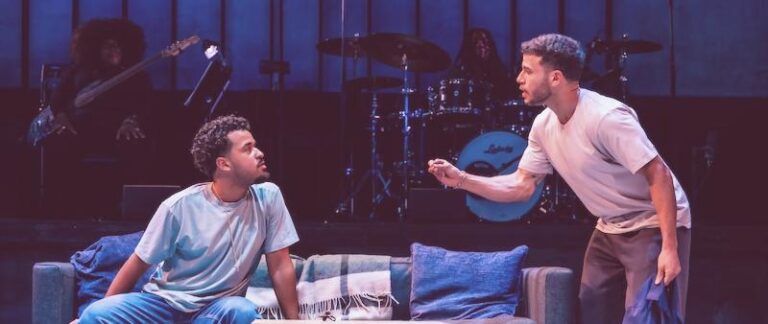
Marlon Alexander Vargas and Alex Hernandez in “Littleboy/Littleman” at The Geffen Playhouse, 2025 (Photo by Jeff Lorch)
For institutional regional theaters across the U.S., producing plays in 2025 was the art of financial survival; these were in theaters that were formed and forged with the aim of fulfilling an artistic mission possibly at odds with the exclusively commercial incentives of Broadway. Much has changed since the debut of Zelda Fichandler’s Arena Stage in Washington, D.C., which, largely underwritten by The Ford Foundation, opened its doors in 1950 with a heady sense of artistic mission as it strove to challenge commercial and political orthodoxy. Since then fiscal pressures on Broadway and in our regional theaters have become almost indistinguishable.
There’s no single consequence of the explosive spike in the costs of putting on a professional play in Southern California. But here are the two most conspicuous:
The number of shows produced by most intimate theaters established for 10 years or longer plummeted, from seasons consisting of four or five productions to only one or two — and many of those were co-productions to help offset costs. We’re seeing theaters taking all year (or more) to raise the funds to put on a single play (or two) that they believe in. Examples: Sacred Fools Theater, Playwrights Arena (producing entirely new plays), The New American Theatre, Open Fist Theater, The Victory Theatre Center (producing entirely new plays), Boston Court Pasadena, Ensemble Studio Theatre – L.A., The Odyssey Theatre Ensemble. Some of these theaters rent or sub-rent their venues to raise funds, while others, in 2025, shifted their programming entirely to readings, staged readings, and workshop/developmental productions (IAMA Theatre, for example)
Aware of the soaring production costs at this time last year, we anticipated a drop off in stage activity across the region for 2025, but that didn’t happen. Filling the void were independent producers who rolled in with the funds to bankroll their labors of love (and/or speculation for a Netflix or Amazon series). It’s been argued that this trend slices into the integrity of the local stage community, but I’m not convinced that’s true. The local stage community hasn’t left town; it’s just putting on fewer productions and doing more developmental projects.
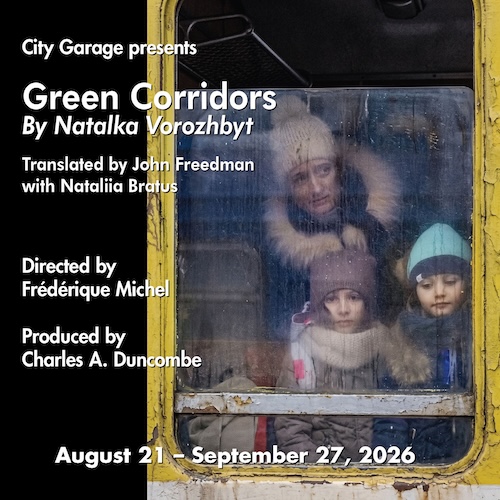
And there are exceptions to this trend of established intimate theaters scaling back: The Fountain Theatre, The Road Theatre, Moving Arts, Rogue Machine, and City Garage, for example, each hammering out four to six productions in 2025.

Carolina Rodriguez, Alexandra Lee, Michael Guarasci, in “Adolescent Salvation at Rogue Machine, 2025 (Photo by Jeff Lorch)
Yet our theater mirrors our values. As art struggles, the nation’s wealth has become increasingly consolidated, as it was in the Gilded Age in the late 19th century. The Jeffrey Epstein scandal serves as a kind of metaphor for how the super-rich live by codes of conduct and immunity that bear little resemblance to how the rest of us get by; they live in an entirely different legal and moral world – and part of that world, that of media and tech moguls, has dedicated itself (for themselves and their shareholders, of course) to manipulating algorithms to set ideological camps against each other while framing the narrative of how we all deserve to live, what protections and opportunities we merit, what we’re permitted to say, and how we’re permitted to say it. The rule of our Gilded Age is pay to play. You want a life in America, you can pay $5 million for a card to get in. You want to say something in the theater, you need to find new and inventive ways to pay for it.
But honestly, is there such a difference between censorship, the cancellation of a show on CBS, and the starving out an entire creative ecosystem? The American theater world, that saw such promise with the birth of the regional theater movement mid 20th century, is becoming like one huge fringe festival, where the performers and playwrights cough up their barista tips to get on a stage. What’s next? Five years of savings for 20 minutes at The Broadwater, while Jeff Bezos laughs all the way to the bank?
We in the theater are just microbes on a petri dish. The guy behind the microscope is named Mark Zuckerberg. He could fund all of America’s theaters for a decade and not even feel dented. The telling impediment is that he chooses not to. That’s his right. But what about ours? Perhaps Elon Musk will step up? I wouldn’t hold my breath.
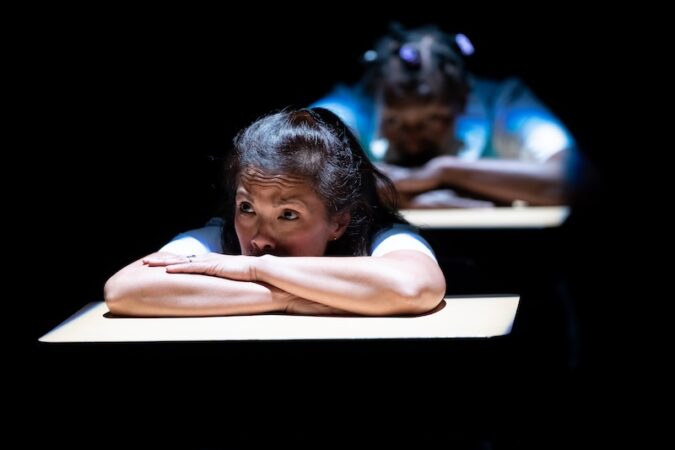
Fran DeLeon and Lorne Green in “Mariology”: Critical Mass Performance Group and Boston Court Pasadena, 2025
The water on that petri dish was taken from a shark tank, where swim the corporations that tell stories to the largest market share.
According to New York Magazine’s Kara Swisher, The Disney Corporation, once a behemoth of corporate storytelling, will likely be “merged” with one of the tech giants within five years. Even Netflix, a leading streamer of stories, is watching its back, looking for ways to compete with the likes of Amazon, Meta, and YouTube, as everyone is either speculating on, or dreading, the impact of thus-far unregulated AI. It’s no coincidence in this world of consolidating capital that in 2029, the Academy Awards will leave television forever, to be broadcast exclusively on YouTube. The times, they are a changing, as are the way we receive our stories.
This provides a daunting backdrop to the task of putting on a play in, say, a 75-seat theater in Southern California, where this world of financial consolidation comes home to land.
And still, we put on plays, some of them very good — and not just Boomers who look back nostalgically on their heydays in the 1990s. The Los Angeles County High School for the Arts has class after class graduating in theater, teenagers studying how to be in, and how to put on plays. They have their work cut out for them. They hunger for something called authenticity. And they’re not stupid. And they’re not naïve, though they are often depressed. Perhaps, when they’re of age, they’ll put up a show not just on TikTok but on a stage in a bar, or a café. It will have conflict, and that conflict will burst, and their story will have what we used to call a resolution. And it will be theirs, and it won’t have been created by AI. A new era, perhaps.
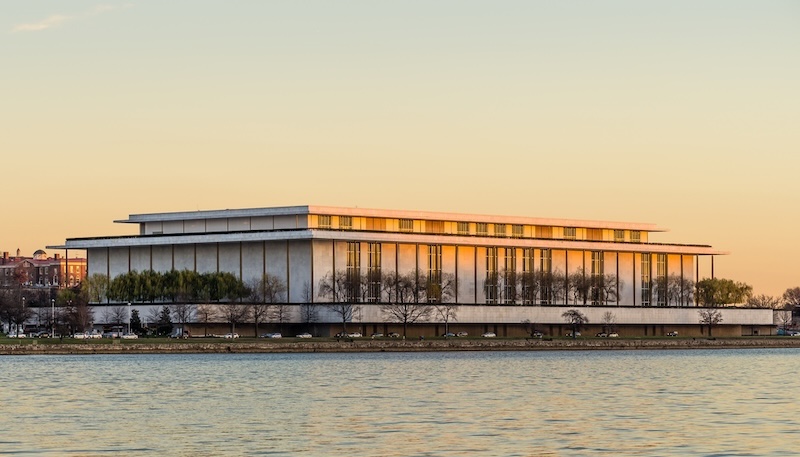
The John F. Kennedy center for the Performing Arts over the Potomac river in Washington DC.
Here’s a story: September 8, 1971. The newly installed Artistic Director of L.A.’s Mark Taper Forum, Gordon Davidson, has been hired to direct a special performance of Leonard Berstein’s Mass. Not in Los Angeles, but in Washington D.C. The spectacle, a Requiem mass commissioned by Jaqueline Kennedy-Onassis, marks the opening of The Kennedy Center, where Mass is being performed. The building, named after the deceased U.S. president, John Fitzgerald Kennedy, is named such by an Act of Congress as a living memorial to the late president who was a proponent of the performing arts, in addition to serving as a centerpiece, a national stage, for American music and theater.
The new and probably illegally added name to that building in 2025 honors the living American president whose greatest contribution to the arts was appearing in a TV reality show dedicated to the glee of firing people. And that’s what we’re now living through. But now is not forever.
Because stories evolve. How will this one unfold, once the friction burns itself out and the plot resolves? Will a new era emerge for the Kennedy Center, and from the halls of power in Washington, D.C. to America’s stages?
Until, perhaps, the next crisis?
Fiction, friction, and restoration? We can only hope, with almost bated breath, for a trajectory more promising than the one on which we’re currently ensnared.
Here are Kennedy’s words, inscribed on the outer walls of the building Congress justly named in his honor:
“I look forward to an America in which we reward achievement in the arts as we reward achievement in business or statecraft. I look forward to an America which will steadily raise the standards of artistic accomplishment and which will steadily enlarge cultural opportunities for all of our citizens. I look forward to an America which commands respect throughout the world not only for its strength but for its civilization as well.”
Part 2: Memorable moments in L.A.’s theater in 2025.