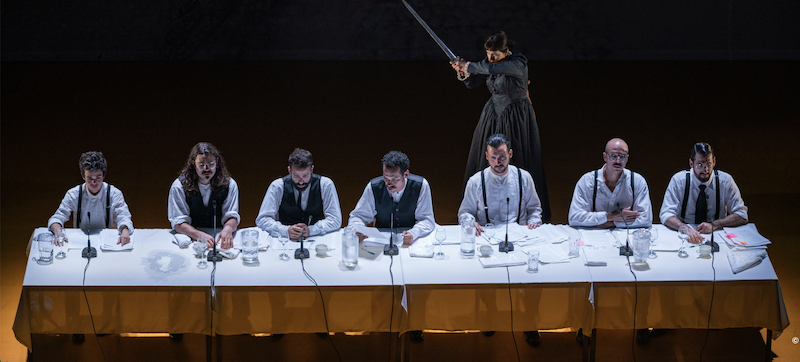
“The Brotherhood” (Photo by Mayra Azzi)
The Shapes of Pain and Violence (From the Personal to the International)
Festival d’Automne, in Paris
By Amanda L. Andrei
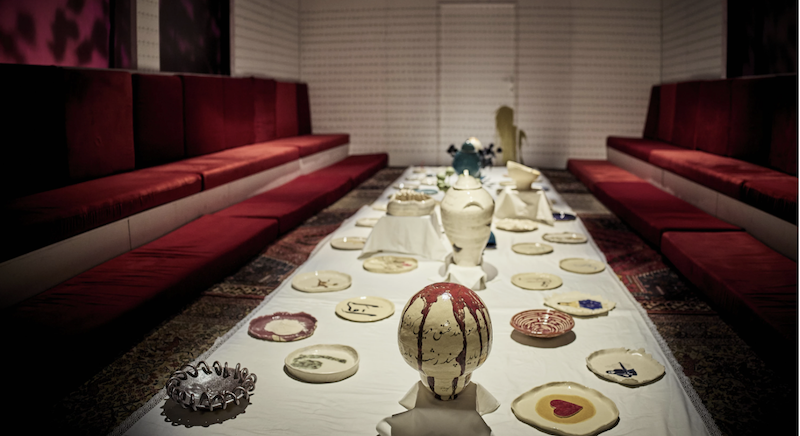
Kaboul, Une Chambre a Soi (“One’s Own Room Inside Kabul”) (Photo by Christophe Raynaud de Lage)
A voice emanating from gold embroidered footprints on a white cloth. The burial of journals and love notes in a massive mound of dirt. And a fictional talkback from hell. It’s November in Paris, and theater here is reflecting the season in all of its dwindling light and wandering ghosts.
I’m at the Festival d’Automne (Festival of Autumn), an annual showcase held between September to December and hosting over 80 performances of international artists. I shuttle among the wide parks and rainy streets of Concord, to the bustling South Asian neighborhood around Gare du Nord, to the huge modern art sculptures of La Villette masked by the chilly dark night, witnessing shows that grapple with the shapes of pain and violence.
Kaboul, Une Chambre à Soi (Kabul: One’s Own Room Inside Kabul) by journalist Caroline Gillet and performance artist Kubra Khademi is a striking immersive experience. Entering Theater Concord, audience members are directed to take off shoes and hang up coats, before being led into a small living room constructed on the stage. Red cushioned benches line two walls of this makeshift home, and the audience sits, facing each other. On the floor between us are dozens of handcrafted ceramics with images of women, flowers, and Arabic calligraphy, along with the embroidered footprints.
In contrast to this domestic beauty comes the voice of Raha, an Afghani woman (speaking in English with overlaid French translations) detailing the 2021 takeover of the capital city of Afghanistan by the Taliban. Video footage from anonymous Afghanis accompanies her voice and the ambient sounds of streets, missiles, and silences punctuated by wind and breath. A young woman (Khademi) sits in front of the door we entered and engages in quiet activities: counting money, reading a book, clipping her nails, embroidering.
Despite the political violence and sense of besiegement, the room feels as if we are being lulled into a trance. With the slow pace, dim lights, and warmth of our neighbors, several audience members fall asleep. I can’t blame them, and in fact, find their behavior intriguing. I’m not bored; I’m soothed. The installation feels less about the horrors of war and about one’s quiet resistance, the kind that can offer rest and shelter in the face of conflict.
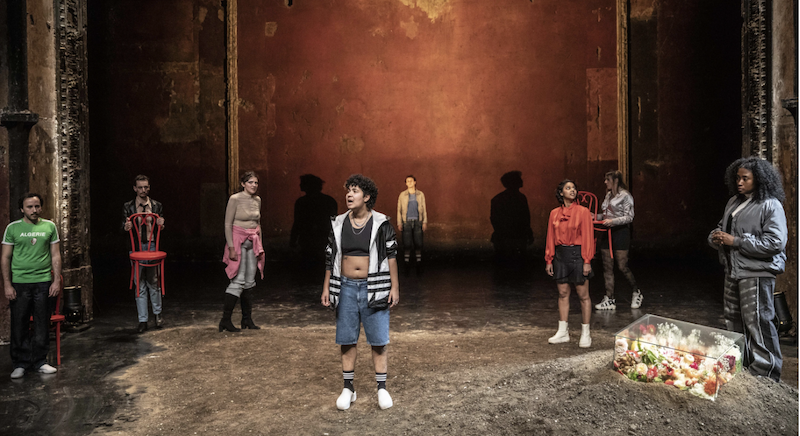
“Lack” (Photo by Jean-Luis Fernandez)
Conceived and directed by Lorraine de Sagazan, Lack at Bouffes du Nord explores frustrations around romance, sex, and relationships from the viewpoints of Gen Z. This devised performance is a collaboration between playwright Guillaume Poix and actors from the Adami Théâtre Talents program, a highly competitive initiative that gives eight young actors the opportunity to work with a renowned director and subsequently perform at Festival d’Automne.
And these actors truly commit, filling every part of the historic 149-year-old theater with confrontations about love and the lack of it. As a self-proclaimed “apostle of love,” Nemo Schiffman crowdsurfs the audience on the ground floor. Kim Verschueren reads about failed relationships from journals and diaries, then hurls them into the huge pile of soil covering the stage, bouquets of bright flowers beneath a clear protective box making the set reminiscent of a graveyard (designed by Anouk Maugein). And between Sagazan’s superb direction and Mélo Lauret’s dynamic stamina, a long list of hashtags becomes a comically biting monologue on identity, yearning, and belonging.
The hilarious Aymen Bouchou is an Algerian actor who builds a persona of his own anxiety (naturally named “Anxiety”). Appearing as a blonde white woman in a long white nightgown (later revealing rear-less underwear), Bouchou dashes around while delivering a choppy, breathy speech that made both audience and the other actors laugh. At first, I couldn’t place the mask — a stretchy contraption that seemed like a reference to a “Karen” or a prominent public figure — and later chatted with a fellow critic who suggested that a large part of the humor derived from the character’s resemblance to far-right politician Marine Le Pen. Aymen’s farcical mashup became a delightfully sharp and illuminating moment of how pain — emotional or political — can be lightened and contained through theater.
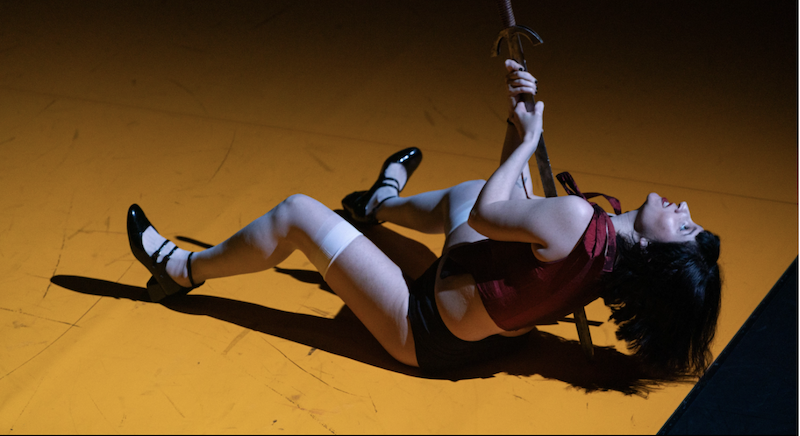
“The Brotherhood: Chapter 2” (Photo by Mayra Azzi)
Questions and confrontations around sexual violence take an unsettling and graphic form in The Brotherhood: Chapter II, the second part of the Trilogia Cadela Força (Bitch Strength Trilogy) by writer, director, and actor Carolina Bianchi, along with her company Cara de Cavalo.
Bianchi’s first chapter stunned me when I encountered it in Vienna last year. A Noiva e o Boa Noite Cinderela (The Bride or Goodnight Cinderella) showcased a descent into hell that put the performance artist’s body into a precarious state of unconsciousness and strove to create a new theatrical language to confront the histories and atrocities of rape. The Brotherhood continued these themes, with a focus on the degeneracy that can emerge from fraternity, the bonds among a group of men. What is this matrix of male privilege that can consume a body, a woman, an art form, theater itself?
Multiple answers flow through the stage. One response: the men in suits, confidently strutting to dance music in one scene, robotically mourning a fallen leader in another. Another reply: the men, naked, silently encircling another man who covers his private parts with his hands while a beaded veil obscures his face. The stage image terrifies me, activating a primal part of my body that recognizes a vulnerable creature facing a collective predator. I want to flee.
And one of the longest answers: a nightmarish and satirical talkback between Bianchi and “famous German director Klaus Haas” (named after an enigmatic and sinister character in Chilean author Robert Bolano’s novel 2666). With touches of wry humor, the two discuss the latter’s illustrious yet shifty career, especially when working with young actresses and staging sexually sensitive scenes. Haas (a superb Kai Wido Meyer) evades questions and oozes a privilege that induces squeamishness. Memories and anecdotes resurfaced for me, times when male theater makers made me uneasy or painful stories from women colleagues boiled my blood. Sexual violence is not merely contained in an initial act to one victim, but ripples in all directions beyond the survivor: outwards to a person’s career and public image, inwards to one’s memories and private thoughts.
Chapter I proclaimed, “F— Catharsis” and resisted notions of healing, focusing instead on feminine rage. Chapter II’s motto: “Dirty Pathos,” shining in neon letters from a pulsating club as masked men gyrated amidst fog and blue light. A seduction, an illusion, a threat: therein lies the core of Brotherhood.