Reflections on a Beloved Teacher’s Retirement
Lois Hunter, On her Quarter Century at the Los Angeles County High School for the Arts
By Maribelle Hoffa
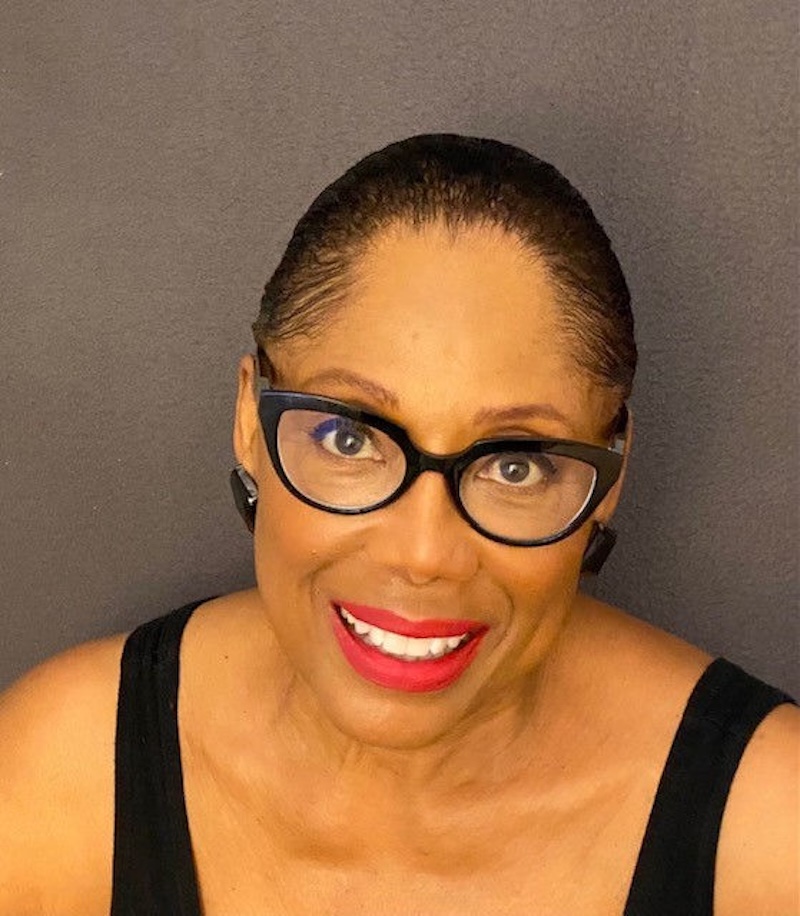
Lois Hunter (Photo, courtesy of Lois Hunter)
This article is part of the Stage Raw/Unusual Suspects Youth Journalism Fellowship
There is nobody more stubborn and more passionate than a young artists whose ambition drives them to change the world.
But no young artist, or young person, can do that on their own. I constantly wonder where I’d be if I didn’t have mentors in my life still teach me how to funnel my creativity; the truth is, I’d be very far behind. So I owe everything to my mentors for keeping it alive.
Lois Hunter is a prime example of this kind of person.
Since 1969, Hunter has taught performing arts to aspiring artists all over California. She studied Theater and English at San Francisco State University, where she also got her teaching credential. Education wasn’t always her path, however, as she quotes that the acting industry is a “sugar to shit business.” So, she went in and out of teaching jobs, while also “hitting the boards,” like touring with Lena Horne in 1978. It wasn’t until 1993 that she was offered a teaching position at Los Angeles County High School of the Arts, one of the most prestigious public art schools in the nation, as an English teacher and choreographer for the musical theater department.
In 2001, she officially became chair of both the Theater and Dance department at LACHSA. She remained in that position for about seven years, before the two departments split and she continued leading the Theater Department. That’s 25 years that Hunter has been in charge of one of the most successful high school theater departments in the entire country.
After more than five decades of teaching, she is preparing to retire, a truth that has lingered over the LACHSA theater department all year. It makes each question feel heavier, and each answer feel honest in a way that only endings allow. I sat down to talk to Hunter, aware of the quiet weight this conversation would carry.
Stage Raw: You mention that you had a lot of back and forth teaching in between when you started LACHSA. What about this school felt different?
Lois Hunter: Because you children want to be here. It kept me going, those kids that really wanted to do it. . . If you’re an artist like I am, you want to work with other artists.
How has LACHSA changed since you first got here? For better or for worse?
Well, what I am gonna say is that there are some kids who were hungrier for the arts when we started. Right now the young people don’t seem to be as hungry to make sure they get their craft learned. But maybe that is by design, because the world is changing, so they have to diversify.
For many, conversations about new technologies are braced with caution. But Hunter barely bats an eye. In fact, she’s not remotely concerned about the impact of Tilly Norwood (the first AI-generated actress, or as Hunter likes to call her, “Silly Tilly”) in theatrical spaces.
LH: Stage acting will make a big recursion very soon. Because that’s where the connection from human to human comes.
SR: As these times are changing, if you were to give every young actor out there one piece of advice to thrive in their life onstage what would it be.
LH: I think that they have to understand that acting is the study of the human condition. So, the more they can have experiences that connect with human emotion, the better. That’s why I encourage my young actors to study math, to study science, to study agriculture, to study botany, because the more you know about the universe, the more you know about the human condition, the better you’re going to be as an actor.
Hunter notes that sometimes she can’t separate her students from her own grandchildren. And now, after 56 years, her time at LACHSA has come to an end. Her presence and love was something that weaved its way into every single student’s performance, regardless of if they knew it or not.
As our time started wrapping up, Hunter recalled another piece of advice she’d give to young actors.
LH: Acting is a strange thing. Because it takes a lot of fortitude and determination . . . The art finds you. You don’t find the art.
SR: So, as an actor, did acting find you? Or did you go looking for it? If you went looking for it, that means that it’s gonna be hard.
LH: What’ll happen is as soon as you have some bumps in the road, you’re gonna [want to] give up. But, if acting finds you, you cannot get away from it. It consumes you.
SR: Do you think that the performing arts generally can find you? Two passions can find you at the same time?
LH: [after thinking over the question for a moment] Something is going to find you because you have it already– the seed– inside of you. But it may not be acting. It may be photography, it could be music, it could be painting, it could be anything. Because if you have that seed inside of you already it will bloom into something. How many actors do I know that are beautiful painters? How many actors do I know that can also sing? So, their seed is planted. It’s just… what is it going to bloom into?
Hunter is directing Clybourne Park as her final official season show this winter — a project she says captures the human connection she was talking about earlier.
Clybourne Park is the Pulitzer Prize and Tony Award-winning play by Bruce Norris that serves as a satirical response to Lorraine Hansberry’s A Raisin in the Sun, exploring race, real estate, and gentrification in a Chicago neighborhood over two acts set 50 years apart (1959 and 2009). The play uses the same house as a battleground for community conflict, first when a Black family moves in, and again when a white couple plans to redevelop the now predominantly Black neighborhood.
LH: It’s something that will speak to everybody in the audience. Everybody’s going to walk away saying, “Oh, that’s him, or that’s me,” or “I know that person.” That’s what I love about Clybourne Park. It’ll get everybody talking.
SR: Clybourne Park promises to be an embodiment of everything that LACSHA’s much beloved Lois Hunter stands for: love, hardship, and true human connection.
CLYBOURNE PARK runs January 23 and 24, 2026, 7:30 p.m. at Caroline’s Loft at LACHSA, Circle Drive on the campus of California State University, Los Angeles. Tickets here.