Reviewed by Joel Beers
South Coast Repertory
Through March 21
RECOMMENDED
Few works of the modern stage—hell, of any era—have been poked, prodded, dissected, and analyzed quite like Edward Albee’s 1962 Who’s Afraid of Virginia Woolf? Its language has been studied as psychological warfare, its marriage of mid-century American realism, European absurdism, and classical tragedy endlessly unpacked. The play has been parsed through Freudian, Jungian, Marxist, and feminist lenses, read as a disembowelment of the American Dream, as a distillation of Cold War anxieties (public bravado masking private terror), and even as flirtations with eugenics embedded in its academic power games. Hovering over it all remains the titular question: just who—or what—is the Virginia Woolf to be feared?
Strip away the theory and interpretation, however, and a more contemporary reference emerges—albeit one several rungs down the cultural ladder: Albee’s night of verbal bloodsport reads like Seinfeld’s grim, wild-eyed heretical uncle. The laugh track is gone, but the petty cruelty, ritualized arguments, and social neuroses remain — only now, the jokes draw actual blood. There’s no plot engine—Virginia Woolf and Seinfeld don’t “go” anywhere. The action is the talking; every petty moment becomes an event. George and Martha, the play’s Alpha and Omega, know exactly where to stab because they’ve been circling each other forever. Stasis becomes horror and comedy at once: nobody grows, nobody learns, the reset is the point. Social rituals are exposed — faculty cocktail party, dinner party, coffee shop hang — same neuroses, different booze.
Of course, there’s much more to Virginia Woolf than petty cruelty and verbal combat. Beneath the chaos and caustic repartee lies a sharp meditation on illusion, identity, and human vulnerability. The invented child, the games and the lies are shields and weapons, exposing longing, failure, and a desperate, sometimes malicious, need for connection. Albee balances comedy and tragedy with brutal precision, crafting a portrait of a marriage—and a society—on the edge.
And then there’s the sheer scope: Virginia Woolf clocks in at least three hours, running comfortably behind some seminal works by O’Neill but far longer than other titans of the American stage, like Death of a Salesman. That’s more than three hours in the same room as four characters, two of whom have mastered the language of cruelty. It’s an ordeal. But in the right hands and the right mouths—like in this breathtakingly intense and lethally funny production at South Coast Repertory directed by Lisa Rothe — it becomes a delicious ordeal, one that leaves you beaten and drained, but also vividly aware of something larger, hauntingly human.
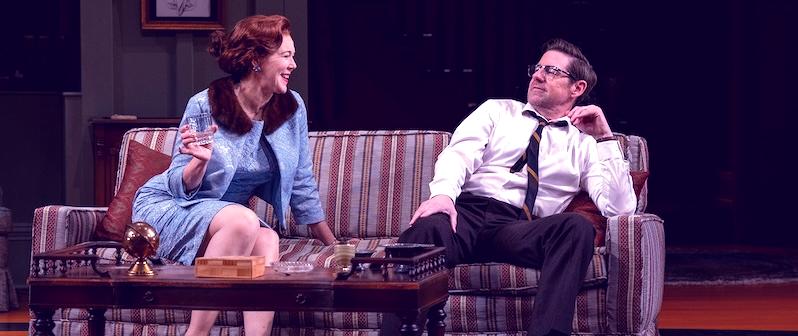
Kim Martin-Cotten and Brian Vaughn play the two main roles of George and Martha, a married couple — she the daughter of the university president, he an associate history professor — who live in a kind of perpetual war zone behind the walls of their faculty home on the campus of a small New England university. The evening begins with a late-night visit from Nick and Honey, a younger academic couple new to campus, ostensibly invited over for drinks after a faculty party. But as the liquor flows and the hours stretch, what starts as polite socializing quickly unravels into psychological combat that often turns physical. Every conversation is a duel, every apparently innocuous question a kind of interrogation or veiled threat.
Martin-Cotten’s Martha is mesmerizing and terrifying at once — she can charm, seduce, and wound in the same breath. Vaughn’s George is equally compelling, simmering with quiet bitterness channeled into sarcastic wit and the occasional explosive outburst, revealing the fragile, wounded ego beneath his facade. Together, they are a riot of invective and manipulation, free-falling in a state of mutually assured destruction, heedless of those they drag into their orbit — namely, the apparently hapless younger colleagues, invited for what they thought would be a simple post-party decompression.
As Nick and Honey, Gabriel Gaston and Elysia Roorbach do as much as they can with roles that are technically supporting but also essential. Their reactions and missteps serve as mirrors, reflecting the toxicity and performative aggression of George and Martha. Through them, the audience sees the destructive power of words and illusions, as well as the seductive danger of being pulled onto someone else’s carefully constructed — and jealously guarded — emotional minefield.
But make no mistake: this is George and Martha’s play. The narrowing, harrowing final scene where the secret that has loomed over the evening is finally exposed and shattered is proof. Here we witness the vulnerability and aching sense of unfulfillment that George and Martha have long tried to conceal — and we see also that, for all their venom and games, they need — and, in their own devastating way, love — each other as only two people can.
South Coast Repertory, 655 Town Center Dr., Costa Mesa. In repertory with God of Carnage, 7:30 p.m. Tuesdays-Wednesdays, 7:30 p.m. Thursdays-Fridays, 2 and 8 p.m., Saturdays, 1 and 7 p.m. Sundays, Through March 21. Scr.org. Running time: three hours and 10 minutes with two intermissions.