Ann Noble (Photo by Craig Schwartz)
Reviewed by Deborah Klugman
A Noise Within
Through March 8
RECOMMENDED
Ann Noble (Photo by Craig Schwartz)
One needn’t delve too deep to grasp why Richard III abides as a compelling, timeless and timely work. To begin, there’s the title character: a clever, charismatic villain, as focused on seducing his audience as he is the widow of a man he has just callously murdered. The opening confidences he airs about his disability and grand designs are arguably —though, in the end, not definitively — the highlight of the play, if only for the masterly way that Shakespeare crafted a psychological portrait of evil that is also so totally and identifiably human.
The second reason why Richard III stays unceasingly relevant is because it’s about politics and power and what people will do to secure it, and keep it. History teaches that not much has changed in that regard over the millennia; the only difference across eras and cultures is one of degree. To reference the obvious: In our own time we’re now experiencing an intense escalation from an era of politics where strings were often pulled behind closed doors to tilt the playing field toward the powerful to circumstances where greed, cruelty and corruption are glaringly — nay, psychedelically exposed (to a degree jaw-droppingly inconceivable to Americans privy to lessons about three branches of government and checks and balances in the 7th grade). As the sane and sensible among us are aware, the prime instigator of this horrific chaos is a geriatric sociopath indifferent to any outcome other his personal domination of the world and everything and everyone in it. And there are loads of people who are willing to facilitate letting him have it.
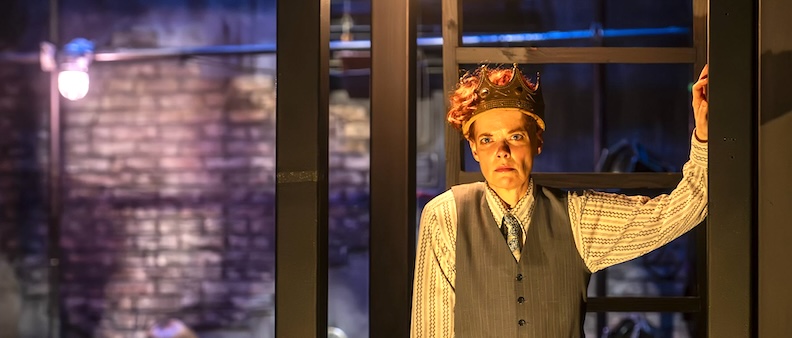
Which brings us to the current production of Richard, directed by Guillermo Cienfuegos at A Noise Within and featuring a singular scintillating performance by Ann Noble in the title role..
Cienfuegos has set the action in England circa the 1970s. The press release speaks of a streamlined production, but it’s more of a stripped-down one, with stark black scaffolding — I’ve seen similar in other productions here — rising to the ceiling (scenic design by Angela Balogh Calin) and a light mist filtered in to suggest the damp foggy air of the London setting. Even the costumes (Christine Cover Ferro) are dark (for the women, I thought, somber to a fault, although admittedly, some of these characters are sometimes in mourning). The exception is Richard who in white shirt and medium grey suit, gives off a slight sheen.
The production begins with a prologue, a rapid fire discursion into the prior history of the British monarchy, accompanied by lights (Ken Booth), video (Nicholas Santiago) and explosive sound, (Christopher Moscatiello) replete with illustrations of the many crimes committed in pursuit of the crown. The details comes at you too fast to absorb, but the gambit in its entirety serves to let us know that Richard’s crimes, while horrific, are not exclusive to him; homicide is part and parcel of the battle for the monarchy in 14th and 15th century Britain.
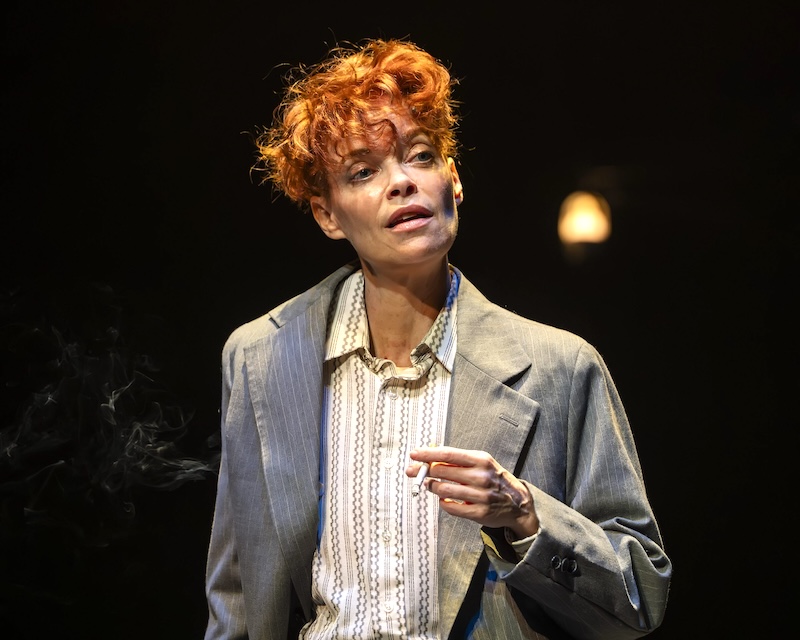
But then the prologue ends, and Noble as Richard saunters on stage, appearing in a pinstriped suit, a cigarette in the left hand while the right hand —disfigured, one assumes — stays in his pocket. The insouciant air this character exudes is that of a privileged citizen of the world, one accustomed to ignoring the rules (in this sense, rather like a distant cousin to a character in a Noël Coward play, albeit a malign and jaded one). Richard’s famous hump is only modestly visible.
Once this Richard begins to speak — his words relayed with scorn, hurt, glee and malevolence (and more!) — the effect is magnetic. Standing in the spotlight is a psychopath with charisma, for whom no lie is too slippery, and no act too gruesome or reprehensibly evil if it will furthers his ambition to be king. Yet we are fascinated.
If the primary reason to see this production is Noble’s performance, a second would be how effectively it mirrors the ongoing horrors on the national stage. There are moments in this two hour and 40 minute show that imprint on one immediately, with a powerful connection to what we see now in the world at large.
One such moment is when a bewildered Clarence, Richard’s brother (Randolph Thompson) and a good and innocent man, huddles in his cell in the Tower, wondering what possible act has brought him to this place but feeling assured that his dear brother Richard will bring about his release — unaware that it is Richard who has connived his imprisonment. Then two assassins appear (Alex Neher and Wesley Guimarães) — one eager to get the job done, one queasy at killing a gentle and reasonable man — and relay to Clarence before they do him in that it is Richard who is responsible for his fate. Later, the same confusion and despair afflicts an incarcerated Hastings (Samuel Garnett), another of Richard’s victims imprisoned and unjustly condemned.
One thinks of the 73,000 people and counting cruelly and randomly incarcerated by ICE in subhuman conditions, most of them merely for the color of their skin.
There are other memorable highlights; for example when Richard’s frail mother, the Duchess of York (Veralyn Jones) with great effort pulls herself from her wheelchair to denounce her evil son. The interchange between the assassins prior to their slaying of Clarence — a bright spot of humor in a grim tale — is a brilliant piece of comedy. Once Richard succeeds to the throne, he turns on the nobles that have supported him and replaces them with thugs, represented most plainly and scarily by Neill Fleming as the archetypical executioner and remorseless killer of men.
Some of the most impressive moments are the fight scenes, eliciting kudos for both fight coordinator Jonathan Rider and a disciplined ensemble. Equally, the final showdown between Richard and his nemesis, Richmond (Guimarães), who will succeed him to the throne as Henry VII, is a top-of-the-line display of stage fighting that has you holding your breath, even as you know that the outcome is assured. And a prior scene, wherein Richard tosses and turns as the ghosts of those he has wronged come back to haunt him, is stunningly rendered in a rolling series of images of their faces (some are eyes only) in Santiago’s skillful design.
As Richard’s vanquisher, Guimarães is pitch perfect as his foil — the good guy come to rescue England from chaos and destruction. The actor’s naturalness and credibility make for an uplifting catharsis, at last. Other notable moments are achieved by Thompson as Clarence, Garnett as Hastings and Micah Lanfer as young Prince Edward, an intelligent boy with the makings of a king, a role, tragically, that he will never play. Tony Pasqualini as Stanley and Lynn Robert Berg as the Duke of Buckingham and Lord Stanley deliver able renderings in their roles as conspirators and political players of the Court.
But other performances, ones that are quintessential to the narrative, disappoint. Throughout, in fact, there’s a surfeit of declaiming — far too much outer display of passion and anger on the part of some of the actors without their honing of a complex personhood underneath. Significantly, it’s the production’s weakest link.
On the other hand, what lands with power in this production is the spectacle of it, or rather, the sum sensory experience of all of its design elements in sync: flashing red lights, hypnotic visuals and sound most of all: turbulent rock music from beginning to end, with death metal to augur the approach of war. It all combines to relay the experience of living in a harsh, unforgiving universe where kindness and warmth are in short supply and bad guys wreak havoc on the lives of others.
A Noise Within, 3326 Foothill Blvd., Pasadena. Thurs.-Sat., 7:30 pm, Sat.-Sun., 2 pm; thru March 8. anoisewithin.org Running time: two hours and 40 minutes with an intermission.