
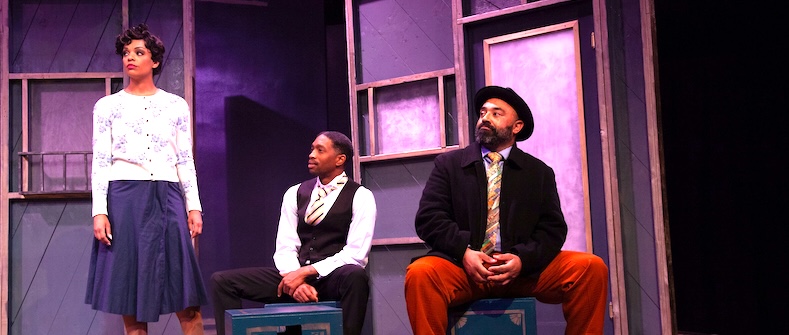


Fana Mina Tesfagiorgis, Ahkei Togun and Luis Kelly-Duarte (Photo by Rafael Cardenas)
Reviewed by Deborah Klugman
Company of Angels
Through March 8
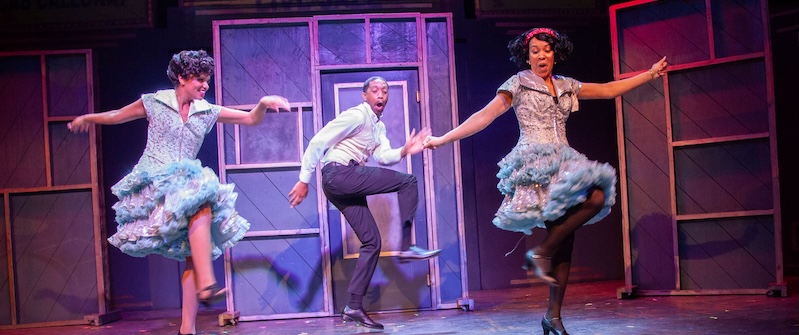
Fana Mina Tesfagiorgis, Ahkei Togun and Rune Valblaine (Photo by Rafael Cardenas)
History at its most truthful and intense is rarely the narrative relayed in the textbooks. In Red Harlem, playwright Kimba Henderson digs deeper to focus on a period in American history when prominent African-American artists and intellectuals — and others not so prominent — were drawn to the teachings of the Communist Party as an alternative to the racism and economic inequality that oppressed them at home.
The play is set in 1932, a year following upon the arrest and trial of the Scottsboro Boys, nine black teenagers falsely accused of raping two white women in the backwoods of Alabama. This chronology is significant not only because of the impact of this event on the hearts and minds of Black men and women as individuals, but also because the Communist Party was the only institution that came directly to the Boys’ defense. At their first trial, the defendants were represented solely by the ILD (International Labor Defense), the Communist Party’s legal arm — the NAACP, at the time jittery about its image, had declined to become involved.
The Party went all out to publicize the event internationally. The powers-that-be in the Soviet Union — Stalin himself in Henderson’s play — commissioned their film company, Meschrabpom, to make a movie that might appeal to Black Americans, one highlighting the contrast between the American system and their own. Historically connected to the project were such public figures as James W. Ford, a Black labor leader and activist, and the Communist Party’s vice-presidential candidate in 1932; Louise Thompson, a well-respected Black intellectual and Marxist; and poet Langston Hughes, who was drafted to participate in the writing of the script. Twenty-two Black Americans were chosen to travel to the Soviet Union, all expenses paid, to participate in the movie, titled Black and White.
Red Harlem pivots around the experience of four (fictional) unknowns: Selena (Fana Mina Tesfagiorgis) and Will (Ahkei Togun), a romantically involved couple who are entertainers in a Harlem nightclub; Lenore (Rama Orleans-Lindsay), a former schoolteacher and an ardent Communist who dedicates time to distributing their literature (which is why she lost her job), and Shifty (Luis Kelly-Duarte), a voluble hustler who’s neither an entertainer nor an ideologue, but who just happens to wander in when the others are being drafted to become part of the project.
Mischa (Claudio Parrone, Jr.), the persuader in question, is a recruiter from Russia, working in tandem with Ford (Micah Johnson), who’d been to Russia and back to negotiate the deal. Most enthusiastic among the potential recruits is Selena, a flirty showgirl who craves the spotlight and is attracted to the possibility of getting paid real money to travel and perform in a foreign land. Her boyfriend, Will, is far warier; an actor with aspirations to do meaningful drama but barred from real roles by the color of his skin, he’s suspicious of the setup and of involvement with a Soviet-sponsored venture.
Lenore is on board by virtue of her ideals — and it soon turns out that she can dance as well. As for Shifty, he’s down for the travel; when Mischa asks if he has any acting experience, he makes one of the play’s most salient points: “I’m a Negro . . . We act every day to get by.”
As the story expands, other characters are introduced: Ralph Bunche (Johnson), the future Nobel Prize winner, who is traveling on the same ocean liner as the performers and is involved in making the film; David Geller (Christopher Cassarino), another interested party, who will develop into Lenore’s love interest; and Hugh Cooper (Dennis Gersten), an American civil engineer and entrepreneur who has been contracted to build dams and other projects for the Russian state. Dylan Jones portrays a cabaret singer who appears in sequences located in Berlin.
Directed by Bernadette Speakes, Red Harlem has a vital story to tell and engaging pivotal performances to help tell it. Tesfagiorgis is thoroughly appealing as an attractive, flighty airhead obsessed with being a star; as her partner, also a performer to his core but one with common sense intelligence and an ethical spine, Togun keeps it understated and real; while Kelly-Duarte turns in the production’s standout performance as an entertaining, salt-of-the-earth guy who calls it as he sees it, and how he sees it is pretty much on the money. Though he stumbles with the accent, both Parrone as the strategizing Russian operative Misha and Johnson in his dual roles as both Ford and Bunche are solid and credible. Other assets to the production include the exuberant song and dance numbers (choreography by Kenya Clay) and the ladies’ period costumes (Mylette Nora). In a variety of unspoken roles, a lively Rune Valblaine makes her energy and stage presence known.
But — the production also has liabilities, beginning with a sprawling script that’s perhaps better suited to film than stage and a production design (scenic and lighting by Justin Huen) that fails to enhance the story. Some of the dialogue relating to the economy of Soviet Russia in the 1930s comes off as educational and expository, one of several elements of the script that could use trimming. A subplot involving Lenore and David is arguably extraneous to the meat of the play; it deals, inescapably, with racism in the United States — but it’s also about regular folk caught up in a war between conflicting ideologies, each of which can disappoint, betray and lead a dreamer astray. Such is the case with Lenore, who starts out an enthusiastic Communist; the problem is that stage presence notwithstanding, Orleans-Lindsay is never convincing as a woman with strong political convictions, any more than her passion for her lover is something one can buy into.
There are also problems with Speakes’ staging — for example, during scene changes, the set’s movable flats appear greyish-green, a color rendering images in the projection design (Emmanuel Munda) difficult to see. These are images that create a sense of the historical era in which the story transpires, along with its variety of settings — ocean liner, Berlin cabaret, and so on — but they are muted rather than pronounced. These same movable flats are maneuvered by the actors between scenes to suggest changes to a different setting, but the results aren’t always effective for that purpose, and take up space on what is already a problematically shallow stage.
With all that, Red Harlem’s illumination of this lesser known but intriguing chronicle from history brings empathetic characters and important themes to the stage. Paring the script and recalibrating some of the tech are worth considering.
Company of Angels, 1350 San Pablo St., LA; Fri.-Sat., 8 pm, Sun., 3 pm; thru March 8. https://www.companyofangels.org/ Running time: approximately two hours and 30 minutes with an intermission.