
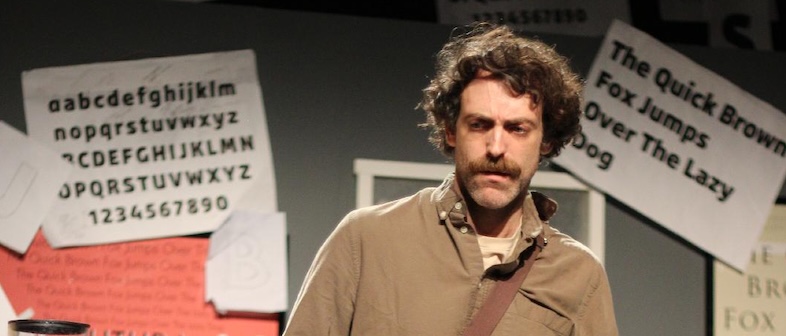
Spencer Weitzel (Photo by H.R. Kean)
Reviewed by Madison Mellon
The Broadwater Mainstage
Through April 12
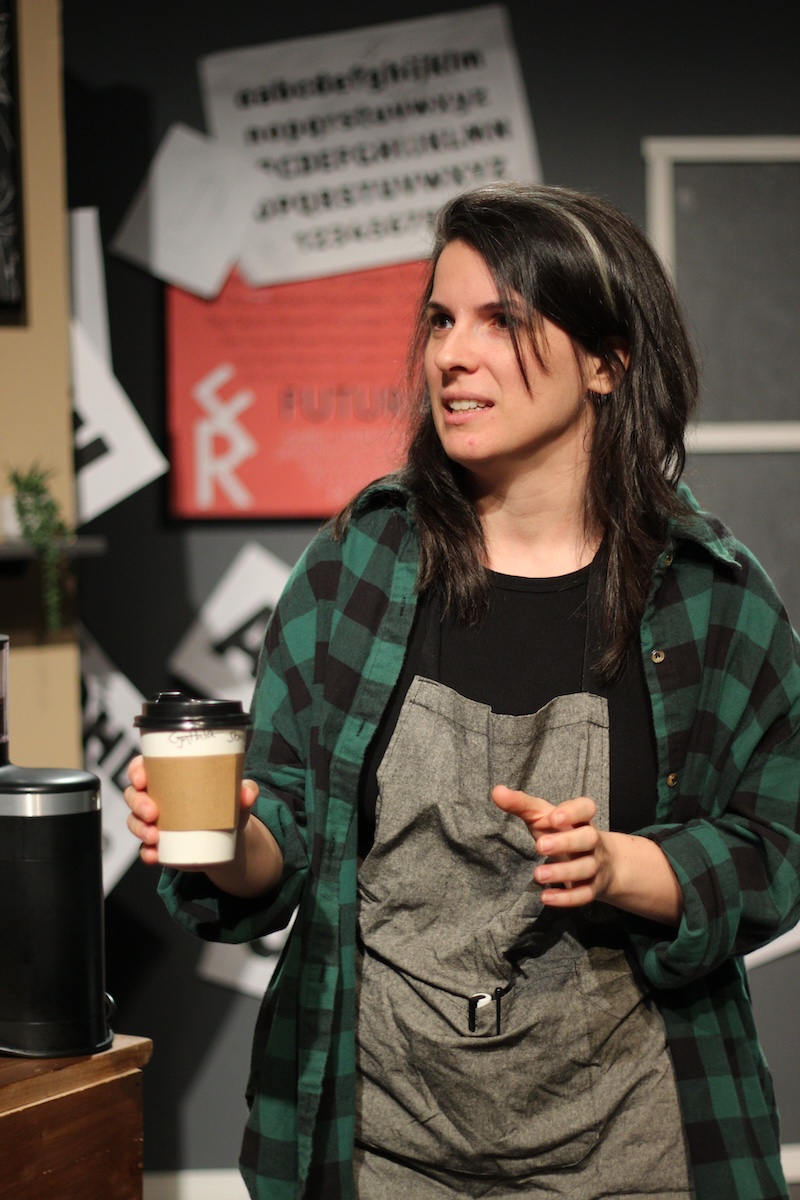
Rachel Zapata (Photo by H.R. Kean)
In The Quick Brown Fox Jumps Over the Lazy Dog, a play that borrows its title from the well-known pangram containing every letter of the alphabet, typography becomes a lens for examining human connection. The result is an inventive premise with a compelling central character, even if the piece does feel somewhat unfocused and struggles to land on a compelling thesis.
Stanley Wilson (Spencer Weitzel) is a reclusive typeface designer who has spent decades honing his craft with little recognition. When he lands a major contract redesigning a typeface for IKEA, it appears to be his long-awaited breakthrough. Instead, mounting pressure, discouraging feedback, and the insistence that his typeface must communicate “love” leave him creatively paralyzed. In an attempt to bring love into his work, Stanley reaches out and forms an awkward but endearing connection with Abigail (Rachel Zapata), a barista at a coffee shop he frequents.
The premise is both original and thematically rich. Typography as a metaphor for human connection and communication is a compelling choice, and the relationship between Stanley and Abigail develops with a natural, understated warmth. Their connection provides a believable emotional throughline that grounds much of the piece.
Weitzel delivers a nuanced performance as Stanley, capturing the character’s idiosyncrasies without reducing him to a caricature. His portrayal balances rigidity and vulnerability, making Stanley consistently engaging even when the script begins to feel meandering.
That loss of focus is most apparent in the second act, which leans heavily into emotional disclosure, with scenes that begin to resemble therapy sessions as characters air backstory and grievances. The result is an overreliance on telling rather than showing. A confrontation between Stanley and his brother Chuck (John Michael Young), centered on their shared childhood trauma, is particularly overwrought and does not land. While these elements aim to deepen Stanley’s emotional landscape, they weaken the play’s central thread rather than clarifying it.
The production’s design elements, with set design by Jason Burns and lighting design by Saman Wright, are effective in concept. Lighting and set create three distinct locations with clarity and simplicity. However, extended transitions disrupt the flow, often lingering to accommodate minor costume changes or unnecessary set adjustments. While this is a minor issue on its own, it does consistently slow the pace of the entire piece.
The play’s conclusion gestures toward a meaningful idea: that typography can serve as a conduit for connection, allowing someone like Stanley to express what he struggles to say aloud. However, the final confrontation in which he articulates this idea is overly drawn-out and diffuse, and lacks the clarity and focus needed to fully land. What should feel like a culminating emotional and thematic statement instead becomes unfocused, diluting the impact of an otherwise compelling insight.
With sharper editing and a tighter focus from producer, writer and director Thomas Yungerberg, The Quick Brown Fox Jumps Over the Lazy Dog could fully realize the promise of its concept As it stands, it is an intriguing premise that would benefit from further refining and focusing.
Broadwater Mainstage, 1078 Lillian Way, Los Angeles, CA 90038. Fri.-Sat., 8 pm; Sun., 2 pm; through April 12.https://www.eventbrite.com/e/the-quick-brown-fox-jumps-over-the-lazy-dog-tickets-1979286451056 Running time: two hours with an intermission.