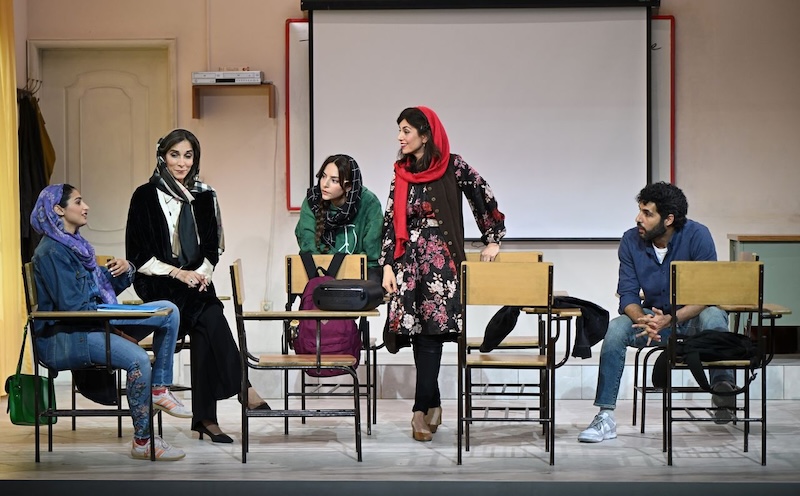

The cast of “English” at The Wallis. (Photo Credit: Kevin Parry)
Reviewed by Monya De
Wallis-Annenberg Center for the Performing Arts
Through April 26
RECOMMENDED
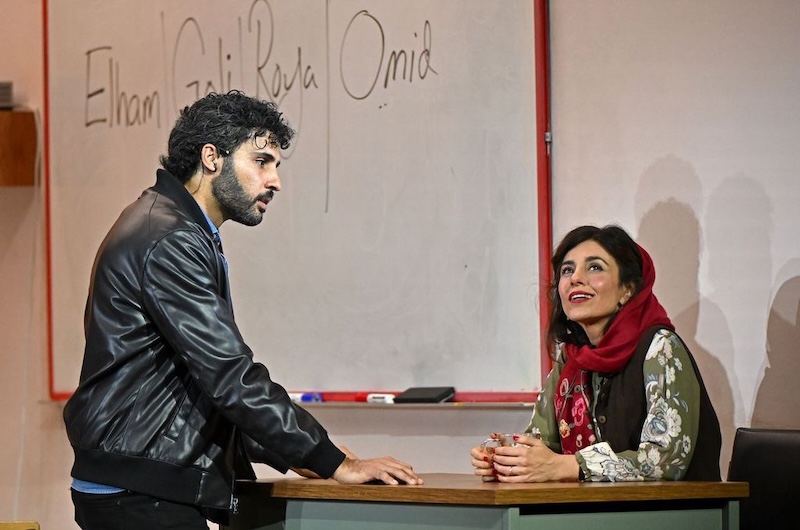
Babak Tafti and Marjan Neshat (Photo by Kevin Parr)
I had not really ever thought much about the TOEFL, the Test of English as a Foreign Language, one that 40 million would-be immigrants and students have taken. But for Sanaz Toossi, preparing for that test is a fraught, emotional, and sometimes unjust window into how humans contort and destroy themselves in the name of acceptance.
In Toossi’s play English now on stage at the Wallis in Beverly Hills with the Broadway cast flown in, four students in 1990s Iran – future med student Elham (Tala Ashe), wide-eyed teen Goli (Ava Lalezarzadeh), elegant grandma Roya (Pooya Mohseni ), and mysterious dude Omid (Babak Tafti) – gather for teacher Marjan’s (Marjan Neshat) in-person class. Goli gives a presentation in halting, accented English – then abruptly continues in English with the mannerisms and casual Californian accent of a teen at the Glendale Galleria, her shoulders dropping about a foot. What’s going on? A few seconds later, the audience catches up with the conceit of the play; the characters speak in American-accented English when they are communicating what they would be saying in Farsi (the Iranian language). Only Marjan stays in her lightly accented English continuously, insisting on English being spoken to the point of giving her students warning strikes for violations.
Ashe plays Elham as direct, fidgety, emotionally labile; we learn she has taken the TOEFL many times as she tries to keep it a secret from her classmates with significantly lower stakes at hand. Elham has already taken the MCAT with a goal of getting to an Australian medical school yet is so triggered by learning English and the perceived identity erasure that she crumples under pressure and retreats to Farsi. True to the time period, no one clocks an adult woman in Iran as having maybe-possibly ADHD and a learning disability. Babak Tafti’s Omid, a character who has spent significant time in the USA, is written as having a lighter Iranian accent, which made it more difficult to pick up on when he was speaking “Farsi,” though he did make up for it somewhat with body language. Omid has made some weird choices from a place of pain, and while Tafti plays them somewhat stoically, the impact gets a bit lost after so many other reveals from the women; this could be why there have been some complaints about this plot line on social media.
I would have enjoyed seeing even more of Ava Lalezarzadeh’s spunky Goli, with big American dreams, but she serves mainly as a foil to the others. Neshat is magnetic as a teacher desperately hanging on to the feathers in her cap – her time spent in the UK, the superiority of her English, and possibly her marriage – deftly builds tension in her clashes with Elham, but it is another student who shatters Marjan’s façade in three different ways, just when you think the play is just a slice of life with no bombshell moment.
Mohseni rings true as the grandmother putting up with learning English in order to communicate with her grandchild, and whose world can only be upended by her son reducing contact. It is a delight to see a trans, brown, Muslim woman playing a regular senior lady in a non-queer focused piece of art. She delivers some of the show’s best lines, which raise uncomfortable truths; people might speak a second language, but their emotional expressions flatten or harden; they sound less intellectual and accomplished than they actually are; they invite negative biases. One starts to think of all the millions of conversations around the world that are really half-conversations.
Toossi wrote English as a response to Muslim travel bans and consequently picked up a Pulitzer Prize and Tony nomination as a 31-year-old. That being said, the political discussion runs light and vague; the genius (or sheer commercialism) of the play is that you could mount it anywhere people take the TOEFL, with translations, accent changes, and a few text changes. .
Marsha Ginsberg’s set design is stark and compact; the school building takes up a weirdly small area of the Wallis stage, lending a black box-like intimacy. The building turns in one moment to indicate the passage of time; in another, for an evening conversation between students. Lighting effects by Reza Behjat are well-considered and effective; a stage spot moves along with the moonlight effects it creates.[
English is a much slower burn than the bombshell-a-minute plays that occupy most stages. The pleasure during most of it is simply getting to know the characters and playing the game of catching when they are shifting into Farsi. But, at the end, when we hear actual Farsi for the first time–at length, un-subtitled, unbothered – this is when the throat-clearing and sniffles began at the Wallis. For while the Iranians knew what Marjan and Elham were saying to each other, the non-Farsi audience experienced a kind of cathartic release, the one that comes from watching five people “isolate themselves from themselves,” to paraphrase the play, and then seeing that confinement end.
Wallis-Annenberg Center for the Performing Arts, 9390 N. Santa Monica Blvd., Beverly Hills; Tues.-Sat., 7:30 pm, Sat.-Sun., 2 pm; thru April 26. https://www.thewallis.org.