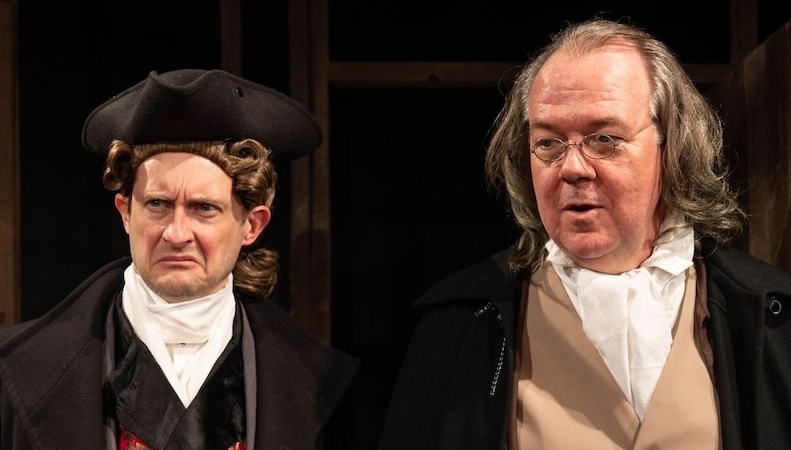


Brandon Bales, Rob Nagle (Photo by Eric Pargac)
Reviewed by Steven Leigh Morris
Moving Arts
Through May 3
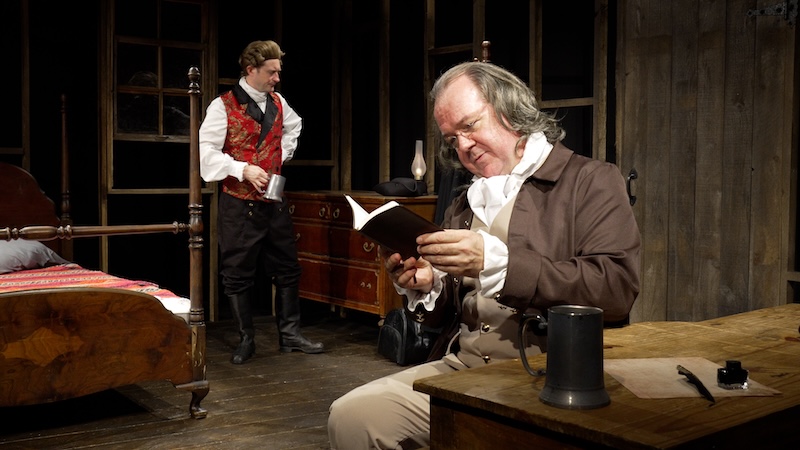
Brandon Bales, Rob Nagle (Photo by Eric Pargac)
“We become what we hate.”
– an old yoga maxim developed into a principle of political science by George Wilson Russell
In Tony Blake’s new play, set in September, 1776, firebrand and snooty Bostonian John Adams (Brandon Bales), destined to become second president of the United States, is so fueled by hatred of the British, one has to wonder how he sleeps at night.
The play dramatizes odd-couple Adams and his senior (from working-class Philadelphia) Benjamin Franklin (Rob Nagle), as they bunk together in a dreary New Jersey inn before meeting for negotiations the next day with Britain’s Admiral Richard Howe. Blake is interested in far more than an incidental chapter of American history. Rather, his play’s largest takeaway is that the United States in 2026 has become precisely what it so reviled at its founding in 1776. It now has the planet’s most dominant and dominating military. Its current, primary military leaders are as full of themselves as a teenager gone astray, heeding to the boomeranging principle that we can take whatever we want by force. That was Britain’s trick against us 250 years ago, and they lost. They failed to comprehend their vulnerabilities. Eventually, they lost all of their colonies, all of their empire, but at the risk of sounding overly romantic, in so doing, they gained their souls.
At the time of Blake’s play, the British monarch, King George III – oft described as England’s “mad king” – has, wait for it, blockaded American ports in order to stifle commerce. He has pillaged and burned defenseless American towns and villages using the resources of the most powerful military on the planet. He has threatened his American detractors with hanging, while tossing out the possibility of pardons to those who submit to unconditional surrender. His two leading military prosecutors of the colonies are brothers, viscount Lord William Howe, commander of the Army, and the aforementioned Admiral Richard Howe, commander of the Navy. All in the family.
Blake’s play is a two-hander between idiosyncratic rebels against the Crown; they irritate and barely trust each other. They are a pair of original No Kings protesters, about to barter with the British emissary on the heels of the Redcoats trouncing General George Washington’s army in Brooklyn. To use contemporary parlance, they have no cards to play.
At the play’s heart lies the question of reconciliation versus defiance. As portrayed by Bales, Adams is the resident militant, while Franklin has a broader perspective. For this, he’s accused by Adams of being weak. Adams is particularly concerned that Franklin will push for the U.S. becoming a “dominion” of Great Britain, with Americans in America entitled to the same rights as privileges as British subjects in Britain. Adams wants none of this. He wants to forge an entirely new country. And in the motel-room-showdown, Adams aims for a pledge from Franklin that the “dominion” option is off the table.
I wasn’t there in 1776, and neither was Blake. But the playwright’s depiction of Adams renders him something of a neurotic. There is a letter, historically preserved, by Benjamin Franklin to William Howe (the admiral’s brother), written only two months prior to this meeting between the pair and Admiral Richard Howe (a meeting that indeed took place, in a crowded inn, so crowded that the two men had to share a bed – according to multiple records.)
In that letter, there isn’t a trace of Franklin gunning for anything but American independence. His first impulse, years prior, was for some kind of reconciliation with the British, but after they declared martial law, and started terrorizing Americans in their own homes, Franklin came to understand that separation or servitude were the only viable options. Still, Franklin had an adult son who was a British loyalist, and in this play, Franklin’s possible family devotion plays into Adams’s concerns.
On viewing the play’s second performance in its run, I couldn’t tell if the play holds up or not. Adams makes a lame pun (in character), and the jocular Franklin responds, “A flash of wit: Good for you John, good for you!” When this repartee occurs once, it’s okay. The second time, it’s less okay. By the third time, it simply deflates good will towards the play.
The production suffers, or seemed to suffer, from the financial pressures now bearing down on the presentation of new work: Bales and Nagle are both fine actors, and this is not their first dance in the park. Both of them, however, were stumbling over lines and attempting heroic recoveries at the performance I attended. I don’t know the extent of their rehearsal time, but given the high caliber of these performers, it was clearly insufficient. This problem may dissipate a week or two into the run. And this is the reason I’m unable to assess the full merits and deficiencies in the play. It warrants a more confident presentation.
Justin Huen’s faithful, rustic set design serves up a credible 18th century room of lodging, and Warren Davis’s sound design brings out the brawling, homicidal mob beyond the thin walls of their room. Darin Anthony directs.
Moving Arts, 3191 Casitas Ave., Atwater. Fri.-Sat & Mon., 8 pm; Sun., 4 pm; thru May 3. https://movingarts.org/project/what-price-freedom/ Running time 90 minutes, no intermission