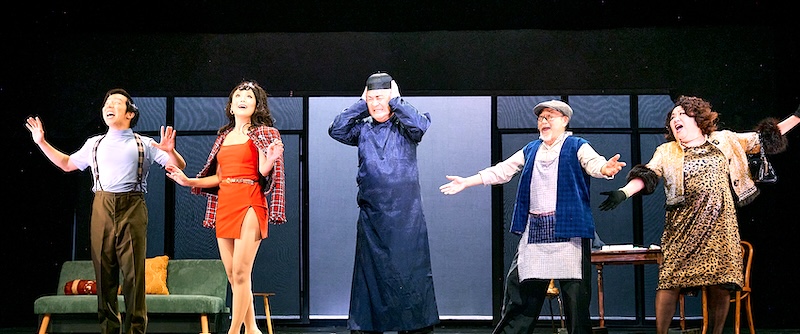
Kenton Chen, Krista Marie Yu, Marc Oka, Gedde Watanabe, and Emily Kuroda (Photo by Mike Palma)
Reviewed by F. Kathleen Foley
East West Players
Through May 31
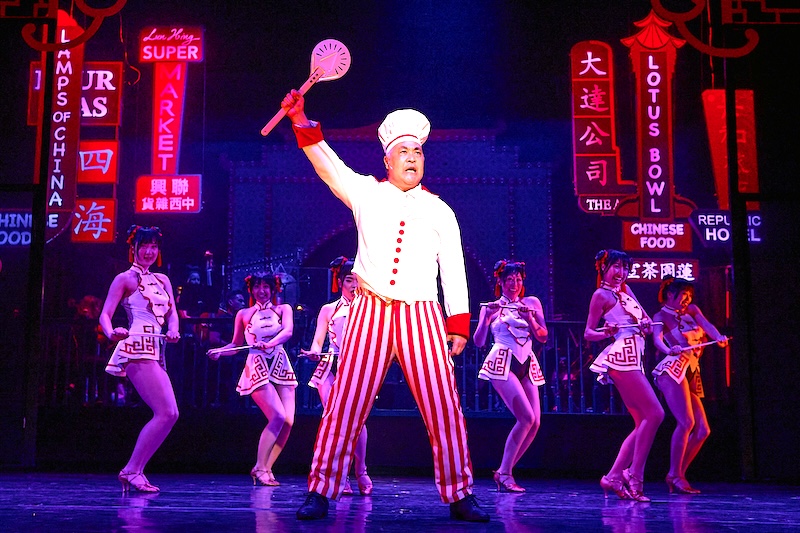
(Center) Marc Oka and (L-R) Esther Lee, Gemma Pedersen, Ai Toyoshima, Sally Hong, Hillary Tang, and Emma Park (Photo by Mike Palma)
First produced on Broadway in 1958, Flower Drum Song, based on C.Y. Lee’s novel, with music by Richard Rodgers and lyrics by Oscar Hammerstein II, was a bit of a hit, running for some 600 performances before being adapted into a major 1961 film.
Unlike shows such as The King and I, which cast primarily all whites in the major roles, Flower Drum Song featured a predominately all-Asian cast — a watershed in ethnic representation.
However, in a present-day context, the original show seems culturally reductive, even racist. David Henry Hwang, who won the 1988 Tony for his play, M. Butterfly, attempted to rectify that problem in his 2002 adaptation, retaining much of the original score but almost completely rewriting the book by Hammerstein and Joseph Fields.
That show premiered at the Mark Taper Forum before transferring to Broadway —a run of less than five months. In this new and “refreshed” adaptation at East West Players, Hwang again attempts to make Drum Song more palatable to contemporary audiences. What results is an eye-catching, extravagantly designed production with big ambitions, as evidenced by the fact that it has been mounted in the capacious Aratani Theatre at the Japanese American Cultural and Community Center rather than East West’s much smaller venue on Judge John Aiso Avenue.
Hwang’s bold disassembling sets the first scene in China, where drably attired workers, China’s new proletariat, dutifully brandish copies of Mao’s little red book. As Mei-Li (Grace Yoo) watches helplessly, her dissident father is arrested and dragged off — possibly to his death.
It’s a visually disturbing set-up wholly appropriate to Hwang’s revolutionary reimagining. That revisionist sensibility extends to the central character of Mei-Li, who isn’t slipping into the country for an arranged marriage, as in the original play and film, but fleeing the ravages of Mao’s cultural revolution.
Mei-Li finds safe harbor with her father’s oldest friend Wang, (Marc Oka), a former Chinese opera star who now runs a San Francisco theater dedicated to the medium. The problem is, there’s little call for Chinese opera in bustling 1960s San Francisco, and his shows have been playing to empty houses. In order to pay the rent— and much to his father’s disapproval — Wang’s son, Ta (Scott Keiji Takeda), turns the theater into a nightclub on select evenings, and the club, with its bevy of scantily attired showgirls (Ruoxuan Li did the fetching costumes), is growing in popularity. Enter Madame Liang (Emily Kuroda), a theatrical agent who takes a shine to the place and its star, Linda Low (Krista Marie Yu). Under her tutelage, the Chop Suey Club becomes a go-to destination for the city’s elite.
While working as a waitress in the club, Mei-Li falls in love with Ta, but he is more taken with flashy Linda’s more evident allure. When Ta insultingly makes his preference clear, Mei-Li decamps, leaving the regretful Ta frantically trying to find her whereabouts.
The action segues to the fortune cookie sweatshop where Mei-Li has found work — and a new admirer in Chao (Cooper Lee Bennett), who has also entered the country illegally. Immigration authorities frequently interrupt the workers’ grinding toil, causing them to hide at a moment’s notice —a timely touch that echoes present realities. Tired of the drudgery and uncertainty of his life in America, Chao wants to leave for Hong Kong and take Mei-Li with him.
Of course, Mei-Li and Ta ultimately reconcile, and in a sweet ending, the openly gay character of Harvard (Kenton Chen) finds his niche as a 1960s San Francisco drag queen. It’s another example of Hwang’s clever updating, as is Mei-Li’s makeover from a “beautiful, small, and shy” archetype to a strong woman who charts her own course.
Yet all Hwang’s innovations can’t distract from the fact that this latest iteration, under the direction of Lily Tung Crystal, is an uneven affair that has been sadly miscast in several key roles. As Ta, ostensibly the romantic lead, Takeda fails to ignite believable chemistry with Yoo’s Mei-li, while in the role of Madame Liang, Kuroda lacks the brass-plated belt voice needed to helm the big ensemble number, “Grant Avenue.” But she later redeems herself in a less vocally demanding duet with Oka, whose amusing transformation from a Chinese opera traditionalist to an applause-hungry nightclub ham is one of the show’s highlights.
Most problematic is Krista Marie Yu’s performance as Linda Low. Yu has the looks and the moves for the role, but her vocal skills are noticeably limited.
That said, the show has been handsomely designed, and the onstage band, helmed by musical director Marc Macalintal, is a dream. Veteran performer Gedde Watanabe, who plays Wang’s old friend Chin, has a pleasing stage presence and solid vocal skills, while Yoo’s angelically pure voice largely compensates for the show’s imbalances. Her strong and resilient Mei-Lin anchors the evening.
East West Players, The Aratani Theatre at the Japanese American Cultural & Community Center, 244 San Pedro St., Little Tokyo; check website for tickets; thru May 31. https://www.eastwestplayers.org/flower Runtime: two hours and 45 minutes with an intermission.