


Mark Stancato, Adam Mattson, Hudson Long, and SteveYoung (photo by Doug Engalla)
The Hornet’s Nest of Bigotry
“A Time to Kill” at The Group Rep
RECOMMENDED
 John Grisham’s debut 1989 novel, A Time to Kill, was initially spurned by publishers but swiftly became a bestseller when it landed in the international marketplace. It’s a sprawling work, centering on the attempts of a small-town Mississippi lawyer, Jake Brigance, to defend a Black man, Carl Lee Hailey, who, in a Clanton, Mississippi courthouse, guns down two young, White male inmates who are handcuffed at the time, and thereby defenseless. They were far from defenseless, however, when they jumped out of the woods to rape and beat almost to death a 10-year-old Black girl, who was walking home with groceries and who happened to be Hailey’s daughter.
The novel’s premise makes one of two assumptions, from which we’re at liberty to choose: first, that Hailey was sufficiently rational to understand that the court system in the Deep South would not deliver justice for the likes of him, or his daughter, now fighting for her life in an ER ward and in the grip of a coma — ergo his deed was an act of pre-meditated vigilantism occurring before the defendants could be judged according to their constitutional right of due process.
The second, contrary assumption, supported by a reading aloud of the vivid, detailed confession by one of the inmates during the hearing attended by Hailey, is that the circumstances in general, and more specifically the harrowing potency of the confession, drove this girl’s father temporarily insane. From that state of mind, Hailey took his revenge. This latter assumption, whether true or not, is the foundation of Brigance’s defense strategy.
What’s doubly curious is that Grisham is a lawyer himself and penned his fiction from an actual case that upset him deeply, but with one notable difference. The case he observed was that of a man who similarly raped and assaulted two girls, but the man was Black, and his victims were White — an inversion of the racial dynamic in Grisham’s book. And that, he noted, was his point: how we look at justice through different prisms when there are alternate racial dynamics in play. For this inversion, he was accused by his detractors of being a radical Left advocate. These accusations were accompanied by critiques, for instance, in 1989, when the action is set and when the book was published, the kind of KKK horrors depicted in his novel were a chapter from the past, along with that toxic breed of racism itself, as though White Supremacy in 1989 lay crushed on the tracks of American progress.
It doesn’t take much of a leap or even a stretch to see how, in 2026, that critique curdles in the flames of those burning crosses.
It took a decade from the time of the book’s publication for Rupert Holmes’ stage adaptation to premiere at the Arena Stage in Washington, D.C., where it was greeted with similarly mixed reviews. (This adaptation is currently on stage at the Group Repertory Theatre.) Writing in 2011, Variety and The Hollywood Reporter complained that, though the play’s structure was taut and effective, much like the book from which it derived, it relied on melodrama and engrained stereotypes of the Deep South.
Two years later, in 2013, in a 5 to 4 ruling, John Roberts’s U.S. Supreme Court struck down Section 4 of the federal Voting Rights Act in Shelby County versus Holder. Keep in mind, this Voting Rights Act of 1965 was hard fought for, literally with blood and broken bones, for almost a century, during which time the KKK was not a movie trope from a distant past, but an embodiment of organized, domestic terrorism.
In that 2013 ruling, the Supreme Court struck down the “pre-clearance” clause in Section 4 of the Voting Rights Act. That clause required states with a history of racial discrimination to obtain permission from the federal government before changing their voting laws. Not necessary, Roberts himself opined. That legacy of violent bigotry and even racism itself was long past.
Six years later, in 2019, The Supreme Court weighed in once more on that same Voting Rights Act in Rucho versus Common Cause, arguing that states have every right to engage in whatever redistricting they like, so long as their new voting districts are determined by partisan interests and not racial ones. And so, some states argued and continue to argue, that though districts with overwhelming Black/Latino constituents are indeed being gutted of representation, these changes are not for racial reasons but for political ones — as though that’s a distinction.
The final and most devastating blow to the Voting Rights Act came this year when the Supreme Court ruled 6-3 in Louisiana versus Callais, which is when they did precisely what John Roberts assured in Shelby versus Holder would never happen: They gutted Section 2, which had outlawed racial discrimination in voting maps. To be clear, the Court did not permit racial discrimination, but its ruling made it next to impossible to challenge redistricting even when a plaintiff could prove that the redistricting was racially motivated.
And so, this year, Black Congressman Al Green, first elected in 2005 in Houston, finds himself fighting for his political life because of redistricting in Texas. And in South Carolina, the attempt to remove through redistricting veteran Black Congressman James Clyburne – that state’s only Black representative — is a transparent effort to shun the will of 1.3 million Black voters, or 25% of the state’s population. (As of this writing, it appears that the state’s redistricting efforts have been turned back, at least for the time being.)
Who needs burning crosses and white hoods when you’ve got a Supreme Court like ours? As novelist William Faulkner, himself well acquainted with the machinations of the Deep South, put it: “The past is not dead. It’s not even past.”
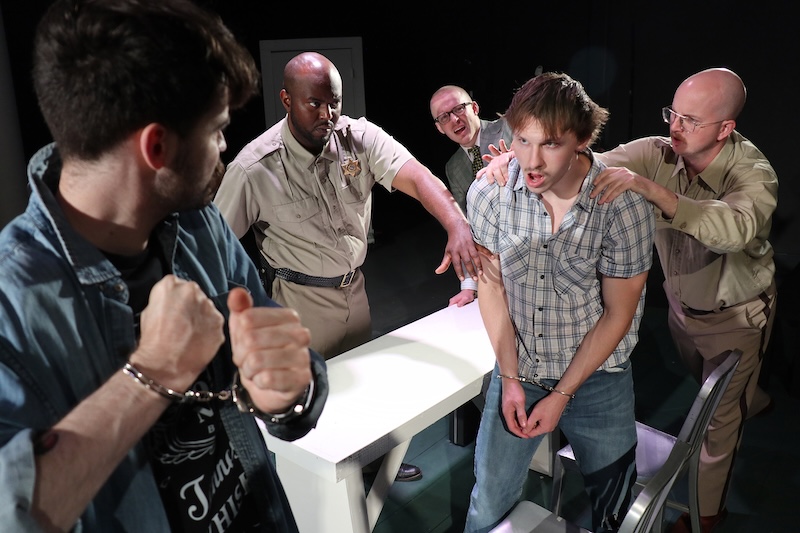
The assailants of a Black child, squirming their way through Mississippi’s criminal justice system: Troy Whitaker, Rosney Mauger, Reed Michael Campbell, Adam Mattson and James Lawrence Powell (photo by Doug Engalla)
This brings us to Group Rep’s haunting, discomfiting revival of Holmes’s adaptation. Yes, it comes packed with melodrama, and yes, stereotypes abound — particularly the trope of the flying-by-the-seat-of-his trousers and slightly inept White savior (defense attorney) coming to the rescue of the wronged, Black criminal.
Grisham is nobody’s fool: He anticipated this complaint by having Hailey’s despondent wife, Gwen (Jennifer C. Holmes), lobby her incarcerated husband to dump the local White lawyer and go with the all-expenses-paid representation from the NAACP. Her husband (a fantastic, tortured performance by Sherrick O’Quinn) thinks it over long and hard before making his choice: to go with the White guy — the devil you know being better, perhaps, than the devil you don’t. Hailey can see that his White lawyer is disheveled; what he may not realize is that his attorney is incorruptible; and in a corrupt world, that may not be helpful to his cause. “When they go low . . .” We saw how that turned out.
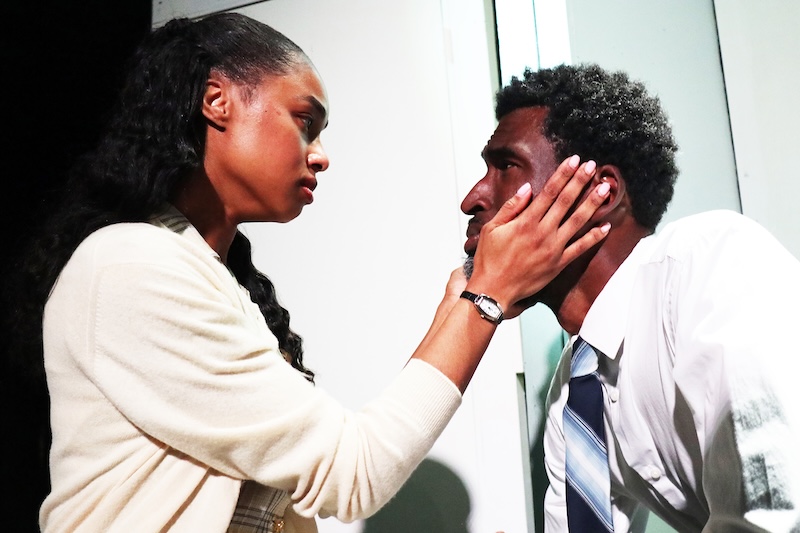
Husband and wife reunion; she pleads with him to go with the NAACP lawyers rather than the local guy: Jennifer C.Holmes and Sherrick O’Quinn (photo by Doug Engalla)
But the core of the matter, and the reason it’s such a pleasure to celebrate Tom Lazarus’s riveting production of this court room epic that employs 17 actors, is Grisham’s initial, racial inversion, and his reason for it.
That reason emerges during the pivotal trial scene: In rearticulating the horrors of the rape to the jury, defense attorney Brigance (an amiable and earnest portrayal by Hudson Long) invokes the victim’s pale skin and flowing blonde locks – oops, sorry. No, she isn’t White. But — how would you feel if she had been? Might you feel differently?
And this is precisely the reason that Grisham wrote the novel.
The defense attorney is clearly addressing White members of the jury. And because of the way Lazarus’ set has been angled, we find ourselves sitting in that same jury box. If we have any introspection whatsoever, we know that we’re all racist to some extent. But who wants to own up to that? That’s attorney Brigance’s calculation.
The matter at hand is Group Rep’s almost stunning capacity to deliver huge ensemble productions with such skill and intelligence. They did this last year with their gorgeous production of Thornton Wilder’s American classic, Our Town. And this is in much the same tradition. I couldn’t locate a performer, or a performance, that didn’t belong. This is director Lazarus’s doing: finding the unity in tone that incorporates wry comedy (bordering on slapstick) into harrowing emotional depths.
The former comes from the character of Lucien Wilbanks, Brigance’s effete counselor, a veteran attorney himself who was disbarred after too much unbecoming conduct inspired by booze. In that role, Michael C. Mahon approaches the outer edges of a lampoon without crossing into it. The emotional depth comes in the husband-and-wife team of Carl Lee and Gwen Hailey: As the accused (nobody can argue that he didn’t gun down two inmates in cold blood), O’Quinn seethes, softly mostly, with indignation born of innate dignity. As his wife, Holmes brings to the surface a despondency that starts in her bones and emerges through her pores. Why did her husband have to do this? How did such vengeance ever help? And yet her love for him is as deeply felt as her exasperation.
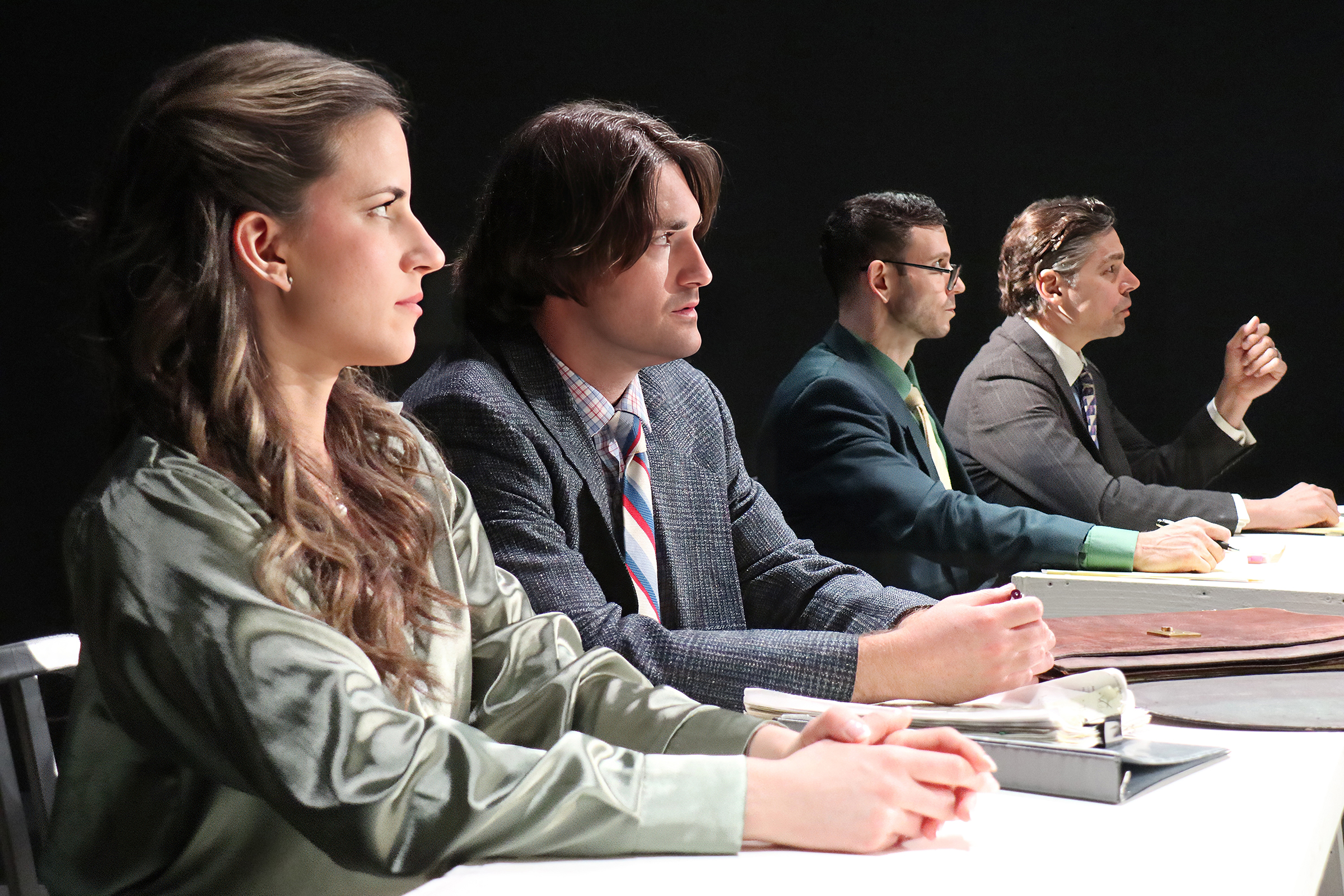
Anica Petrovic, Hudson Long, Dominic Ryan Gabriel, and Mark Stancato (photo by Doug Engalla)
I found myself slightly at odds with the interpretation of prosecutor Rufus R. Buckley (Mark Stancato) who plays into the grain of the performative lawyer (think of the character’s namesake, the late William F. Buckley), who traffics in an imperious blend of ingratiation and condescension. Were his convictions more deeply felt rather than ridiculed, he might have added a sheet of complexity, both emotional and philosophical, to the conundrums facing the accused. As is, he plays into the kind of Southern stereotype that so annoyed some of Grisham’s initial readers. Had he cut against that grain, I’m not sure it would have solved a problem that’s clearly engrained in the text, but it might have helped. If director Lazarus deserves credit for this production’s multiple virtues, he deserves responsibility for its minor shortcomings.
But I did so appreciate the many characters, and characterizations, that dwell on the edges. For budget reasons, they wouldn’t exist in any play written after 2020, but here they are, filling out the community that constitutes the world of this play.
As presiding Judge Omar Noose (that’s Grisham being none-too-subtle), Neil Thompson evinces an almost carefree sense of humor — not quite glib, but nonetheless a guy who’s seen it all and has somehow retained his good humor and is doing his damndest to be fair. If this is a rigged justice system, it’s not because of him.
Anica Petrovic is terrific as the in-from-Boston/studying in Mississippi legal intern and civil rights advocate who gloms onto and grounds the flailing local defense attorney with matters of law that he hasn’t had the time to research. Her only challenge to his principles is to his marriage vows, but that’s another story.
Rosney Mauger, as the first and only Black sheriff in Ford County, where the action unfolds, effortlessly straddles the divide between what would be his job security and his empathy for yet another in a stream of Black defendants.
As expert witnesses, Patrick Anthony displays just the right degree of indignation when defending his legally damning policy of pronouncing every defendant “sane” in court, as needed by the state prosecution, when he himself works for that same state – before having the defendants locked up in the state mental asylum that he manages. As his opponent, Steve Rozic cuts a sympathetic figure, both honorable and humiliated, as an expert wrongly accused, in court, of sexual deviance
The cumulative effect of this production of Holmes’s tight adaptation is a fully engaging and richly constructed community of players; like last season’s Our Town, it’s smart enough to defy the cliches that so many detractors claim are its downfall. It mostly (but not entirely) avoids eviscerating the Deep South, which is home to people, like people everywhere else, who are both good and evil; but that region is also home to a shop of horrors that never quite seems to go out of business selling KKK hoods and flammable crosses. We have such shops, too, selling different products. Let’s not kid ourselves.
The book was likely a best seller because it settles onto a view of humanity that’s at least somewhat redemptive. Of that, I’m not persuaded, though it sure feels good to imagine.
The Group Rep. The Lonny Chapman Theatre, 10900 Burbank Blvd., North Hollywood; Fri.-Sat., 8 pm, Sun., 2 pm; thru June 28. www.theGROUPrep.com. Running time: two hours and 35 minutes including one intermission.