Photo by Ron Lyon
Reviewed by Joel Beers
One More Productions at the Gem Theatre
Through July 12
RECOMMENDED
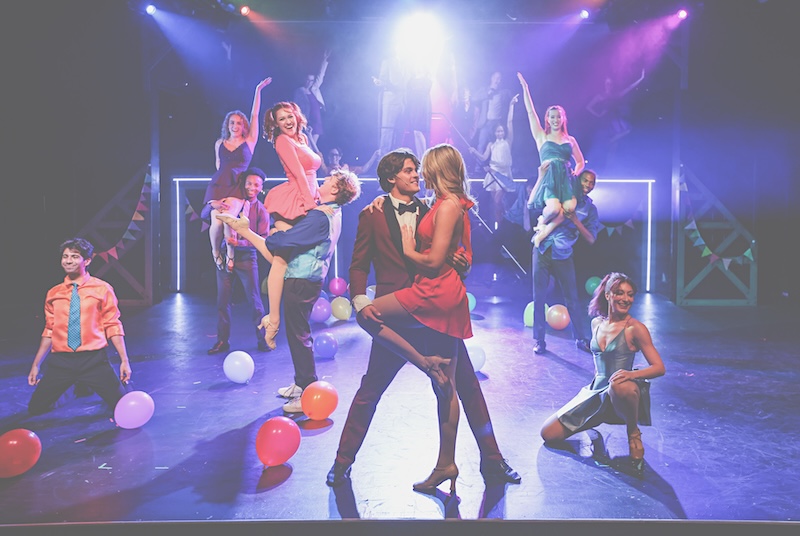
Photo by Ron Lyon
The 1984 film Footloose was epochal in several ways:
- It reminded people that there were Whites other than John Travolta who could (somewhat) dance.
- It launched the career of the connective tissue of the known universe (Kevin Bacon).
- It gave half of the 1970s folk-rock duo Loggins & Messina a much-needed do-over.
- It was also a film that was propelled by its soundtrack, which featured some monster hits.
When it came time for a Broadway musical 14 years later, everything already felt slightly dated. Those hits were still recognizable, but the cultural moment had moved on. Twenty-eight years after that, those songs are certifiable oldies, and its story, which is framed around youthful rebellion in a conservative small town banning dancing, seems positively archaic.
While the stage adaptation adds roughly 10 songs (written by Tom Snow and Dean Pitchford) not in the film it is, for the most part, faithful to the original storyline, which is kind of Rebel Without a Cause without the danger and West Side Story without the ethnicity. It’s also a suitably 1980s Hollywood teen-angst romance with an MTV pop-rock conscience, built on power ballads like Almost Paradise and big-radio anthems like the titular song, Let’s Hear It for the Boy, and Holding Out for a Hero.
And, it’s a different take on the age-old city mouse meets country mouse motif, with the city mouse stepping into a world of small-town rules, earnest sermons, and pervasive grief, and showing the country mice the path to reconciliation, healing, and celebration.
Ren, a high school senior, has just moved from Chicago with his mother to the small town of Bomont, where a ban on dancing has been imposed after a car plunged off a bridge five years earlier, killing four teenagers who had alcohol — and, gasp, marijuana — in their systems.
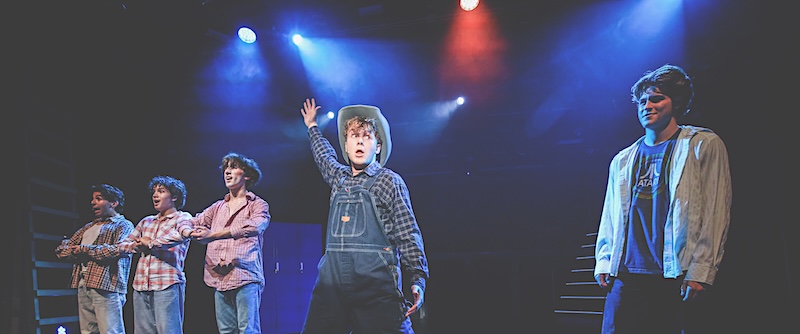
The central characters remain intact: Ren, the town pastor; Reverend Moore, who effectively wields a steel hand on the town council; his daughter Ariel, the most complicated figure in the story; Willard, the oafish epitome of the country mouse with a heart of gold; and a supporting cast defined by grief, authority versus youth, repression, and release through music and dance.
The musical expands the emotional arcs of several characters, most notably Reverend Moore and Ariel, and gives more definition to supporting roles like Willard. It also preserves the film’s mega-hits, which remain the production’s biggest numbers.
The challenge is the newer songs added for the stage version. While they attempt to deepen character, they are indistinct and don’t carry the same melodic force as the originals.
But that doesn’t mean this production wavers in delivering. Nikki Snelson, the director and choreographer, has extensive Broadway, regional, and international credits as a performer and creator. The large company of 26 includes current and recent high school and college students, alongside several veterans of the greater Orange County performing scene.
Snelson’s direction is thoughtful, energetic, and layered, capturing both the exuberance of the iconic numbers and the more earnest attempts at emotional expansion in the added songs. Where the production truly excels is with its choreography: vigorous, precise, and staged with real momentum.
The ensemble — clearly full of performers still actively in thrall to discovering and making theater in real time — brings an infectious energy that drives the show forward.
Any production of Footloose lives or dies with its lead, and Jackson De Lange, currently a junior at Loyola Marymount University, is a strong anchor. He has the tousled, young Leonardo DiCaprio look, paired with the cocky ease of early Jack Nicholson. He sings, dances, acts, and carries the stage with confidence and charisma.
The comic relief, Willard, is played with strong comedic timing by Luke Gilstrap, currently studying at Rancho Santiago Community College.
While some supporting performers haven’t yet fully developed their vocals, they compensate with energy and commitment.
Among the seasoned performers, Jason Guffey’s Reverend Shaw Moore is a sympathetic authority figure whose arc carries real weight. Nicole Barnhart (Vi, the Reverend’s wife), Jennifer Harmon (Ethel, Ren’s mother) and Aaron Gibbs (Chuck, the bad guy) provide grounded, effective support in limited but important roles.
Strong direction and choreography — particularly in large musical set pieces like Let’s Hear It for the Boy (a number that should be sculpted into the Mount Rushmore of musical theater, Orange County Chapter) elevate the production, eclipsing its weaker elements.
That said, Footloose remains a show that trades more in nostalgia than revelation. That This was already apparent in 1998, but it’s even more striking in 2026, with even its more progressive numbers undermined by 1980s gender coding.
For example, Learning to Be Silent, which critiques the silencing of women under paternal control, is followed by Holding Out for a Hero — a song that seems to frame masculinity as something larger-than-life and almost mythic, aligning with the 1980s pop culture penchant for heroic, hyper-stylized male figures.
But this is a production that does more than rises above its flaws: It’s fun, frequently ecstatic, and a blast to watch.
One More Productions at the Gem Theatre, 12852 Main St., Garden Grove; Thurs.-Fri., 8 pm, Sat., 2 & 8 pm, Sun 2 pm. www.thegemoc.com . Running time: two hours and 15 minutes with an intermission; thru July 12.