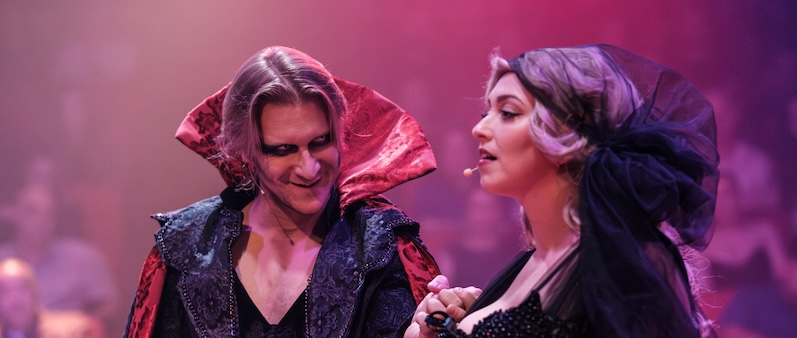
Justin Meyer and Kelly Krippendorf (Photo by Brian Ian)
Reviewed by Joel Beers
Nocturne Theatre
Through Aug. 23
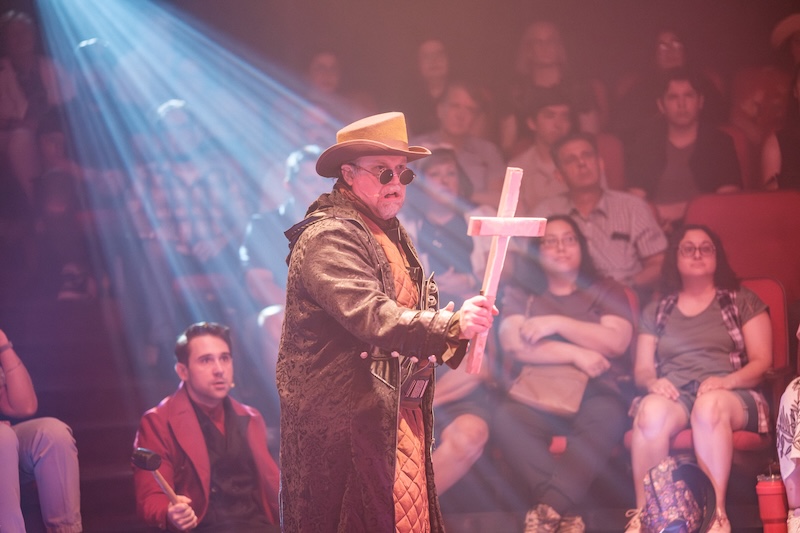
J.D. Wallis (Photo by Brian Ian)
When the mercury is hovering around 90 degrees at dusk in the heart of Glendale, one of the last things you might consider sinking your teeth into is a two-and-a-half-hour rock opera based on Bram Stoker’s 1897 novella, Dracula.
But maybe it’s the setting — frigid Transylvania, fog-drenched London and the icy northern seas — or the fact that the theater-in-the-round Nocturne Theatre leans so heavily into the Gothic aesthetic. Or, most likely, it’s the stellar performances and production values. Whatever the reason, this production of Frank Wildhorn’s 2004 musical is a remarkably fine mounting of a remarkably mediocre musical. In fact, if one were so inclined, one might suggest that the show would have benefited from having a wooden stake hammered through its heart shortly after its Broadway opening.
But this was Broadway in the early 2000s, when the old-fashioned mega-musical was beginning to give way to Disney spectacles, pop scores and jukebox musicals — and everything about this show is big: its running time, its relentless procession of songs, its emotions and the sheer number of things it wants to be: Gothic romance, horror story, tragic love story and faithful adaptation of Stoker, all at once.
When everything is big, however, nothing is particularly subtle. The musical’s ambitions are enormous, but its ability to dramatize them is less so, rendering our bloodsucking lord of the dead less of a villain than the score and book.
The songs are indistinguishable from one another and too often tell us what we already know rather than dramatizing anything new. For a story built on suspense, seduction and dread, Wildhorn’s score has surprisingly little interest in subtlety, preferring to tell us what to feel rather than making us feel it, sacrificing silence and ambiguity on the altar of bombast and obviousness.
Case in point: “Deep in the Darkest Night,” the vampire hunters’ swelling second-act anthem about becoming “points of light” against Dracula’s darkness. It is the musical in miniature: sincere, enormous and almost comically determined to make sure we understand the metaphor.
There are exceptions. “Life After Life,” for instance, has the sweep and menace the rest of the score so desperately needs. But too many of the songs occupy the same melodic and emotional territory — yearning, longing, tragic love and soaring declarations — as though Wildhorn has given nearly everyone variations on the same tune, many of which oddly sound poised on the edge of veering into Survivor’s “Eye of the Tiger.”
The book by Don Black and Christopher Hampton doesn’t help much. Despite its fidelity to Stoker, the plot can be surprisingly difficult to decipher, rushing through major developments with so little dramatic connective tissue that you might find yourself reaching for your CliffsNotes.
And yet the Nocturne production finds much of what the musical itself lacks. Most vampire vehicles, however successful, touch on some combination of seduction, eroticism, horror, obsession and danger. This one does too — largely because the performers and designers put it there, most notably Tanya Cyr’s costume and creature design, Gavin Dietz’s costume construction, director Justin Meyer’s evocative lighting design and Lisa-Marie Burnside’s choreography.
The gifted chorus — Burnside, Rachel Fictum and Kimberly Butler, billed as vampire/aerialists, and Abhaya Krishnan-Jha, billed as a vampire/singer — leaves no gyration ungyrated, whether dangling and twisting from fabric dropped from the ceiling or weaving through a metallic circle attached to the skeleton of an ocean vessel. Their physicality provides much of the production’s sensuality and menace.
The cast is uniformly excellent. Justin Meyer, who also directs, and Samantha Rose, as Dracula and Mina respectively, both possess powerful voices and effectively convey what neither the book nor the score makes particularly clear: the profound metaphysical and emotional connection between their characters. Their performances provide much of the erotic tension that the writing seems determined to explain rather than dramatize.
Andrew Diego nearly steals the show as Renfield, the psychopathic facilitator caught between Dracula and his victims, but that’s not to downplay the extraordinary talent on display throughout the cast.
They don’t exactly resurrect the musical, but they make it more alive than it has any right to be.
Nocturne Theatre, 324 N. Orange St., Glendale. Thurs., 7:30 pm. Fri., 8 pm. Sat. & Sun., 2 pm. www.thenocturnetheatre.com. Runtime: two hours and 30 minutes with an intermission.