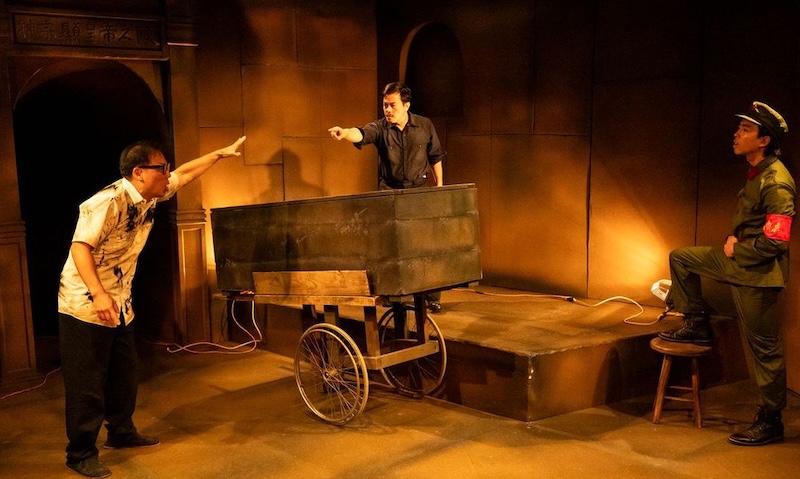
Wayne Lee, West Liang, Jonathan Cheung (Photo by Eric Pargac)
Stephen Dierkes’s three snapshots from China in his “Tomb of Ten Thousand Calendars”
An interview with Dierkes and director Jeff Liu
By Amanda L. Andrei
Ninety feet underground, trouble is brewing. A tense family, a betrayed citizen, a desperate lover, all at the site of an emperor’s tomb — and across three momentous eras of Chinese history. In the Tomb of Ten Thousand Calendars, written by Stephen Dierkes and directed by Jeff Liu, opens August 29 at Moving Arts Theater. Stage Raw contributor Amanda L. Andrei met with both.
Dierkes’s play dramatizes three snapshots from China’s fraught and often bloody history: the stultification of dynastic China (1620), the upheaval and fervent idealism of the Cultural Revolution (1966), and the personal and globalist power struggles of today (2026). All of this takes place 90 feet below ground, in the tomb of the Wanli Emperor. The Noble Consort yearns to be buried with her love but lacks the status for it; a former teacher tries to survive in a time when idols and intellectuals alike are being erased; an immigrant father tries desperately to connect with his Americanized son.
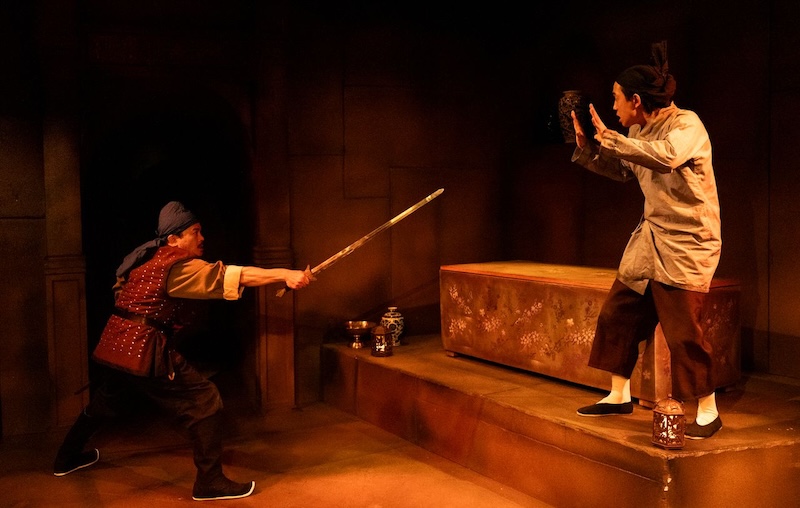
West Liang, Jonathan Cheung (Photo by Eric Pargac)
Stage Raw: What drew you into this play, or inspired you? How did you find your way into this world?
Stephen Dierkes: I picked up a book on the Cultural Revolution because so much of the Cultural Revolution reflects in extremes what’s happening in America right now, and I read about the denunciation of the dead emperor. I thought, Huh, that’s interesting. And it’s actually kind of funny denouncing a corpse. You know, it’s so absurd. I looked it up and read more about it, and saw this tomb was 90 feet underground, and that really excited me. I thought this is a world here outside of time, you know – I just got very excited about it. . . The arc of the play is a personal story.
I’m not trying to write a Chinese play, you know. I’m trying to write a Steve Dierkes play, for whatever that’s worth. There’s no way I can be authentic, but a play is a dream.
Jeff Liu: I like plays that are ambitious and tackle, big ideas and have an interest in history and culture. I am also Chinese American, so part of it is that I’m always a bit on the lookout for three-dimensional depictions of Chinese and Chinese American characters because you just never know when we become the convenient enemy again. You know what I mean? Like we saw with COVID, right? Wuhan virus, kung flu, and then scratch the surface, and you realize underneath all this tariff business is partly about China. To me, part of this Chinese American experience, at least as mine, is to try and build that bridge if we can. There’s so much misunderstanding and misinformation.
When I first read the play, it struck me with the humanity given to these Chinese characters in China. It’s a different system, but in the end they’re just human beings trying to survive in different systems of power, right? The play is so much about power and hierarchy, which we have everywhere. But this is a culturally-specific kind, and then within that, how are these people trying to survive? Then the interesting thing of four actors, but they play different characters in each part, and so their power shifts.
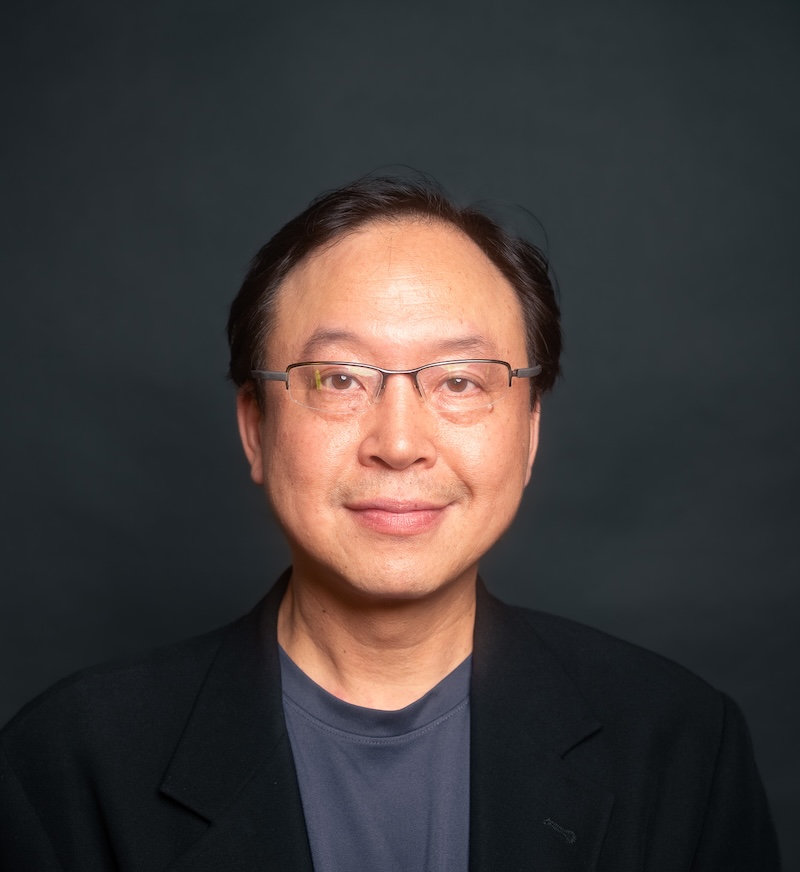
Director Jeff Liu (Photo courtesy of the subject)
SR: Have you ever been on a heritage trip? Depending on what “heritage trip” might mean to you.
JL: I would say yes but not just one – I’m from southern Illinois, but I also went to British secondary school in Hong Kong. I got the chance to travel to China quite a bit with my family and so I’ve gotten to see many of the great kind of historical sites. With China, you never know – whatever year it is, they’ll discover this entirely new, thousands-of-years-old archaeological complex – which confirms something that was quasi-legendary or rumor was history. In China it’s layers and layers of civilization, some of which are lost or destroyed or buried, but they’re still excavating stuff.
As part of the Chinese diaspora, going back is different. Part of the other cliché is, Did you have a Joy Luckmoment?” [laugh] And some people go back and feel nothing and they’re like, What’s wrong with me? But I’m like, it’s all valid.
SD: My blood is 100% German, so I have no romance about my origins. I couldn’t care less about my bloodlines, you know. I could understand if I was something else, that would be cool, you know. But when I went to Germany, it was also too much like America. I would much rather go to some place that feels different. I’ve been to China and I’ve seen some of that. My husband is Chinese, a Hong Konger, and for him, it was a heritage trip.
As I’m getting older, I’m reading more history, and I look at it like it’s all a family album.
SR: There are connections, despite space and time, is a little bit of what I’m hearing.
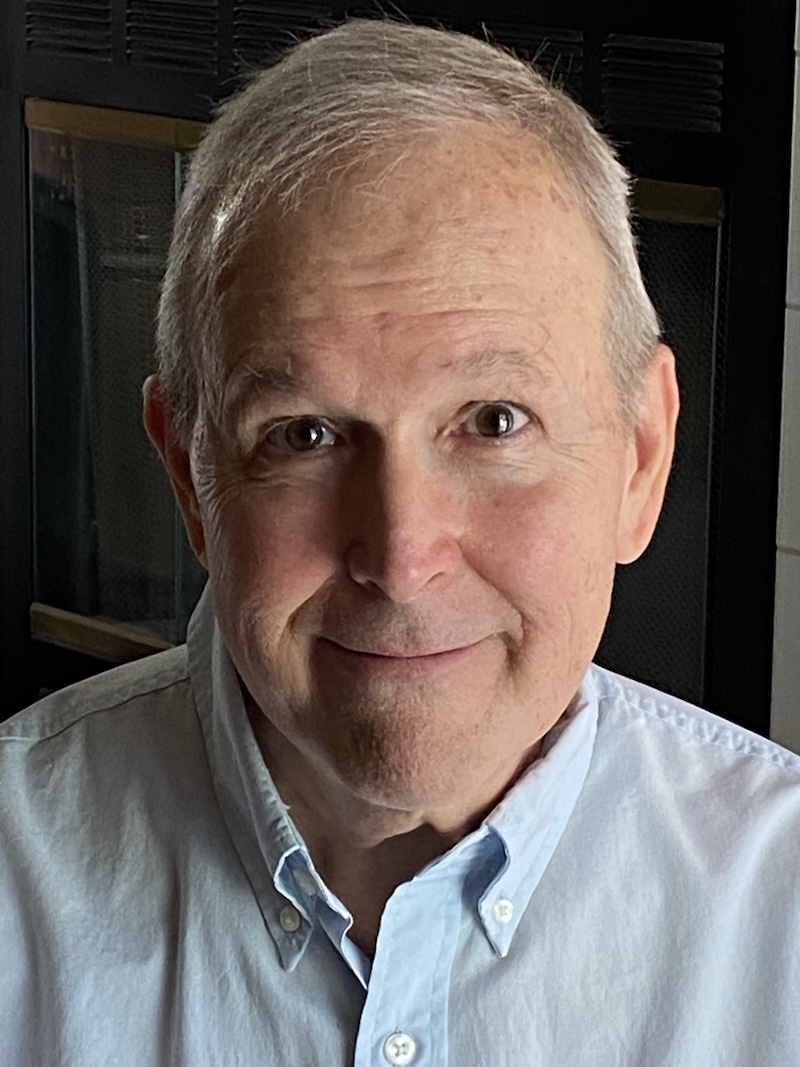
Playwright Stephen Dierkes
SD: There’s a universality to it.
SR: What discoveries did you make while bringing this play onto its feet?
JL: Lots – and we still are making discoveries! There’s the question of: How do these three stories speak to each other? As we’re working with the actors to create throughlines but also distinct bodies for each time – each one is different – how do themes start talking to each other? And what does the writer want to do? Everything he thinks might be there, but there might also be more.
SD: The creative team offered suggestions and said, you know, when the son says he doesn’t want to be a Chinaman. I knew it was a slur, but one of the cast members said, “The mother better respond to that. [The character should say] ‘How dare you say that to me?’” Things like that. And the father, I picture him as this very rigid guy who mistakes rigidity for strength. But there are other parts. Is this too touchy feely for him?
Jeff was suggested to me as a director because he’s Chinese American, and I have benefited from that. But really, he’s just a really good director, and that’s what I value most. He and the cast have come up with suggestions, and I’ve taken many of them. It’s little things here and there.
SR: The play jumps between three time periods: 1620, 1966, and the present, and it repeats these themes about family and political upheaval. It’s especially cool that there’s a 60 year, that special zodiac number, cycle between the 1966 period and today. Speculate with me for a moment, thinking of the world of the play or the world around us today: what would you see for this world 60 years from now, in 2086? Who’s around, and what’s happening?
SD: Just in the last couple years, we have a couple of real game changers like AI, you know, and drone warfare. To me, that has changed a lot. But we also have had many years coming climate change, and all of those things I feel very pessimistic about.
To the extent that I guess anything, I see the 21st century as being the Chinese century. But the play isn’t about China’s global domination. The play is more about cultural change and how we treat each other, generation from generation. But to the extent that it is about global politics, I think China has the future. One good thing that I can predict is that whether whatever status America is in, it’s going to be more culturally diverse, diverse, and glory, hallelujah! You know, it’s time, it’s past done, so that’s one good thing. And maybe what’s being done now is fixable. I think we need some fighters, and it can’t be business as usual if we’re going to turn it around.
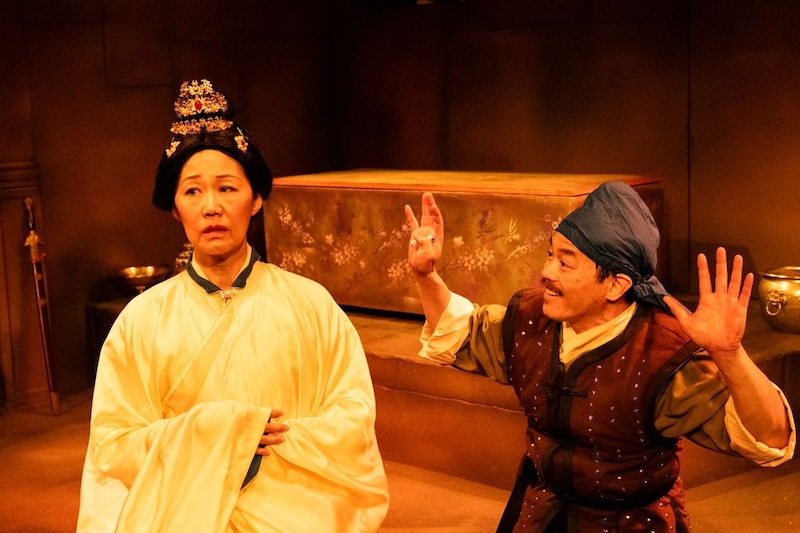
Elaine Kao, West Liang (Photo by Eric Pargac)
JL: There can only be global solutions. We work together or we perish. If enough people can come around to that, and enough people can do their work to have empathy – and that includes the people who don’t agree with you. People forget that empathy isn’t just for people you like, because that’s easy.
Doom and gloom are not yet written. Despair and indifference remain the age-old and ultimate enemy. If we’ve gone far enough to go, hey, can we please work on these things, and we’re willing to do that work, as artists and citizens. For first world countries, what are we willing to give up of our comfort? If we can do that, we have a road to the future, to survival, and we give the next generations chances to keep building on it.
IN THE TOMB OF 10,000 CALENDARS | Stephen Dierkes’s play about an emperor laid to rest, a revolution, and a son who rejects his father’s legacy | Directed by Jeff Liu | . Moving Arts, 3191 Casitas Ave., Atwater. Opens Sat., Aug. 29; Thurs.-Sat., 8 pm, Sun., 4 pm, Mon., 8 pm; thru Sept. 20. https://movingarts.org/