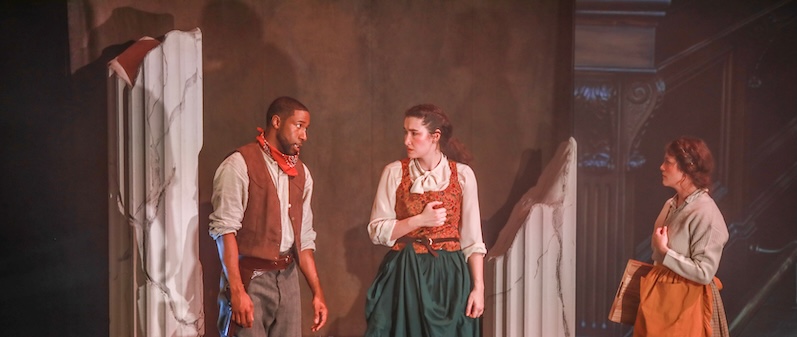
Corey Dorris, Vivianna McCormick and Avery Norris (Photo by Jim Cox)
Reviewed by Martín Hernández
El Portal Theatre
Through Oct. 17
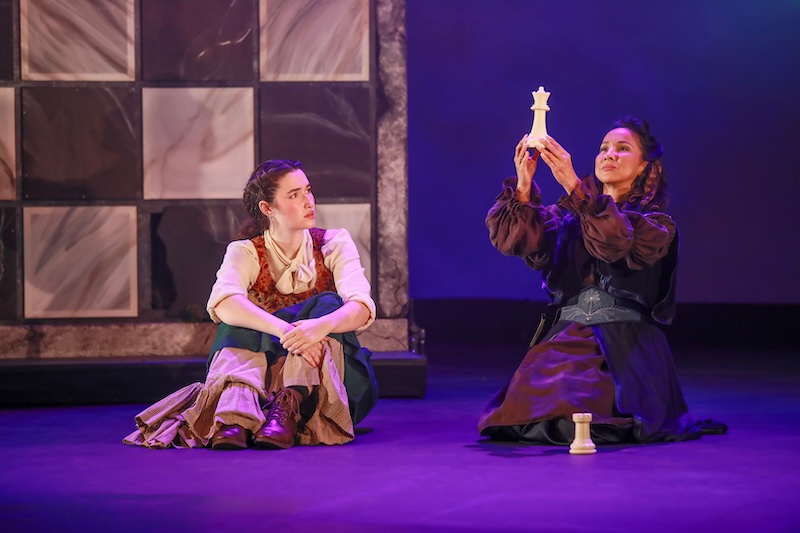
April Nixon and Carolina Hoyos (Photo by Jim Cox)
In Crone Creed, an order of supernatural female sentinels known as the Crone has been monitoring humanity since time immemorial to ensure it does good. Armed with oversized chess pieces ranging in magical powers, these semi-immortals protect their anointed charges from the Fallen, humans who reject the Crone and whose insatiable lust for power lead them to enthusiastically grasp the role of oppressors over the millennia.
Playwrights John Epstein, Casey Morgan, and T. Theresa Scarano craft an epic fantasy that plays more like a movie – the finale even bodes potential for a sequel – than a theater piece. Composer Brandon Moore’s overbearing, recorded score, Daniel B. Chapman’s mostly AI-generated video and photo projections, and Eliseo Aragon’s impressive lighting design ofttimes reflect a magical universe. The dependence on tech, however, is insufficient to compensate for a puzzling plotline, underdeveloped characters, and a heavily expository text under Marc Morgenstern’s direction of Theater4All’s inaugural production.
Following a bloody battle in medieval Europe, Reika (Jacquelyn Ritz) reveals a treasonous secret to her Crone sisters Roya (April Nixon) and Dara (Carolina Hoyos), with Roya’s punishment of Reika causing severe consequences. Decades later, poverty wrought from Reika’s offense leads her ambitious and bitter son, Yanni (Ben Ubiñas) to ally with the Church and nobility to raise him from his peasant status. Yanni’s sister Vita (Vivianna McCormick) tries to convince Yanni that his new “friends” are exploiting him, while sister Tessca (Avery Norris) eschews her siblings and embraces religion as a way to gain redemption. Yanni and Vita discover chess pieces that Reika hid from them and use them to battle each other across the ages.
Then comes a time jump to the US circa1836. Vita enlists the aid of Wiley (Corey Dorris), a local cowboy, to wrest control of a church dominated by black-clad “priest” Yanni, whose brainwashed parishioners do his unseemly bidding. Tessca turns up as a barmaid who aids her sister. Tessca is also hiding a secret that is revealed when the siblings are transported to 1956. Yanni now owns a farm where Vita, Tessca, and Dara toil in slave-like and sexually exploitive conditions with their fellow farmworkers, who now look to Vita for their salvation.
The projected AI images and recordings bring a hollow and robotic contradiction to what is supposedly a humanizing story extolling the liberation of the oppressed from their oppressor. (This is especially true given how AI poses a threat to actors and designers overall.) These images and recordings are also problematic in other ways. One AI video includes a clip of Native American men stereotypically dancing in generic buckskin and feathered headdress. Also, while zooming out on a still image of a 19th century stone house, an automobile is revealed on an adjacent driveway.
Given the lack of character development, performers do well with the material they are given, even with the one-note deliveries. Roya’s semi-narration and New Age-tinged deciphering of the Crone philosophy help steer the story but does do not explain confounding plot points. For example, despite allusions to the father of Reika’s children, we know nothing of who he was. And there are unanswered questions. For example, what is significant about the years 1836 and 1954 in U.S. history? And where in the U.S. do these events take place or is all this repression meant to be symbolic of the the nation as a whole?
Epstein, Morgan, and Scarano also focus on the need for an individual savior, a Chosen One, rather than calling for a collective liberation movement to challenge repression. This is evidenced by Vita being told at one point “you have sparked hope in the people,” or Yanni’s declaration, “I was meant for something greater,” it is easy to see the danger an ego-driven cult of personality, on the Left or Right, can pose to a people-driven social movement.
Theatre4all, El Portal Theatre, 5269 Lankershim Blvd, N. Hollywood.; Fri.-Sun., 7:30 pm, Sat.-Sun., 1:30 pm; thru Oct. 17. https://ci.ovationtix.com/371/production/1285555 Runtime: two hours with a 15 minute intermission.