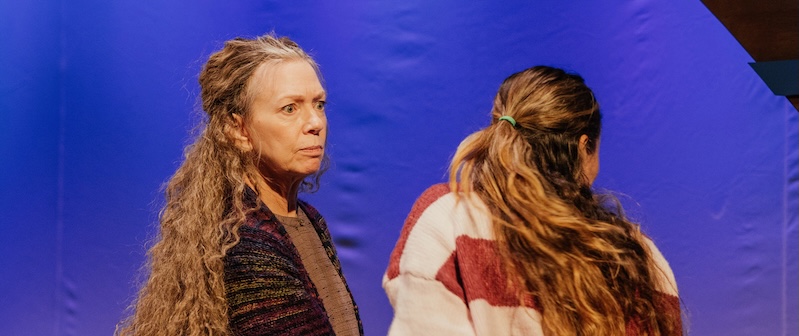
Rachel Sorsa and Caitlin Zambito (Photo by Jeff Lorch)
Reviewed by Deborah Klugman
Rogue Machine Theatre at the Matrix Theatre
Through November 15
RECOMMENDED
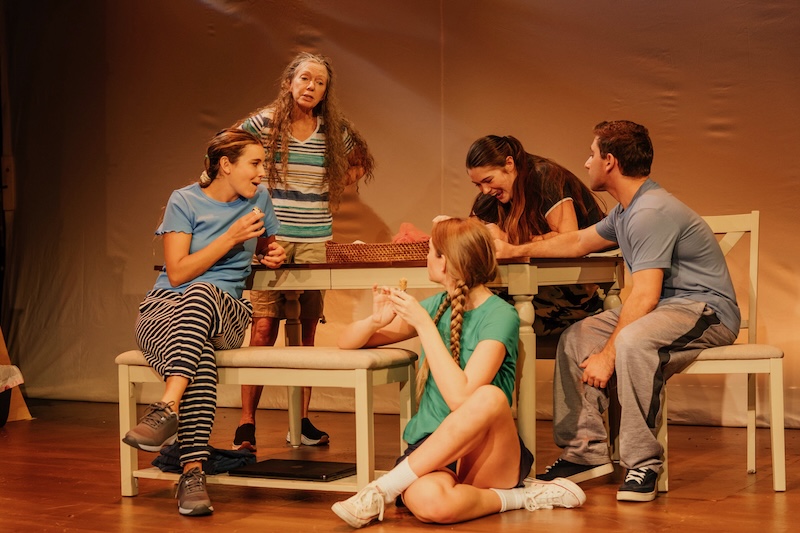
Caitlin Zambito, Rachel Sorsa, Meg Cain, Cordelia Leigh, and Zack Rocklin-Waltch. (Photo by Jeff Lorch)
What is the opposite of a cult?” asks one character of the audience near the end Joy Gregory’s most excellent premiering play, which is staged with commensurate skill and grace by director Lina Patel and an on-point ensemble. That question, posed by an academic researcher who hovers at the margin of the story, goes to the heart of its message, here rendered not through a dialectic but through characters that embody the remarkable contradictions and complexities of being human.
While the details may be fictional, the core plot is based on a real story circa 2011 — that of Megan Phelps, the granddaughter of Fred Phelps who founded the Westboro Baptist Church, a hyper-Calvinist Christian sect most famous for their hateful anti-gay and antisemitic views, and even more egregiously for their belief that tragic happenings like AIDS and 9/11, are judgments visited upon our nation by a wrathful God, incensed at our mortal sins and transgressions.
Thus it is that when we first meet Megan (Caitlin Zambito), she and her family — her mother Shirley (Rachel Sorsa) and her sisters Bekah (Cordelia Leigh) and Grace (Meg Cain) — are staging a demonstration in proximity to the funeral of young soldiers who have died in Iraq and Afghanistan. The women’s sport T-shirts with slogans like “God Hates Fags” while they hurl vicious prophesies of damnation at the mourners and proclaim with conviction that the deaths of these young people should be understood as divine retribution. There’s positive glee in their words and their body language; all three of the younger women are filled with exuberant energy — they dance wildly (choreography by Emmy Frevele) and gush between themselves like normal teenagers do, in sharp contrast to the toxic hate they spew at others.
All three girls — but Megan in particular — are influenced by their mother, a religious fanatic to the core, swift to discipline her children when they contradict her, but also as lovingly demonstrative as any caring mother, brushing her daughter’s hair with affection and teaching them to bake goodies in a family tradition. No tradwife, Mom Shirley is also an attorney, who fights in court for the right of members of her sect to freely voice hate under the First Amendment.
Things begin to change for Megan when she goes on Twitter and encounters Chad (Zack Rocklin-Waltch), a young progressive with the ability to challenge opposing points of view with equanimity, even those toxic ones espoused by Megan’s church. Chad engages in a back-and-forth chat with Megan, whom he’s fascinated by at the expense of his day-to-day live-in girlfriend (Shannon Lee Clair), who finds him disturbingly distracted. In their talks, Chad refutes Megan’s theological certainties based on passages from Leviticus with other passages plucked from the same Biblical source. Very gradually, she comes to see that there may indeed be another way of looking at the world than the one she’s been brought up to accept.
Megan’s journey to a new truth is the spine of the play but it’s the broader, dramatic landscape, the venture into the inner lives of cult members and the illumination of their common humanity with others, that make the story as compelling as it is. That and Patel’s direction, which delivers spot-on performances from everyone — although it is Sorsa’s unyielding matriarch that proves most fascinating and delivers the show’s powerful catharsis.
The tech elements add to the experience of a spare yet vivid drama: Amanda Knehans’s scenic design serves up a split backdrop — airy and plain as the background for Megan and her family, a paneled interior for Chad, appropriate to the world of a secular person. Christine Cover Ferro’s bright costumes underscore the youth of Megan and her siblings and the rough readiness of their combative mother. At times the play harks back to another era, which is when lighting designer Azra King-Abadt flooding of the stage with indigo hues is so effective.
One other detail bears mention, having to do with the framing of this contemporary story with reference to the Shakers, a religious group that developed in 18 century England and was exported to the States where it came under the leadership of a charismatic woman, Ann Lee. Lee’s history is relayed to us by the same character, an academic researcher (Clair) who, near the end, asks of the audience, “What is a cult?’ — and who goes on to point out the differences between the Shakers back then and the Calvinist Christians of today, for whom misogyny and repression are the norm. It’s a riveting contrast, but it leaves out a key detail — the Shakers’ conviction that celibacy is the way to go, and the incompatibility of that belief with an enduring legacy. Today, only three professed Shakers remain.
Rogue Machine at the Matrix Theatre, 7657 Melrose Ave., West Hollywood. Opens Sat., Oct. 10; Fri.-Sat., 8 pm, Sun., 2 pm, Mon., 8 pm; thru Nov. 15. www.roguemachinetheatre.org Runtime: approximately 80 minutes with no intermission.