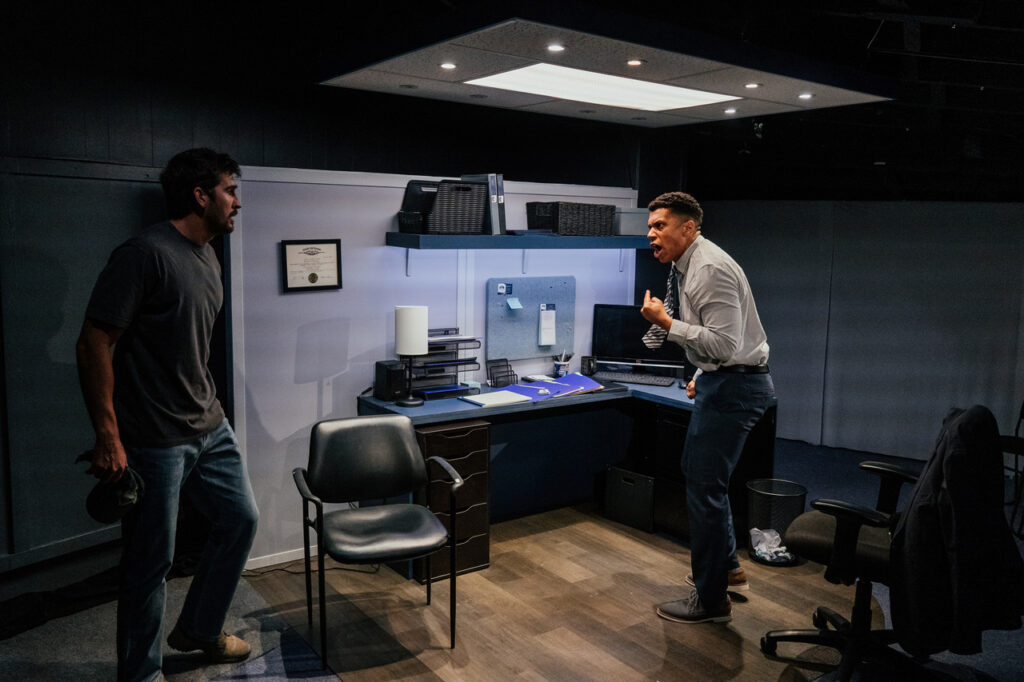
Carlo Mancasola and Nicholas Anthony Reid (Photo by Jeff Lorch)
Reviewed by Kayden J. Merritt
Rogue Machine Theatre
Extended Through Nov. 21st
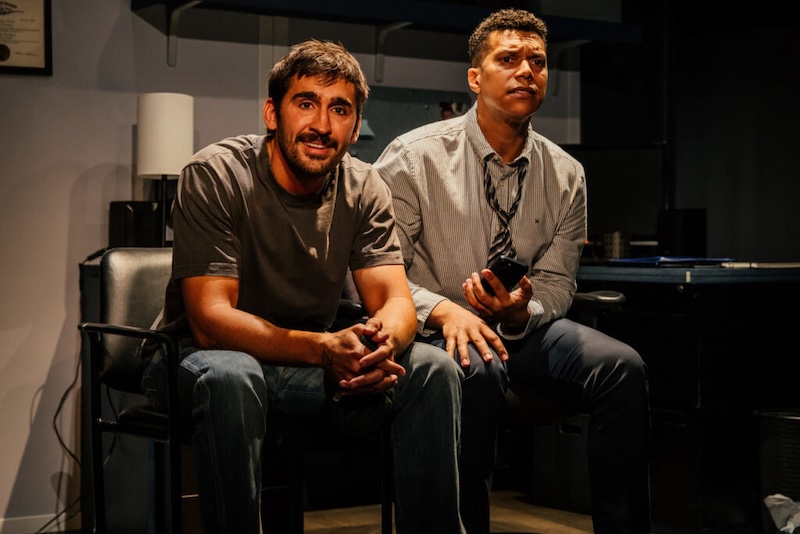
Carlo Mancasola and Nicholas Anthony Reid (Photo by Jeff Lorch)
This review is part of the Stage Raw/Unusual Suspects Youth Journalism Program
Rogue Machine’s A Case for the Existence of God makes a striking impression as the audience funnels into the intimate 30-seat Henry Murrow Stage upstairs at The Matrix. An office cubicle of Twin Falls Heritage Firm is transformed into limbo through the hypnotic drones of Christopher Moscatiello’s sound design.
Meet Ryan (Carlo Mancasola), a yogurt plant worker determined to reclaim a piece of his family’s lost land, and Keith (played by Nicholas Anthony Reid), a mortgage broker raising his foster daughter alone. When Ryan asks Keith to help him secure a mortgage for a small plot of land, an unlikely friendship sparks between the two as they share their anxieties of fatherhood. However, when systemic interventions threaten each father’s relationship to their daughters, deep-seated resentments & jealousies between the pair reveal themselves.
Playwright Samuel D. Hunter paints a wonderfully rich world for Keith and Ryan,and keeps us invested in their crumbling lives offstage. While the dialogue occasionally falls into some frustrating clichés, it is balanced against hauntingly beautiful revelations from both characters. During a particularly harrowing moment, Ryan exclaims, “We have to believe that it won’t happen. We have to believe that, like, things still make sense.” No doubt this sentiment is felt by many Americans in our current economic climate, and this line exemplifies one of many moments that A Case for the Existence of God strikes hard at the wounds of American culture.
Stephanie Kerley Schwartz’s scenic design is contained but effective in creating a detail-rich environment. The lighting design by Ric Zimmerman is a standout, with a variety of stark tones and unique light sources capturing the distinct emotional atmospheres of each setting. John Perrin Flynn’s direction captures the shifting tides of the central relationship well, but struggles to contend with the limitations of the space when scenes were framed “outside” of the central cubicle, making the occasional scene in a park or at Keith’s house feel ungrounded.
The performances are well constructed, with Carlo Mancasola’s quiet inner turmoil as Ryan being a particular standout. Nicholas Anthony Reid captures the contained anxiety of Keith, but at times his heightened volume and energy overwhelms the intimacy of the space. Both actors are at their best during a prolonged drinking scene, where their intoxication forces them to open up about their inner worlds. In moments where the performers and production elements fully engage with the intimacy of the space, the beauty of Hunter’s writing soars.
Ultimately, Samuel D. Hunter and Rogue Machine successfully pose pertinent questions about hope in an age of American destitution. However, with the occasional hiccups in the writing and direction, the jury’s still out on the final verdict.
Rogue Machine at the Matrix Theatre, upstage on the Henry Murray Stage, 7657 Melrose Ave, Hollywood; Fri. and Mon., 8 pm, Sat.-Sun., 5 pm; thru Nov. 21. https://roguemachine.ludus.com Running time: 90 minutes, no intermission