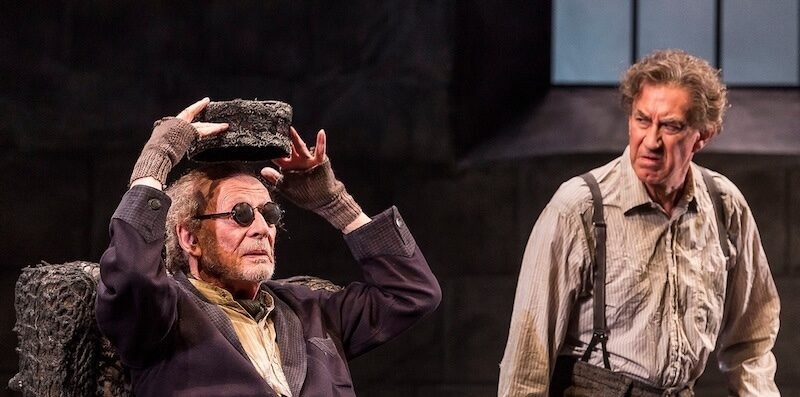
Alan Mandell and Barry McGovern in “Endgame” at the Kirk Douglas Theatre (Photo by Craig Schwartz)
Alan Mandell: 1927-2026
The Absurdists’ Best Agent
 Alan Mandell died Tuesday at the age of 98.
This is a monumental passing — of a stage actor, director, theater administrator, philanthropist, afficionado of modern art and sculpture (which adorned his two most recent Westside homes), a lover of poetry and a supporter of poets. Growing up in Toronto during the Great Depression, and coming of age in New York and San Francisco, he made Los Angeles his home. In many ways, he was a magnet for this city, and for its theater. He came to embody it, or at least a quadrant of it.
His work as general manager of the Lincoln Center, and as an actor and business manager with Julius Irving and Herbert Blau at the San Francisco Actors’ Workshop — this is all now the stuff of theater lore, as is his association with Rick Cluchy and the San Quentin Drama Workshop, which the pair co-founded. In Samuel Beckett’s Waiting for Godot, Alan spoke of playing the slave Lucky (“All he wants is some encouragement.”), and of bringing the play to San Quentin in a performance for prisoners who were a rapturously appreciative audience for the absurdist comedy, with its wit and metaphysical cruelty. It had a far tougher launch among the middle- and high-brow audiences of Paris and London, Dublin and Miami, who were polarized, bewildered and hostile. (Being locked up in a prison cell fast-tracks insight into how “civilization” really works.)
Alan was not a scholar, but he had an intuitive connection to the absurdist writers of the 1950s and 1960, forging personal friendships with Samuel Beckett and Harold Pinter.
The value of a person, however, may lie less in accomplishments, which dissipate into the ether over time — almost, though not entirely, regardless of fame — as with the support, the nourishment, the love, offered to people and communities. Such support, nourishment, and love, does not dissipate. It is remembered by the recipients with gratitude, and passed along to new generations as a matter of habit. (That is also how civilization works.)
Such were the gifts that Alan offered to countless playwrights, performers, and institutions. He was fiercely dedicated to helping playwright Mayo Simon get his works produced. He was similarly dedicated to writers such as Robert Harders and directors such as Reza Abdoh, whose expressionist performances were, by design, harrowing assaults on the nerves. Alan appeared to be genteel, in the manner of Sir Alex Guinness, but beneath that veneer lay a rebel toying with nihilism.
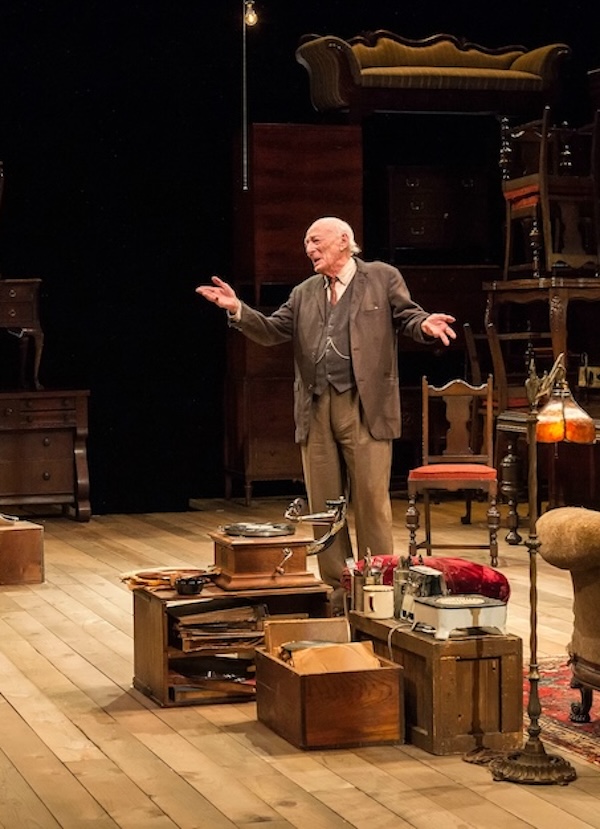
Alan Mandell in “The Price” at the Mark Taper Forum (Photo by Craig Schwartz)
Alan was an actor, often self-focused, meticulous in the pursuit of embodying a role, as he showed onstage as a wily Jewish antiques dealer in Arthur Miller’s The Price at the Mark Taper Forum. (He relished trying on a Yiddish dialect at any time and for no reason, as though that voice somehow took him home to his Toronto childhood.)
He was no less fastidious as a director, which I saw for myself as his assistant at Bill Bushnell and Diane White’s Los Angeles Theatre Center, where he worked as “consultant director.” The productions I observed and assisted were Beckett’s Happy Days, starring Barbara Baine, and Pinter’s The Birthday Party.
That fastidiousness came on full bore when he directed my own play, Beachwood Drive, Off-Broadway at New York’s Abingdon Theatre. The play centered on the conundrum of a Ukrainian prostitute, played by my Russian wife, Lena Starostina. She had done the role in Los Angeles, and in a tour of four Polish cities by Playwrights’ Arena, all to some acclaim, but her performance didn’t hit the stratosphere until Alan worked with her. English was not her native tongue, and she had extensive soliloquies, in English, and hair-trigger repartee with other actors. Keep in mind, she had been trained at the Moscow Art Theatre; she was no slouch. But Alan’s brow remained furrowed for much of the rehearsals with her. He broke down every beat in her every line, had her read her role in slow motion, to capture every transition and the reason for every transition before he permitted her to continue. At 1 a.m. during one special session with just her, she simply broke down in tears saying she can’t do this, she’s not good enough.
“My dear,” he intoned in a soft but thundering pitch. “You will do this, because when you do this, you will be great in this.” And so, the rehearsal continued for another hour.
All of the actors got fine reviews, but of her performance, the New York Times wrote:
“Ms. Starostina, a graduate of the Moscow Art Theater Institute, is particularly good as Nadya. With her bad dye job and real-life body (she bravely wears short shorts at one point), she’s just the right mix of beautiful and faded. And her stillness sets her apart: at times it reads as fierce self-possession, at others like a consuming loneliness.”
This was Alan’s doing; she knew it, she said it.
A few years later, the New York Theatre Workshop presented a reading of a different play I’d written. I was a bit mystified by how this came to pass, as I knew so few people in New York, and the place is so fiercely competitive. So I asked them.
“It was Alan Mandell,” the administrator said.
When I spoke with him by phone about this time last year, he was quite proud that he was about to turn 98. I said I must visit.
“You can visit when I turn 100,” he replied.
“So you’re giving me a two-year reprieve?”
“Well . . . he said. “You deserve it.”
Such was the nimbleness of his wit.
Alan was many people rolled into one. He could be impish, playful, wry, exuberant, dismissive, patronizing, and he could lift you up, as though from the bottom of the ocean, and make you welcome and valued. And he did this a lot. He was fiercely professional, and exceedingly kind.
“The passing of an era” is such a platitude. But with this man’s passing it holds a core truth. As a community, we’re just a little bit smaller than we were last week.