
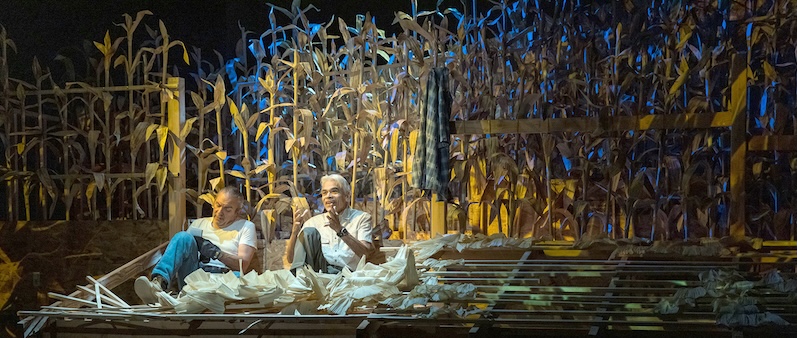

Geoffrey Rivas and Sal Lopez (Photo by Grettel Cortes Photography)
Reviewed by Deborah Klugman
Latino Theater Company
Through November 15
RECOMMENDED
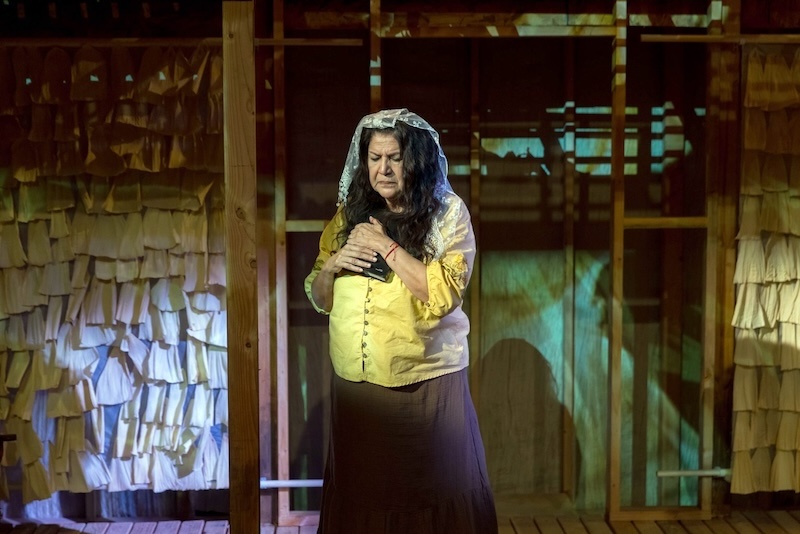
Evelina Fernández (Photo by Grettel Cortes Photography)
What’s the despair quotient for someone who’s lived a “pretend” life, who’s hewed to the idea of a vocation but not the vocation itself? Or the measure of despondency for a religious devotee who sees the walled-off world they’ve constructed for themselves and the values they’ve always honored dissolve, metaphorically speaking, to dust.
These themes predominate in playwright Luis Alfaro’s Speaking in Tongues, his witty poignant new dramedy premiering at the Latino Theater Company and centering on a tiny congregation of Pentecostal churchgoers in impoverished Tulare County in Central California. Dramedy may be too blithe a descriptive, for as much as this play entertains, it also comes with an unmistakable dollop of sadness as it lovingly ruminates on the choices, or non-choices, that people make in their lives.
Alfaro spun this story from a portion of Mexican American history, namely the spread of Pentecostal and Apostolic churches in central California (his place of growing up) in the early decades of the 20th century. The teachings of these denominations — including the omnipresence of the holy spirit and a person’s path to salvation through faith — brought solace to penurious Mexican-American workers whose long, back breaking days in the fields with few rewards made for a harsh existence. But things change — we learn later in the play that attendance is not what it was, as young people become alienated from the conservative screed of their elders and other folks simply drift away, absorbed into the consumerist universe of modern day.
Directed by José Luis Valenzuela, the production begins with a Pentecostal hymn (Esperanza America, in a beautiful lilting vocal) while another woman, a troubled Hermana Romie (Evelina Fernandez) — prays hard to her Lord and Savior. The scene then segues to daytime, where we meet Hermano Mando (Sal Lopez), a man in late middle age still reeling from the decision of his longtime spouse to divorce him over his purchase of a brand new Ford Mustang with their lifetime of mutual savings. Mando confides his woes and other concerns to his lifelong friend and fellow congregant Hermano Tico (Geoffrey Rivas), perhaps the most stable and sensible of the four elder church members, with a sly quip and a scriptural quote always at the ready. His divorce aside, Hermano Mando’s most pressing concern is the disappearance of the church’s pastor, whom he insinuates may have been murdered by his wife. This turns out to be Hermana Romie — who at that moment is roaming the nearby cornfields with a heavy step and, it appears, a heavier heart.
In contrast to the weighty matter of a missing pastor is the issue of food preparation for an upcoming event. It seems there’s a surfeit of potato salad and no chicken wings, a situation deeply upsetting to Hermana Cubby (Lucy Rodriguez), a literal inferno of self-righteousness who takes perverse pleasure in pointing out the sins of others. Possessed of a whiplashing tongue and an unforgiving heart, she even calls to judgment a hermana in her 90s who’s failed to show up for the preparation of tamales.
The play’s fifth character, Sister Tiri (America) is Hermana Romie and the pastor’s daughter, who, in signs of the future, makes known that her days as a churchgoer will soon end. It isn’t Tiri, however, whose rebuff of Pentecostal values is most searing, but that of her mother, whose secrets gush forth just short of the play’s end.
As is typical of this director’s work, the production is best savored as a panorama, with sound, visuals, projections and set design as startling and vital to the story as any performance. Prairie T. Trivuth scenic design is a two tiered affair — the bottom tier is a rudimentary dwelling, the communal meeting place of the congregants, while above is the evocation of a cornfield, filled with tall yellowing stalks, where Romie and Tiri are seen to wander. In nighttime sequences, the set is bathed in reds or blues and greens (lighting design by Xinyuan Li) with images of fireflies or butterflies (designer Yee Eun Nam), and the commensurate, almost musical, sound of insect and animal life (Robert J. Revell). All this translates into an understanding of this particular place on earth — one that, cosmically speaking, might be considered the middle of nowhere, but for these characters is the place where they have made their home.
As to the performances, they serve the story well, succeeding in making us laugh or cry, as needed.
In the end, it’s the playwright’s vision that’s most arresting, the affection with which he’s drawn his characters — simple modest folk whose way of life soon will vanish in a maelstrom of change.
The Latino Theater Company at LATC, 514 S. Spring St., downtown LA. Thurs.-Sat., 8 pm, Sun., 2 pm; thru Nov. 15. https://www.latinotheaterco.org/ Runtime: approximately 75 minutes.