
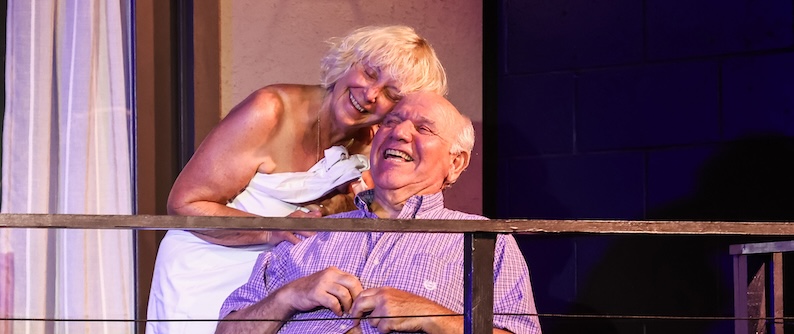
Katherine James and Alan Blumenfeld (Photo by John Dlugolecki)
Reviewed by Deborah Klugman
Open Fist Theatre Company at Atwater Village Theatre
Through December 19
RECOMMENDED
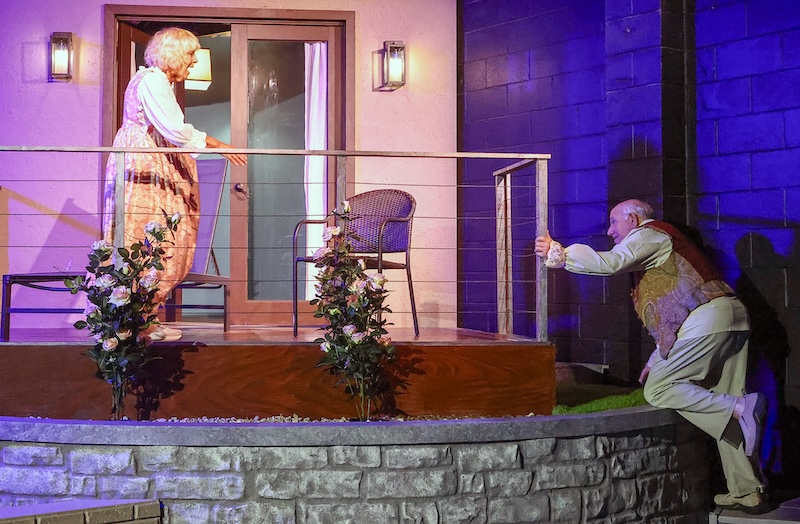
Katherine James and Alan Blumenfeld (Photo by John Dlugolecki)
In Romeo and Juliet: Time Enough for Love, conceived and directed by Christian Lebano, the celebrated star-crossed lovers are no longer teenagers living in 16th century Verona but senior citizens residing in a assisted living facility in Miami. The narrative — which transplants a Renaissance tale, with its stern patriarchal values of family and honor, to a modern day American retirement home, isn’t easy to buy into. Yet, tragic catharsis notwithstanding, the show is entertaining, with many fine performances and plenty of humor — some of it intended, some not. And if the main point of the play is that true love isn’t just for kids, well, it’s a point very well-made.
While Shakespeare’s language (with modifications) has been preserved, most everything else has been altered. Romeo (Alan Blumenfeld) isn’t lithe and dashing; he’s roundish and dorky and has serious problems scaling the balcony. His Juliet (Katherine James), whom he’s positively mad about, is a guileless 70-something gamin with the heart and soul of a sweet 16-year-old. The relatives obstructing their romance are not their parents but their children — primarily Juliet’s domineering son (Sam Cowan) and his slinky, condescending wife (Natalia Jofre). The Nurse (Emma Fassler), Juliet’s personal caretaker, is trim and lively and a bit ditzy while Juliet’s hot-tempered cousin Tybalt (a formidable Barbara Schofield) is an elderly matriarch who brandishes her cane with pointed homicidal intent.
The story is set in July, 2026 and opens in a community room in Verona Manor, a nicely appointed interior (scenic design by Destiny Kast and Lebano) resembling the foyer of an upscale retirement facility where, in the real world, you might find the sort of upper-middle class Americans able to afford the exorbitant monthly fee. At the top of the play there’s a fencing bout performed by members of the community in modern dress, enacted for an audience of their peers. A little later comes a full scale masquerade ball, with music (composer Sean Paxton) and dancing (choreographer Melissa Schade) and eye-arresting Renaissance costumes (Vicki Conrad) — all well executed but seeming rather odd given its contrast to the contemporary community room décor.
The primary bad guy is Cowan’s Capulet, and Cowan does a great job projecting this chilly, unlikable guy who is 100% certain of his privilege and his right to exercise his will over his family — yet who still exhibits a filial tenderness for his mother. The attractive Jofre is highly watchable as his flirty appearance-conscious wife (great costuming again by Conrad) smiling perkily as she complicitly maneuvers to annihilate Juliet’s spirit.
On the opposite side of the moral fence, James Fowler delivers a strong, well-grounded Friar Lawrence, the facility’s resident chaplain who does all he can to bring the lovers together. Fassler’s nurse, who clearly cares dearly for her mistress, is a charmer. Hutchins Foster steals the spotlight as the bawdy, garrulous and rather unpleasantly churlish Mercutio; the scenes where Romeo gets together with his best buds Mercutio and Benvolio (Stephen Rockwell) are apt simulations of jocular male bonding.
Even the sequences involving the staff of the facility, who have a few or no lines of dialogue, are artfully realized, testimony to the “there are no small parts, only small actors” principle of performance. Credit each of these performers and Lebano’s direction.
But the best raison d’être for seeing this production is the love story itself and the delightful performances that make it happen. Not exactly the sharpest tool in the shed, this Romeo is both laughable and lovable in his earnestness. And you can see why he’s smitten: James’s Juliet is one of those sweet lovely women whose spirit doesn’t age — even as she bears the brunt of society’s unjust prescriptive for women. While Romeo runs around as he wishes, she remains confined, subject to the whims of her dictatorial son, who is demanding that she marry Paris (Paul Ganus), and dismissing her protests.
Which brings us to perhaps the production’s weakest link: it’s never clear why the Capulets would want this wedding between a biologically elderly woman and a suitor who, actually, appears younger than she. Why? Are the family fortunes imperiled? Nothing is said about it. Would there be a child to carry on the family name? No, there would not. Yes, in Renaissance or Elizabeth times, when upper class marriages were forged as alliances and young daughters were bargaining tools for the advancement of a family, of course the story worked (and Shakespeare was at least in part casting a light on the danger and cruelty of the custom). But transposing this conflict to an elderly community in Miami makes for an awkward fit that’s hard to dismiss as you weigh whether or not to take it seriously. Fortunately, the on-stage talent makes the time spent deliberating on it worth one’s while.
Open Fist Theatre Company, Atwater Village Theatre, 3269 Casitas Ave., Atwater. Thurs.-Sat., 7:30 pm, Sat., 4 pm, Sun., 2 pm, Mon., 7: 30 pm; thru Dec. 19. https://openfist.org/ Runtime: two hours and 45 minutes with an intermission.