The Conundrum of Matt Schatz’s “Bobby Robotowitz”
When an AI Chatbox Traffics in Human Connection
By Caitlin Durkin
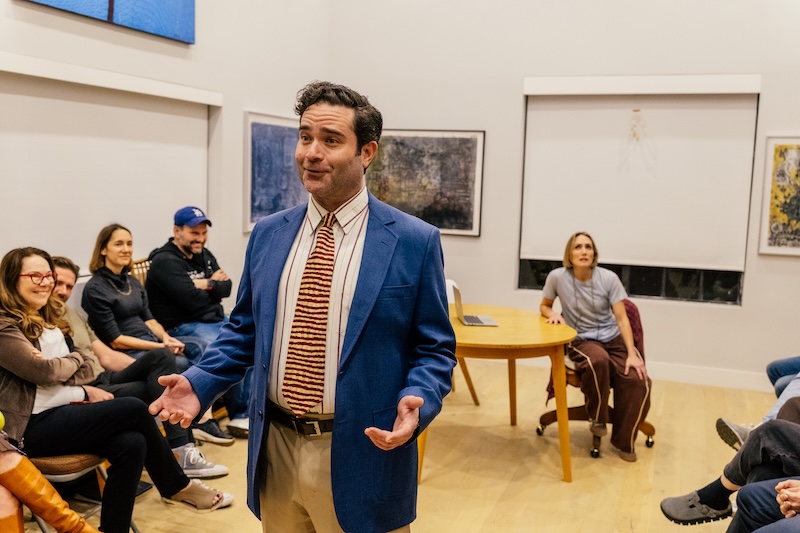
James Luster and Amy Rosoff (Photo by Jeff Lorch)
This article is part of the Stage Raw/Unusual Suspects Youth Journalism Program
We are all wrestling with the difficult questions that have emerged with the meteoric rise of AI, and new works are reflecting that existentialism. In theater spaces that celebrate the very antithesis of AI—live, human connection—are audiences too fatigued for plays about artificial intelligence? Bobby Robotowitz by Matt Schatz is currently running at IAMA Theater in association with InHouse Theater as part of the National New Play Network’s rolling world premiere. The play follows Dina Katzman (Amy Rosoff) as she develops a relationship with an AI chatbot, personified as “Bobby” (James Luster). Dina, a writer, begins using the chatbot for innocent little grammar questions. Through snippy vignettes we see time pass as Dina experiments with their interactions: she names him, asks him personal questions, seeks out parenting advice, confides in him about her personal life, and, most dramatically, uploads her writing to him.
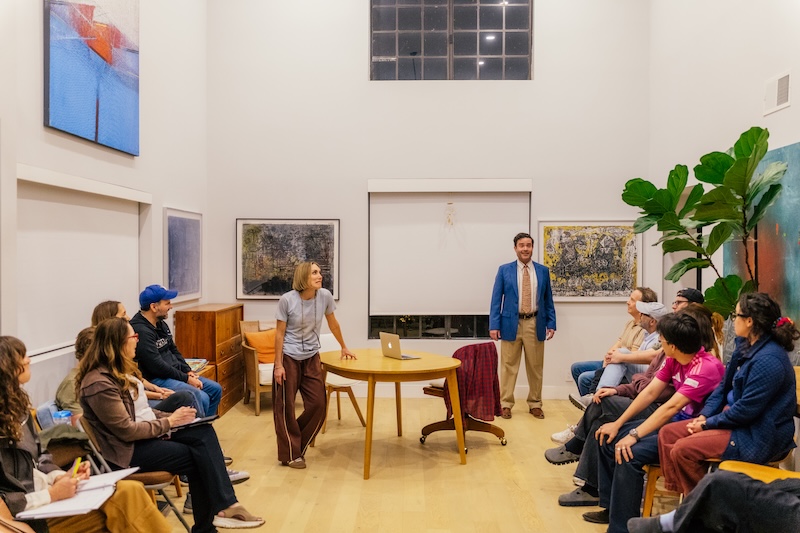
The setting of this play is, well, no setting, because in the world of the play everything the audience is hearing is actually typed-out messages. A two-hander where one character cannot speak unless spoken to in this way is demanding, but Amy Rosoff leads the play with expertise. Casey Stangl skillfully directs the piece, creating movement for the actors around the small space and illustrating the characters’ emotional closeness through physical closeness. However, the absence of eye contact craftily maintains Dani and Bobby’s cross-species disconnect. The production is site-specific, meaning that three days before the performance an email arrived in my inbox with the address of an apartment building on the westside. IAMA’s collaboration with InHouse Theater, an LA theater company that performs works in non-traditional spaces, was the inspiration for this choice. The production further emphasizes the site-specificity of their production by having two separate casts for the westside and eastside locations, each cast running for three weekends. However, beyond some potential intention to show that this is happening in many houses to many people, the double casting seems insignificant to the site-specificity of IAMA and InHouse’s collaboration. The play itself is not written to be site-specific. This production is the first stop of the rolling world premiere and the other theaters—in DC, Pennsylvania, New Jersey, and Florida—will perform on traditional stages. Sitting in the thrust in an eclectic mix of chairs, seemingly collected from around the home, the audience was incredibly intimate with one another and the performance. The design was humble, with the set consisting of a desk with a laptop and two chairs and the lighting relying on the apartment’s light fixtures, to emphasize that the audience was sitting in somebody’s real home to watch a play taking place in somebody’s home (scenic/props/lighting design by Justin Huen).
While much recent art has explored questions about the AI boom, Bobby Robotowitz makes a delightfully new contribution to the conversation by showing how the imperceptible slide into dependence leaves us little time to question whether we trust chatbots. The free and readily available artificial intelligence chatbots are now at a level of sophistication that humans, frighteningly, interact with AI as if it were also a human. Schatz stresses this point, not only by having Dani name her chatbot Bobby, but by literally personifying the chatbot as a character for an actor to play. Dina uses Bobby simultaneously as a thing that does tasks for her and as a close confidant with whom she shares her thoughts and feelings. As the AI industry becomes persistently more prevalent, these issues of blurred boundaries between what is human and what is not have escalated.
Schatz cleverly uses his play to expose AI sycophancy—large language models’ tendency to agree with users through statistical pattern matching. Because we expect our interactions with AI to be like those with humans, Bobby’s positive reinforcement leads Dina to trust, depend, and admire him. Many have warned of the dangers of AI distorting reality, but Bobby Robotowitz explores the human feeling of being lied to. We want to believe that there is sincerity behind people’s words and opinions, so Schatz’ plot asks if humans will accept consonance and connection from an AI without the assurance that it truly means what it says. And, yes, humans lie to each other all the time, but there’s no hard and fast way for us to prove that we were lied to by a human like we can with an AI chatbot. The proof of the deception is what really hurts.
Amy Rosoff and James Luster (Photo by Jeff Lorch)
Right now it is very human to turn to AI, become reliant, and exist in a digital one-person echo chamber. What then is the purpose of the prevalence of these AI plays? Are they morality plays? Warnings? Reflections? The rush to make art about the current problems we are facing of course makes sense. In the world of theater, however, this moment comes with unprecedented questions about what it means to have humans play non-humans. In Bobby Robotowitz, a play warning about AI’s erosion of human connection, it feels poignant that an actor must suppress their humanity to play a personified chatbot. Just six years ago theater circles questioned the inverse, as the pandemic forced theater to be experienced digitally and asynchronously—but the root of all these questions remains how we define “live” as human experience becomes more entwined with technology. As artificial intelligence use in the film industry has risen, some have made the case that live theater will have a renaissance because it is an art form where you can verify with your own eyes that what is before you is not artificial. But if theater is our last artistic refuge from AI, perhaps audiences will no longer tolerate plays so centered on the topic, much in the way that coronavirus stories have not been stomached. Art, of course, can be used as a mirror with which to reflect our society, but perhaps Covid-19 showed us that when things get too existential audiences want art to be their form of escape. Creating and watching human stories might be the exact remedy we are looking for right now.
At a moment when AI already saturates our daily lives, perhaps the theater should cease to reflect this crisis of humanity back at audiences. Rather, live theater has the opportunity to offer something artificial intelligence cannot: the irreducibly human experience of being in a room together. Nonetheless, Bobby Robotowitz is a timely new work that explores the peculiar feelings of betrayal between a human and a chatbot, which is made more intimate and human in IAMA and InHouse Theatre’s site-specific production.
The westside cast (Amy Rosoff, James Luster) has now closed. The eastside cast (Erin Alexis, Drew Rausch) is running through November 23.
IAMA Theatre Company and InHouse Theater at various locations; through Nov 23. https://www.iamatheatre.com/