
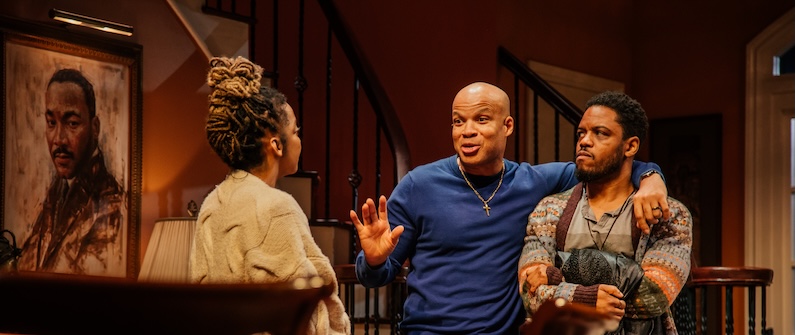
Kara Young, Glenn Davis and Jon Michael Hill (Photo by Jeff Lorch)
Reviewed by Steven Leigh Morris
Geffen Playhouse
Through Dec. 20
RECOMMENDED
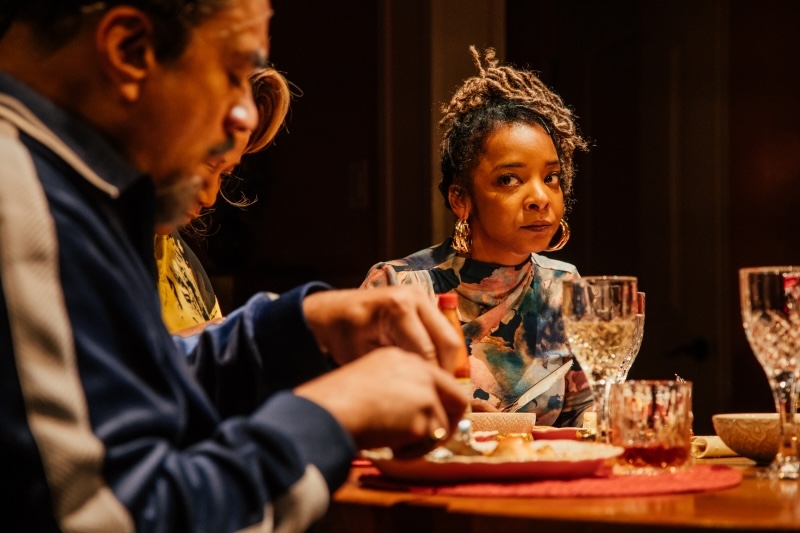
Harry Lennix, Alana Arenas and Kara Young (Photo by Jeff Lorch)
If one were to be grumpy, there’s an argument to be made that local regional theaters, such as the Geffen Playhouse, should be employing local actors rather than packing Broadway casts onto a FedEx truck and shipping them west. Supporting local talent, which is exceedingly talented, has been a stated priority by leadership at the Geffen. And yet the cast of the currently playing Geffen production of Branden Jacobs-Jenkins’s play, Purpose, is almost entirely imported from the Broadway/Steppenwolf Theatre Company’s earlier rendition. The only exceptions are four understudy roles, which are cast locally.
The rebuttal to this complaint, if it’s a complaint, is that every theater has the right, if not the responsibility, to employ the best cast possible, that the pursuit of excellence overrules the pursuit of employment opportunities for local thespians. There are times when a social justice ideology needs to take a back seat to the higher purposes of art.
But how do you know if you don’t try? If you don’t look? Can a theater not be a servant of two masters?
The conundrum in all this is that this New York cast is tried and tested. Why meddle with perfection, and perfection this is. From Jacobs-Jenkins’s play to Phylicia Rashad’s masterful staging of it.
Purpose is cut from an American classical cloth: Think Arthur Miller’s Death of a Salesman and August Wilson’s Fences. Prodigal sons return to a patriarch, living or dead, in plays that challenge the values of men on both sides of a generational divide, while cutting deep swaths of insight into the motives and characters of the women in these families.
Arthur Miller’s Willy Loman is traveling salesman, cursed by loneliness on the road and by an elder son who comes to realize that the American Dream of equal opportunity, in which his father was so invested, is a mirage. (It took until the mid-term election of 2026 for the veracity of that view to fully land with American voters, though the nation’s African American community has known for this for centuries and has pressed the case to a larger society that’s been either indifferent or shown some measure of intransience grappling with ground-level inequalities.)
This brings us to Troy Maxson in Wilson’s Fences, a former baseball star in the Negro leagues, who now works as a sanitation worker with such a rabid disappointment in the way his life unfolded, he tries to stifle an athletic opportunity for one of his sons. Both of these patriarchs are guilty of cheating on their devoted wives, and these infidelities are turning points in the lives of at least one of their sons.
Brandon-Jenkins’s patriarch is a civil rights leader, orator, and reverend named Solomon Jasper, portrayed here with a dignified and stoic righteousness by Harry Lennix. The beauty of Lennix’s portrayal lies in the way his gentle facade shape-shifts with blisteringly pointed repartee when noting the failings of both of his sons. He is jury, judge, and executioner. Each of these three plays have sons who have been incarcerated for petty offenses, wounding their parents, and emerging as emblems of both moral failure and of the corruptions that reside not just with leaders. And this is a significant part of where each play tilts from agit prop towards the larger frame of tragedy, the scathing disappointment of parents in their children, and of children in their parents.
As a civil rights leader of repute, a latter-day Jesse Jackson, Solomon Jasper has a family reputation to uphold. That reputation is strictly enforced by his no-nonsense wife, Claudine (Latanya Richardson Jackson), and compromised by his younger son’s indictment on charges of embezzlement, for which he has returned chastened from prison, on leave before needing to return to complete his sentence. That younger son is also named Solomon, nicknamed “Junior” and played by Glenn Davis with the energy of earnest pride and dedication to his own rehabilitation, which morphs into emotional and mental collapse when that dedication is challenged. It probably goes without saying that most of that challenge comes from his father. Junior wants to give self-improvement lectures (charging fees, of course), based on his time behind bars. I kept flashing to Donald Trump’s former attorney, Michael Cohen, who was imprisoned on tax evasion and campaign finance violations and lost his law license. Emerging from a three-year prison sentence, he was all over cable TV presenting himself as an anti-Trump warrior for truth and responsibility, who had learned his lesson — until he returned to the Trump camp once more. There are some people for whom a moral center is actually a sinkhole, and this is the depiction that Solomon presents to and about his own son, driving the younger man to full-blown emotional collapse.
The problem with the law doesn’t end with Junior. The reason he’s out of prison for now, is that he’s serving a consecutive sentence with his estranged wife Morgan, indicted for tax evasion, Morgan is preparing to serve her sentence in the time that Junior is free. And so they switch, in and out of prison, in a court-sanctioned arrangement that allows at least one of them to care for their infant children at any time that the other is serving their sentence. Compounding Morgan’s rage with the situation is that she was pressured to sign off on the tax forms by the Jasper family’s accountant, and for which she was found liable.
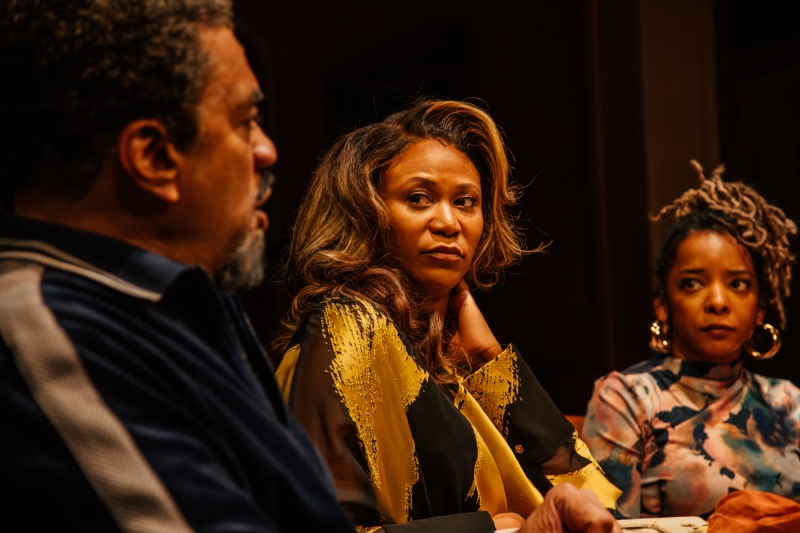
Harry Lennix, Alana Arenas and Kara Young (Photo by Jeff Lorch)
Alana Arenas presents a striking and magnificent figure as Morgan, carrying a boulder of resentment against this entire family in general, and against her husband in particular. For this reason, she’s kept their children far away from this family reunion that’s ostensibly for Claudine’s birthday, but it happens not to be her birthday at all. Morgan can’t stand the sight of any of them, for what they did to her, for the prison she’s about to enter on their behalf, and for the hypocrisy underlying their lofty social principles. Arenas sashays across the living room donned in sunglasses, like a movie star on the wrong set, conveying with her silence a bolt of electric fury.
The play’s centerpiece, however, is the prodigal son, Nazareth or “Naz” (Jon Michael Hill) and the woman he brings, reluctantly, in tow, a “friend” named Aziza (Kara Young, sharing the role with Nija Okoro) who drove him to the play’s Illinois setting all the way from Brooklyn.
Naz is a nature photographer, an avocation that draws the wrath of his father for not being socially useful. He is also the narrator of his memory play. His florid audience-address narration is so extensive that it feels as though Purpose is largely a one-man show, with the unfolding family drama used as an ancillary project.
That drama entails the arrival of his Aziza, simply wanting to give Naz his phone charger that he left in her car. His primary goal at this point is to get her away from his toxic family. However, his mother Claudine, being a manipulator of the first order, sees Aziza’s exhaustion from the drive, but don’t confuse her with any compassionate intent. What she also sees, and affirmed by Soloman, is a girlfriend and, potentially, a family legacy. Naz warns us, the audience, to hang on to our hats as things are about to explode. This is because Aziza will alert the family that her relationship with Naz is strictly platonic mainly because she’s a lesbian. More to the point, he’s her sperm donor for a child she wants to bring into the world. Suddenly, the legal ramifications leap out from the off-stage study, and Claudine is ushering Aziza there to sign an N.D.A.
Young’s performance as Aziza is delightfully twitchy, portraying contradicting layers of perplexity, self-assurance, candor, and the ultimate aim to keep whatever she’s thinking to herself, since this is a clan that uses everything that anyone might say against them.
Hill’s Naz is a kind of amiable bedrock, a latter-day Tom from The Glass Menagerie, establishing a clear rapport with us, though more sporadically with his kin, despite his best efforts to do so. The character is also asexual, which he tries to explain to his dumbfounded father. This may be because he’s either autistic or on the spectrum. Given his hermitic tendencies and his love of nature, this is a particularly intriguing idea, far more interesting than if Jacobs-Jenkins had resorted to rendering him gay or trans. We’ve been there in the theater, done that. A lot.
His spectrum diagnosis becomes a factor for Aziza as to whether or not she wishes to bear his child, as she also sees these traits exhibited by others in his family.
Is something, like the civil rights movement itself, coming to an end here, due to insurmountable factors of corrosion? Or is something continuing? The play suggests that both may be true at the same time.
Todd Rosenthal’s interior set features a large dining room window behind which we see the gently falling snow that inhibits Aziza’s drive back to New York. By Act 2, the visage has turned to frost, emblematic of the season, of this family’s legacy, and perhaps of our era.
Geffen Playhouse, LeConte Ave., Westwood. Opens Wed., Nov 18; Wed.-Thurs., 7:30 pm, Fri.-Sat., 8 pm, Sat., 2 pm, Sun., 1 and 8 pm., Tues.. Dec. 1, 8, and 15, 7:30 pm; thru Dec. 20. www.geffenplayhouse.org Running time: Two hours and 30 minutes, includes intermission