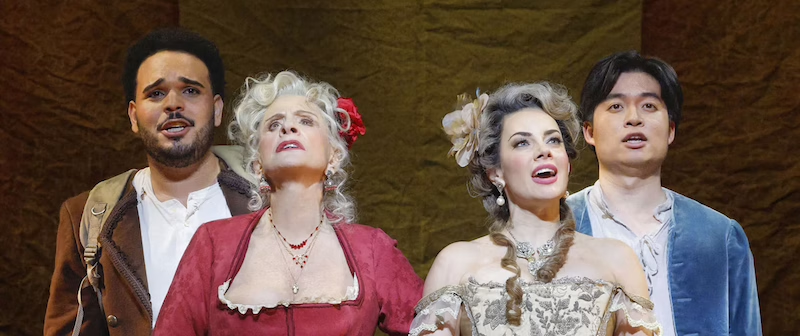
Samuel Wallace, Patti LuPone, Meghan Picerno and Duke Kim (Photo by Corey Weaver)
Reviewed by G. Bruce Smith
Los Angeles Opera
Through December 13
RECOMMENDED
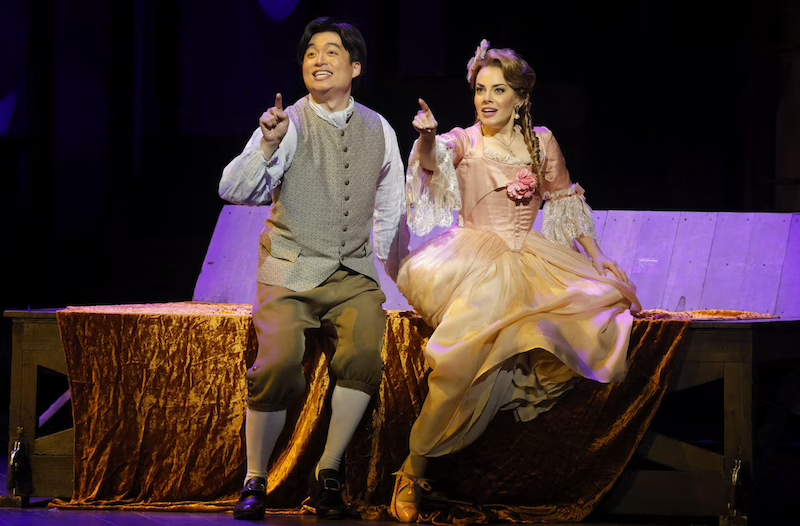
Duke Kim and Meghan Picerno (Photo by Corey Weaver)
Candide — the delightfully satirical operetta/musical hybrid based on Voltaire’s much-loved novella — was pretty much a flop when it opened on Broadway in 1956. Critics and audiences praised Leonard Bernstein’s score but some found Lillian Hellman’s book weighty. It closed after 73 performances. Ten years later, Gordon Davidson directed it in a concert staging for The Theatre Group at UCLA’s Royce Hall, re-including music that the 1956 director, Tyrone Guthrie, had cut. L.A.’s premiere philanthropist, Dorothy Chandler, saw that production, invited herself to a post-show soiree at the Davidson’s home, and about five weeks later, she offered Davidson the job as Founding Artistic Director of the Mark Taper Forum, which was still under construction and wrapped in scaffolding.
Because of its dazzling score, Bernstein’s Candide had a later revival on Broadway in 1974, directed by Hal Prince with a new book by Hugh Wheeler and lyrics added by Stephen Sondheim. This time it was a hit — and it has been produced ever since by theaters and opera houses throughout the country.
How fortuitous for us.
The Los Angeles Opera production, directed by Francesca Zambello, does not disappoint. Featuring such luminaries as Scott Bakula as Voltaire (the narrator) and Dr. Pangloss , and Patti LuPone as Old Lady, it sparkles with top-notch singing, delightful choreography (Eric Sean Fogel), and clever comedy. (The production is in English, with English supertitles.)
Candide follows the eponymous protagonist (tenor Duke Kim) — a youth from Westphalia of obscure origins who travels the world in search of Cunegonde (soprano Meghan Picerno), the woman he loves. He encounters tragedies — both natural and man-made — throughout the world.
Meanwhile, in Act I, Cunegonde has been taken as the mistress of two men in Lisbon. Candide and Dr. Pangloss, his former tutor (now mentor and friend), travel to Lisbon, where Dr. Pangloss is apparently killed and Candide is flogged for blasphemy. With the help of Old Lady, Candide is reunited with Cunegonde. The three flee to Spain, where they meet Cacambo (Samuel Wallace), who proposes a journey to the New World.
In Act II, they arrive in Montevideo and, unknown to Candide, Cunegonde, who worships wealth, marries the governor. Candide and Cacambo take off for Paraguay (for unclear reasons) and on to El Dorado, the legendary land of gold, where they are dazzled by the wealth and happiness of its inhabitants.
Eventually, they end up in Venice where, at a masquerade ball, Cunegonde is revealed for the greedy woman she is, a heartbreaking moment for Candide (beautifully expressed in his solo, “Nothing More Than This”). The ending, marked by the lovely “Make Our Garden Grow” (Candide, Cunegonde, Company), is a perfect closure to the tale (more on that later).
Candide — as written and as performed here — is alluring in so many ways. Though much of the story is dark, the comedy — which at times borders on farce — shines brightly. Nowhere is this more apparent than in one of Candide’s most well-known numbers, “Glitter and Be Gay,” in which Cunegonde laments being a kept woman while enjoying the jewels and luxury that come with it. As vocalist, Picerno not only sustains impossibly lofty notes, but manifests the song with brilliant comic flair.
As Candide, Kim turns in a solid performance, both as a singer and actor, capturing his character’s journey — sometimes poignantly — from youthful optimism to a sad kind of wisdom.
Bakula is an experienced musical theater singer (ranging from light baritone to tenor), and it shows in his performance. And it’s always a treat to see the gifted LuPone on stage.
As is customary for a Los Angeles Opera production, the scenic design (James Noone) is spectacular, and the costumes (Jennifer Moeller) — ranging from mid-18th century garb to glittering El Dorado outfits — are dazzling. At one level, Candide asks universal questions such as: If God is good, why is evil allowed to exist? How can human cruelty be explained? The optimism of Dr. Pangloss is ridiculed throughout the story: After all, how can anyone be optimistic in a world of brutality?
And yet at another level, Candide explores whether happiness can exist, and if so, what that looks like. Candide has seen death and destruction, and endured the crushing blow of Cunemonde’s falsehood. But he’s also seen the utopia of El Dorado, and in the end, he comes down on the side of a simple, humble life.
Los Angeles Opera at the Dorothy Chandler Pavilion, 135 N. Grand Ave., downtown LA. Sunday, Nov. 29, 2pm; Wednesday, Dec. 2, 7:30pm; Saturday, Dec. 5, 7:30pm; Thursday, Dec. 10, 7:30pm; and Sunday, Dec. 13, 2pm. laopera.org. Runtime:,Two hour and, 30 minutes with an intermission.