“Confederates” and the Intricate Shapes of History
Reflections on Dominique Morriseau’s play at The Fountain Theatre
by Blaine Berhane
RECOMMENDED
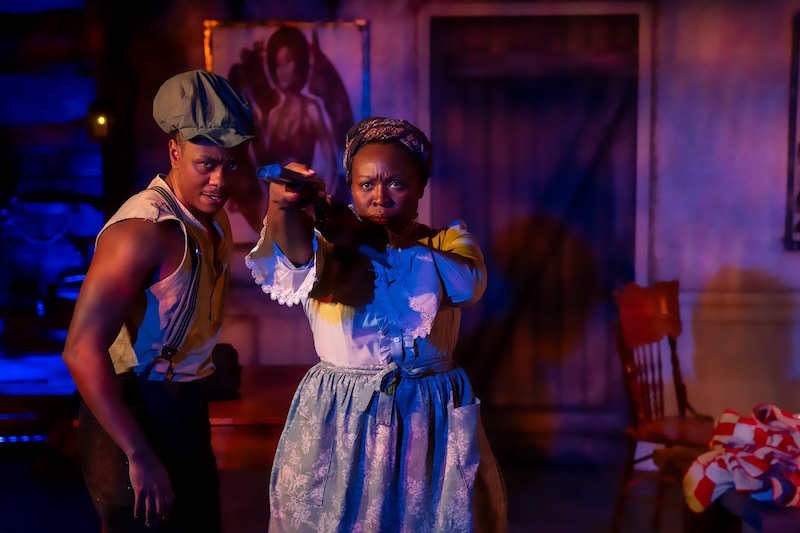
Daks McClettie II and Nedra Ryan Taylor (Photo by Davis Northern)
This article is part of the Stage Raw/Unusual Suspects Youth Journalism Fellowship
Few plays tackle subjects as complicated and consequential as race, gender and solidarity with both comedy and nuance more deftly than Dominique Morisseau’s Confederates. This Los Angeles premiere at the Fountain Theatre, directed by Raymond O. Caldwell, excels at handling weighty subject matter with sharp humor. A terrific ensemble, two compelling central performances and thoughtful direction make this production well worth seeing.
The play travels between two Black women who live nearly 160 years apart from each other. Sara (Nedra Ryan Taylor) is enslaved in the Civil War South, where she secretly gathers Confederate military information for the Union. In the present day, Sandra (Sarah Scott Davis) is a professor at a predominantly white university who finds herself at the center of a humiliating incident which exposes the casual cruelty and institutional hypocrisy beneath her department’s professional veneer. Though their circumstances are vastly different, both women navigate systems that demand their compliance and deny their agency.
What is particularly intriguing about Confederates is how it examines community and the obligations we have to one another. Morisseau interrogates what solidarity actually means between people who share identities but differ in their relationships to power, privilege and institutional authority. What do Black women owe one another across those differences? And what responsibilities come with being part of a community that shares a history of marginalization but not necessarily the same experiences?
Morisseau doesn’t paint a flattering portrait of these communities, nor does she suggest that shared identity guarantees mutual understanding. Instead, she links community with conflict, and belonging to a community with additional responsibilities and expectations. Solidarity is easy to celebrate as an ideal, but much harder to practice when it requires accountability, sacrifice or a willingness to recognize someone else’s experience.
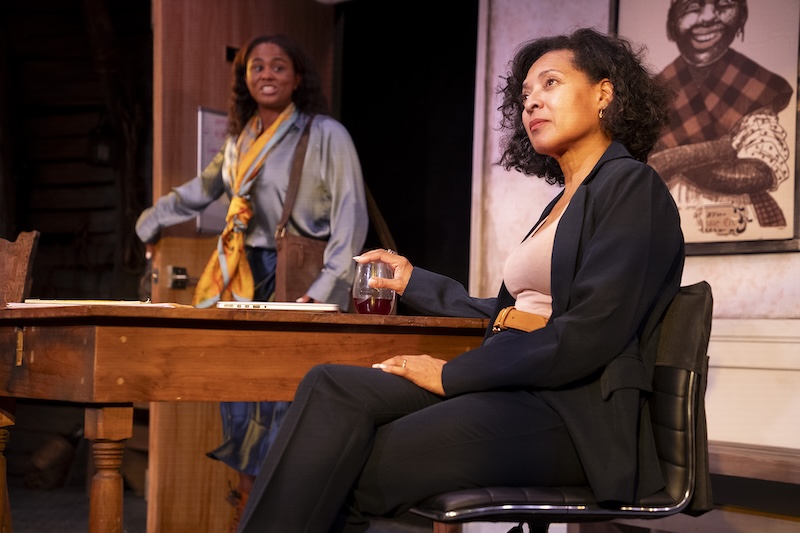
Cortney Scott Wright and Sarah Scott Davis (Photo by Davis Northern)
Confederates is an impressive piece of writing, and this production makes the most of its considerable range. Here, both the discomfort and the comedy of Morisseau’s writing coexist. Morisseau is adept at highlighting the absurdity in these situations without losing sight of their seriousness. Caldwell understands humor to be one of the play’s sharpest tools, not incidental to the material, and the play is full of sharp, often laugh-out-loud moments that never trivialize the underlying conflict. This staging balances tension and amusement beautifully, allowing the humor to breathe without turning the characters or their circumstances into punchlines.
Andrea Allmond’s sound design and original music, distinguishes the two timelines effectively. A rhythmic quality to the pace is important to Caldwell, who confidently uses it to balance the play’s rapid shifts of timelines and tone. His staging transitions between the two settings seamlessly, and the story moves ever forward without breaking rhythm.
Taylor delivers a standout performance as Sara. She brings both depth and excellent comedic timing to a woman who is constantly oscillating between survival and resistance. As Sandra, Davis brings an increasingly volatile edge to the character, culminating in an explosive moment late in the play. The other actors (Mara Klein, Daks McClettie II and Cortney P. Wright) perform two roles each, and imbue their characters with distinctive qualities. It is impressive ensemble work, especially in a play that requires the actors to cycle between two very different worlds quickly.
Two final speeches make for the most striking moments of the production. They converge the play’s timelines and its central questions powerfully, void of a neat resolution or any clear take away. Rather, this final sequence homes in on the emotional weight of these two women’s experiences in a way that is unexpected and deeply moving. It’s better not to reveal more; the effect is best experienced firsthand.
The Fountain Theatre, 5060 Fountain Ave., Los Angeles, CA 90029. Thurs.-Sat., 8 pm; Sun., 2 pm; select Mondays, 8 pm; through Dec. 13. https://fountaintheatre.com. Runtime: approximately 100 minutes, no intermission.