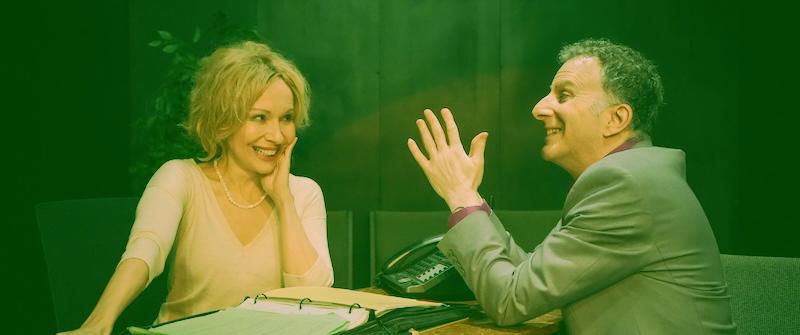

Nina Bell and Jerry Weil (Photo by Aziz Tazi)
Reviewed by Lovell Estell III
Borough Park Productions at the Hudson Guild Theatre
Through December 14
In David Mamet’s controversial 1992 drama Oleanna, questionable allegations of sexual misconduct involving a college professor and a young female student led to disagreeable consequences for the teacher. A similar situation arises in playwright/director Art Shulman’s world premiere, two-act drama (inspired by a true incident), where ambiguous accusations of ethnic discrimination threaten the career of an accomplished, well regarded instructor.
As the play opens, we meet Professor Joshua Goldman (Jerry Weil), in mid-lecture, prompting students to answer some questions he asks. Shortly thereafter, Goldman is visited in his office by Ali Alkashar (Aziz Tazi), an international student from the Middle East, who seldom attends class and readily “cuts corners” when it comes to his coursework.
The two discuss his test scores on final exams, and Ali’s puzzling improvement over previous tests raises suspicions in Goldman’s mind, given that Ali is a notorious slacker and a member of a study group the professor calls “the Middle Eastern Mafia”. After Ali leaves his office, Goldman checks some documents, and after an “aha” moment, concludes that cheating has occurred. After he informs the department chair Dr. Kate O’Connor (Nina Bell), of his findings, she tells him to go forward with a report to student affairs.
Which he does, and when Ali later confronts Goldman, whom he calls a “lousy, biased professor,” about his “F” grade and the pending investigation by Student Affairs, Ali’s departing words (“You will regret what you have done”), foreshadow troubles ahead for Goldman.
And they arrive. After Ali is acquitted for lack of evidence, he goes to the office of Equity and Diversity and charges Goldman with ethnic discrimination — charges that if upheld, would result in the professor’s termination from the university.
The play platforms controversial issues that are certainly relevant to our times, considering the distortions arising from the runaway train of identity politics and policy, and the current administration’s focus on — or perhaps obsession with — alleged liberal bias permeating the nation’s top-tier colleges. Shulman’s script is thoughtfully written (no more evident than in the finale, where, during the hearing, Goldman gives a perceptive, thoroughly incisive analysis on the blurry, troubling distinctions between bias and discrimination. However, some of its twelve scenes are not as trenchant as they should be; one with Fatima (Rasha Elabaji) and Ali that takes place after Ali’s acquittal is surprisingly shallow and ineffective.
But the script’s negligible flaws are not as much of a problem as the performances (This reviewer counted five glaring instances of flubbed lines.). Weil and Bell are steadfastly consistent and convincing in their roles, but Tazi is noticeably unpolished and tenuous in his performance. Andrée Mulia appears as April Waters, an advocate for the university in the legal proceedings, but her acting is just plain flat and uninspiring, as is Elabaji’s. Rounding out the cast is Sammie Wayne IV, as Judge Javier Ramirez and Morry Schorr as union rep Omar Bashar.
Hudson Guild Theatre, 6539 Santa Monica Blvd., Hollywood. Fri.-Sat., 7:30 pm, Sun., 2 pm Sat., Dec. 6, 2 pm; thru Dec. 14. Running time: one hour and 50 minutes with an intermission. http://onstage411.com/bias