
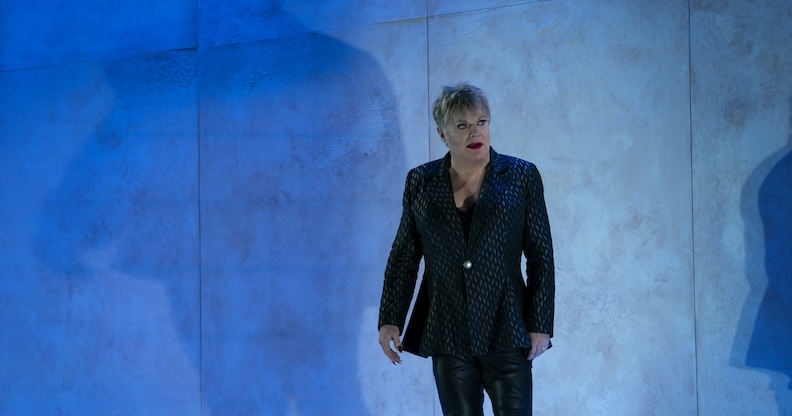

Eddie Izzard (Amanda Searle)
Parking Lot Hell in Hollywood, and Taking the Train to a Theater in Newhall
Eddie Izzard’s “Hamlet,” Sam Shepard’s “Curse”

Many years ago, a colleague was in the throes of leaving his post as theater critic for The Los Angeles Times to move to Chicago, to continue writing about theater and movies for The Chicago Tribune. The way he explained his decision to leave SoCal went something like this: “I was in my third hour on the gridlocked, southbound Golden State Freeway, trying to get to South Coast Repertory when I understood that I could no longer persuade myself that I was living the dream.”
When the theater was “recovering” from the Covid pandemic, Stage Raw conducted an audience survey that included a question to the 20% of respondents who said they had no intention of returning to live theater in Los Angeles. Their reasons ranged from “changing habits,” to high theater ticket prices, to traffic and parking, to the overriding sense that none of this was worth the effort when the final, uninspiring results started to feel like an abuse of time and energy.
Both of these stories ran through my mind after Eddie Izzard’s touring solo performance of Hamlet (care of Westbeth Entertainment) at the Ricardo Montalbán Theatre on Vine Street, being jammed within a car, within the indoor parking lot adjoining the venue, waiting and waiting and waiting for almost an hour, for the privilege of being allowed to leave this concrete tomb for the comparative freedom of Vine Street. All of the three ticket machines were broken, leaving one garage attendant, on his own, to process the $18 parking fee for the entire audience, one car at a time — at least for those who were foolish enough to pay the peak rate to park close to the theater. I was supposed to meet a friend for dinner after the performance that we’d both attended — a plan vanquished by a combination of the show’s two-and-a-half-hour running time, and the added hour spent trapped in the parking garage. To its credit, the parking garage management had posted a helpful sign: “Expect Delays Leaving.” All of which raised the question: Is any of this really worth the trouble? To be even more snotty for a moment: With little diminishment of the experience, we could have just gone to dinner, or we could have watched any number of Hamlets on Netflix or YouTube, some of them for free.
“Ah! But the live experience!” you counter. “There’s nothing else like it.” Izzard addressed this in her pre-performance remarks, explaining how some 400 years ago, Shakespeare’s plays were performed without a “fourth wall” proscenium (“a 19th century invention,” she posited), thereby placing the audience in closer proximity to the actors for an Elizabethan quasi-immersive experience. “That’s what we’re aiming for,” Izzard explained. These were telling and misinformative remarks: Fourth Wall or Proscenium theaters came about in ancient Rome, long before Shakespeare, and were later modified in the late 1500s, also in Italy, in order to separate the stage from the theater’s machinery, to enhance the sense of spectacle from sliding and hanging sets. Izzard’s remarks were further upended by her actual performance in the actual theater, a 20th century edifice designed for audience-actor separation: The Montalbán (née the James A. Doolittle and Huntington Hartford theaters) is a mid-size proscenium theater. The absence of a front curtain does little to change that, unless the entire audience is parked on the stage itself; for this performance, it was not.
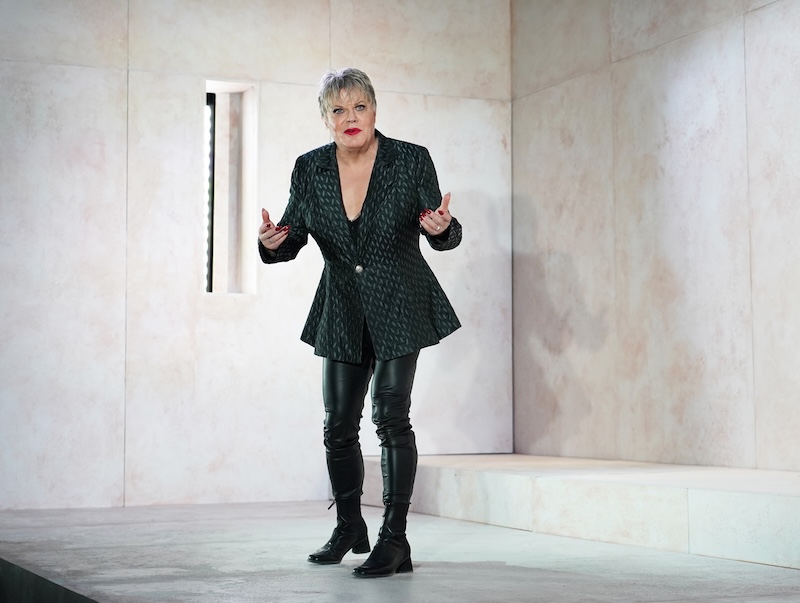
Izzard (Carol Rosegg Photography)
Tom Piper’s set consisted of a kind of open-fronted cubical edifice with tall, narrow slats, resembling windows in school, office and prison buildings constructed here in the 1960s. The slats let you know there is a world out there, but you are not allowed to see it. Tyler Elich’s high-density lighting transformed the texture of the set: Gleaming white, it looked like it was made of marble; in more modest yellow hues, it resembled stucco.
My friend and I did find a diner open into the wee-hours, and she noted that I didn’t appear to have enjoyed the show much. Well, perhaps she was misreading my body language. I didn’t not enjoy it. The gender-fluid Izzard sported a black-goth jacket with matching black vinyl trousers (one leg framed by a knee brace from a recent accident), plus red fingernails chiseled into daggers, as she recited pretty much the entirety of Shakespeare’s Hamlet (adapted by Mark Izzard). It’s a very good play, and Izzard clearly understood its deeper resonances. What’s not to like?
Single-handed (no, triple handed if you include Rosencrantz and Guildenstern, each portrayed by one of Izzard’s hands like sock-puppets), Izzard portrayed almost two dozen of the play’s characters, and about half an hour in, I settled into the realization that she really was going to traverse the entire play. Which means that Izzard memorized the whole epic, every role. There’s that old adage, mocking the reaction of novice theater audiences, “How did they memorize all those lines?” Well, here, the question is not so daft. Izzard’s skill at recall is actually a feat and an accomplishment.
Under Selina Cadell’s direction, with composer Eliza Thompson’s Renaissance musical accompaniments, it was a nimble, understate rendition, keeping moroseness and melodrama at bay, with splashes of irreverence that thankfully did not undercut the play’s core seriousness.
Different characters were differentiated with subtle modulations of voice and posture (Claudius assumes a gruffness that disappears when Izzard morphs into Gertude), but gads, you have to know this play inside out to keep track of who is who in any given scene. I can imagine the performance being incomprehensible to somebody with no, or scant, familiarity with the play.
What gets lost in these kinds of one-person shows is the action that unfolds in the space between two characters engaged in conflict.
The performance was at its best in moments of comic repartee between, say, the First and Second Gravedigger, a scene that, even in the original, feels designed for standup comedy — here, a show of dexterity and a forte of Izzard.
However, the one-person conceit falls apart in the swordfight between Hamlet and Laertes, with Claudius and Gertrude egging them on. Izzard more or less lumbers as Hamlet, and then Laertes. The clash, the heart of the matter, lies not in any one character but the electrical charge that engulfs the ensemble — physically manifested in those swords and their clashing steel. None of that exists in a one-person performance, raising the larger question of what this performance contributes to Shakespeare’s play.
The play’s words are often as beautiful as words can be:
I have of late, (but wherefore I know not) lost all my mirth, forgone all custom of exercises; and indeed, it goes so heavily with my disposition; that this goodly frame the earth, seems to me a sterile promontory; this most excellent canopy the air, look you, this brave o’er hanging firmament, this majestical roof, fretted with golden fire: why, it appeareth no other thing to me, than a foul and pestilent congregation of vapors.
Izzard delivers this speech without artifice and with sublime, unadorned clarity. It’s a miniature portrait of manic depression in a young man contemplating suicide while trying to fathom the limits of his power and the extent of his paralysis.
The week of this performance was the same week that, in different confrontations, two innocent and worthy people, U.S. citizens and political protestors against our own government, were gunned down, executed in cold blood, in broad daylight, on frozen American streets, by masked, armed federal government “authorities” who believed they were free from the responsibilities of due process or the rule of law, or even from the vaguest principles of humanity or restraint; all of this was excused by a government that showed no interest in holding them accountable for their bloody deeds. Furthermore, government officials went to great lengths to demonize the dead, inverting the definition of perpetrator and victim. How can Shakespeare’s words, particularly the venomous and fork-tongued Claudius, Rosencrantz and Guildenstern, not resonate in a week such as this, under such circumstances?
Yes, it’s a beautiful play, with meanings that are reborn with the sands of time.
And still, the larger endeavor, the solo performance of this epic, the size and scale of it, started to feel as though the play were being painted with a roller rather than a brush. It contained moments of texture, but the cumulative effect was something like one of the seemingly stucco walls of Piper’s set, a uniform swath with occasional bumps and ripples.
One does grow weary expending time and energy on such feverishly marketed theater events such as this, when the results are neither bad nor inspiring. Going to see a play. Who cares? Honestly! Yes, they work so hard to get the play on its feet — well, some do, anyway –— but still. They try any number of tricks and deceits to focus the attention of wandering eyes from the natural competition of a chaotic world that bears down upon us with crushing force — of movies so conveniently streamed, and music, and clubs and galleries, and nature. Two prominent strands of life in 2026 conspire against attending live theater.
First, there’s the aforementioned challenges of getting there (transportation, ticket prices, parking, etc.)
The far greater challenge is the ability of live theater to strike a chord that resonates as true in a world where lies and deceit are the prevalent vocabulary. Striking a chord, or even a note, of “true” is something that theater, at its best, can still afford to offer. Of course, true is in the eye of the beholder, but still — one can gage it from the motives of creation. And this is why theater events that are so heavily marketed feel, to me, at a distance from something that’s true.
I admit this is a flawed argument. Marketing need not be the enemy of truth. There have been great, heavily marketed shows on Broadway and beyond. Most of the time, however, marketing speaks in the language of the carnival barker, and my hunch is that most of us are exhausted from hucksters trying to steal our information and sell us crap, online and off.
And so, after the harrowing parking experience following Eddie Izzard’s adequate Hamlet on a Friday night, I thought I’d try a different approach when seeing Sam Shepard’s 1976 play, Curse of the Starving Class, put on by a troupe named The Eclipse Theatre, which performs up in Newhall. This is a theater just south of Santa Clarita — a stone’s throw (five miles) from Cal Arts, Valencia in northern L.A. County.
I’ve been there before, and it’s a drive I dread – because I live in the Riverside County mountains, and it takes between two and a half to three hours to get there. And so, for my own sanity, compounded by the logistical frustrations of Friday night, I decide to try to turn the entire, following Sunday into a theatrical event.
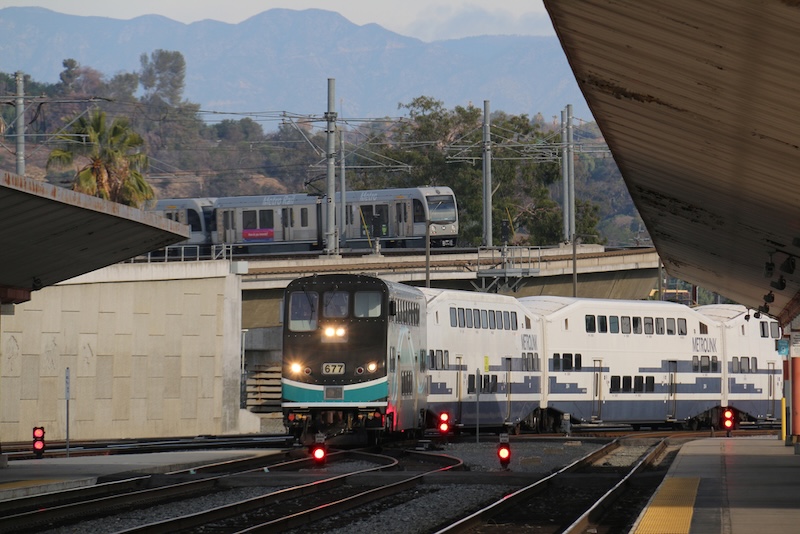
On track for theater in Newhall
For the 2 pm Sunday matinee, I left my house at 7 am for a one-hour drive to the University of Redlands, where there’s a shuttle-train station (it’s called the Arrow Line) with free all-day parking. Get to the platform at 7:55 as the train is just pulling in for an 8:06 departure. This is a sleek and spotlessly clean commuter train that runs between Redlands and San Bernardino and is administered by Southern California’s Metrolink service. ($10 for an all-day weekend pass, which grants free access to all connecting trains and buses in L.A. County; $5 is you’re a student, over 65, or disabled). With a laptop and books in my backpack, I look out the window to see the cars streaking along the adjoining concrete gutters of the San Bernardino Freeway. Between the freeway and the train tracks is an orange grove, six trees deep, laden with fruit, an orchard out of sight from the freeway itself because of the concrete barriers. If you want to see something, take the train.
Some 25-minutes out of Redlands, the train swerves northwest along the outskirts of San Bernardino, and vistas of what Arlo Guthrie called “the graveyards of the rusted automobiles.”
The downtown San Bernardino “Transportation Center” is an inauspicious place, four open air platforms, bright yellow and orange vests on security guards swooning on bicycles along the platforms, with the city’s meager office buildings (with a hefty dose of optimism, one could call them skyscrapers) in eye-shot. There’s nothing to do there, not even a cup of coffee on the horizon, but it’s only a 10 minute-wait to board the much larger, triple-decker L.A.-bound Metrolink train “on Platform 3”). At 8:43, the train lurches west for its 105-minute trek through the Inland Empire and San Gabriel Valley, stopping at places like Fontana, Claremont, Pomona and Cal State, L.A. before screeching at 10:20, steel on steel, under the corrugated rafters of L.A.’s Union Station.
(From Pomona, there’s a direct transfer to the A-Line light rail, which rolls through Glendora, Azuza and Pasadena (within walking distance stops to A Noise Within, Boston Court Theatre, and Pasadena Playhouse), before rolling down into L.A.’s Union Station (easy subway connections to LA Theatre Center, REDCAT, the Taper, the Ahmanson, and The Pantages) en route to Long Beach. From the end of that line, you’re a short walk to Long Beach’s Garage Theatre and the International City Theatre.)
The sights on the sparsely populated San Bernardino Line en route to L.A. are far from bucolic, mostly voyeuristic glimpses into aging apartment blocks and the backyards of wood-framed stucco houses and swimming pools (some concrete, some plastic) in places like El Monte and Baldwin Park. Multiple cars in driveways. The cars are shiny; the houses, less so. Laundry hanging on outdoor pentagon umbrellas. Abandoned plastic toy cars strewn in yards. From the train, you start to see the values of the region, and why a play like Curse of the Starving Class is so apt.
The only way off the Union Station platforms is subterranean — under the train tracks through a corridor that takes you into the still beautiful, gilded arc deco train station lobby. (Don’t use the bathrooms, they’re disgusting, and have been so for decades.)
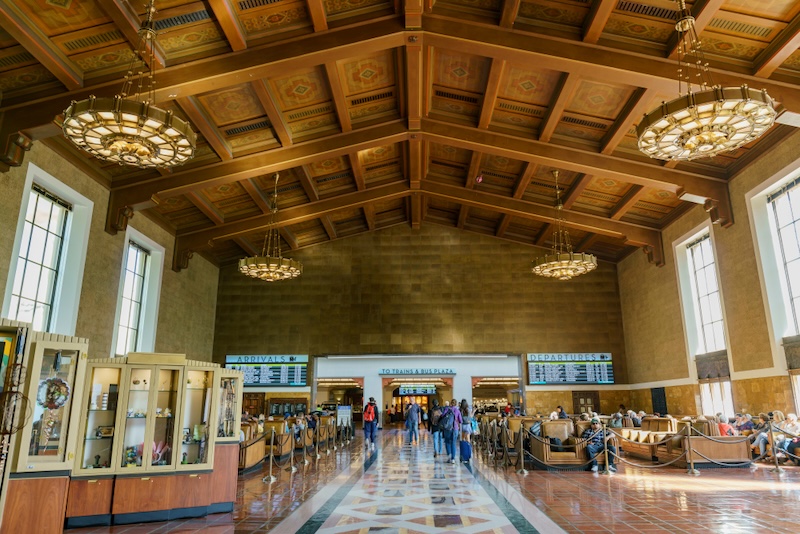
Los Angeles Union Station
I cross Alameda Street to meet a friend for brunch at La Luz Del Dia Mexican restaurant on Olvera Street, in the heart of historic Los Angeles. After brunch, we circle the old town center, where a mariachi band is accompanying dancing children, their skirts of bright red and green and blue swaying with their choreographed moves. A small, older audience sits on bleachers, some clapping to the music’s beat, most nodding and smiling. We presume theater is something rarefied. It’s not.
At 12:30, I’m back in Union Station, on Platform 3B, for my connecting northbound train to Lancaster, with a stop at my Newhall destination. I’m the only passenger in my car. Nuts. This is virtually free, comfortable, even romantic, transportation. We remain a car culture. It’s in our DNA as a city, as a region. The train slides northwest along San Fernando Boulevard, stopping at Glendale, downtown Burbank, past the Burbank Airport and up into Sylmar before it veers northeast towards the San Gabriel mountains and climbs into a long tunnel. When it finally emerges, I’m rolling through lush oak grove pastures of sloping green, punctuated by industrial yards and dilapidated buildings. Curse of the Starving Class is set in California’s Central Valley (Eclipse Theatre has reset it in the farmlands of Santa Clarita, so this is the landscape of the production.) Who needs a set, when you see it outside the train window. As the train pulls into Newhall, I see the parking lot and back side of the theater (The MAIN) right out the window. I arrive 30 minutes before curtain, stress-free.
Director Shana Harell, along with Nancy Lantis and her husband Phil Lantis, designed the set, which takes us inside one of those dilapidated homes I saw from the train. There’s a table that doubles as a bed for characters too drunk and/or exhausted to make their way to the offstage bedroom.
There’s a thoughtful, allegorical mural backdrop, designed by Bryan Maly, that consists of five panels of differing width. Painted across the swath of the panels is a desert landscape with a road winding up to a mountain range, a road into a kind of mirage, as one would find around Desert Hot Springs.
In the opening scene, a young man named Wesley (Aidan Frame) is trying to build/repair a frame for the front door that his father, Weston (Jeff Frame, who happens to be Aidan’s real life dad) destroyed while inebriated while trying to break into his own home, after he’s locked out by his comparatively tranquil, no-nonsense wife, Ella (Nancy Lantis).
A central feature of the set is the smudged and mostly empty refrigerator – the emptiness serves as an emblem for this “Tate” family’s financial and spiritual poverty. There is one other family member, young daughter Emma (Sally Lantis, who is Nancy Lantis’s real life daughter) — this production really is a family affair.
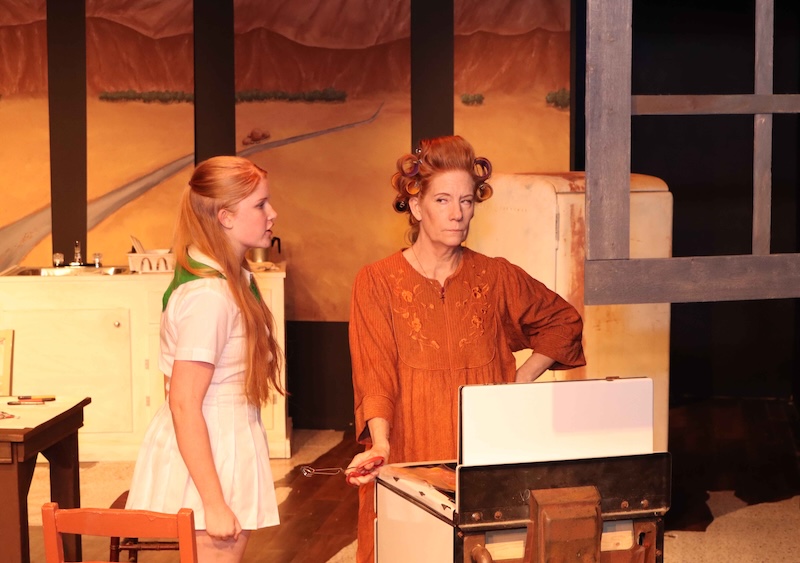
Sally Lantis and Nancy Lantis, real life daughter and mother portraying Sam Shepard’s daughter and mother (Photo courtesy of Eclipse Theatre)
There are three schemes at work (the word plot gives these characters’ motives more dignity than they deserve): Ella wants out, to escape to Europe, which she knows nothing about, but at least it promises to be better than inland California. She is “working” with a conman named Taylor (Chris Loprete) to sell the house out from under her dissolute husband, Weston, who’s claim to this play’s fame is his being tricked to buy a plot of useless land in Desert Hot Springs; he was persuaded that it’s great farm land, though he neglected to research that it had no access to water. Ella and Taylor think they can sell the house from under him by declaring Weston mentally incompetent. (This is not an unreasonable argument, the desert land purchase aside;, he’s certainly not doing particularly well running the farm, he’s sporadically sober, mostly absent, and is buried by debt.) Can Sally or her brother, Weston, keep their mom’s conniving secret from their dad when they learn of the scheme? Where lie their loyalties?
Meanwhile, Weston aims to sell the same house out from under his wife for an obscenely low price, in cash, to his Mafia-like creditors (Guy Noland, in a particularly sharp, scary performance, along with David Salper and Moimoi Gilmore). Praise is also warranted for Andrew Adams as a Highway Patrol officer out to diffuse some tensions with young Emma, who quickly learns the arts of prostitution as a means to her liberation from all this muck.
So the question in this ever-so-American story is who can defraud whom by moving quickly enough to get away with it, so as to get out of this suffocating situation? The physical filth (Wesley pees on the kitchen floor in order to soil one of his sisters’ 4-H projects) is as squalid as the feculence in the restrooms of Union Station. Weston’s clothes are stained with feces and spew, viscerally captured in Nancy Lantis’s costume design.
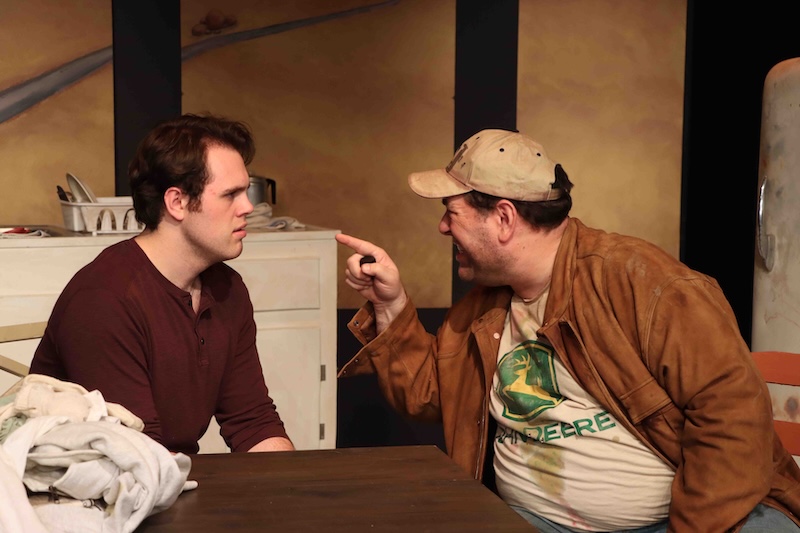
Aidan Frame and Jeff Frame, real life son and father portraying Sam Shepard’s son and father (Photo courtesy of Eclipse Theatre)
It’s as though Sam Shepard anticipated what today is called the affordability crisis, the difference being that in 1976, he was writing about a swath of the impoverished, which, in 2026, has grown exponentially and is on track to keep expanding. That alone could be the “curse” of the title, though not specifically what Shepard intended.
I enjoyed this production, thanks to the evocative qualities of all the actors. Jeff Frame as the patriarch has a thundering presence, but, goodness, director Harrell keeps things far too languid, permitting some of her actors, the Frames in particular, to take mud baths in the spaces between their lines — particularly in their already linguistically bloated soliloquies.
And still, this production is connected to the landscape around the theater, and to its community. Despite the pacing issues, it contains an authenticity that gives it value.
There is, finally, an issue when comparing the characters in Shakespeare to those of Shepard, and that’s the venality of the poor and the rich. No class holds a claim to the mantle of honesty or dishonesty, and there’s another chord of truth resonating behind both plays: that people in general are rotten to the core.
And yet, and yet . . . What about the Renée Goods and the Alex Prettis, and all the Minnesotans who took to the street in defense of their neighbors, that cluster of the brave- and kind-hearted? They do show up on occasion, in Shakespeare, in Shepard, and in our times, too. And when they do, they change the world, their sacrifice saves us all, at least for a moment or two.
EDDIE IZZARD IN HAMLET Eddie Izzard in a solo adaptation of Shakespeare’s iconic play. The Montalbán Theatre, 1615 Vine Street, Hollywood. Fri., 8 pm, Sat., Jan. 24, 8 pm, Thurs., Jan. 29, 8 pm, Sun. Jan. 25, 3 pm, Sat., Jan. 31, 3 pm; thru Jan. 31.TICKETMASTER.COM Running time: Two hours and thirty minutes with one intermission.
CURSE OF THE STARVING CLASS Sam Shepard’s emotionally charged dark comedy explores the crumbling American Dream through the lens of a dysfunctional family on the brink. The MAIN, 24266 Main St., Newhall. Opens Fri., Jan. 23; Fri.-Sat., 8 pm, mats Sat.-Sun., 2 pm; thru Feb. 1. https://curse2026.eventbrite.com Running time: Two hours and forty-five minutes, with one intermission.