
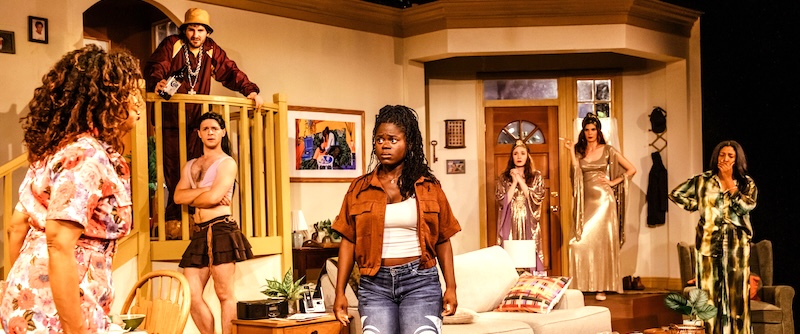


Marie-Francoise Theodore, Tyler Gaylord , Michael Guarasci (below), iesha m. daniels, Daisy Tichenor, Gala Nikolic, Jasmine Ashanti (Photo by Jeff Lorch)
Reviewed by Deborah Klugman
Rogue Machine at the Matrix Theatre
Through April 19
RECOMMENDED
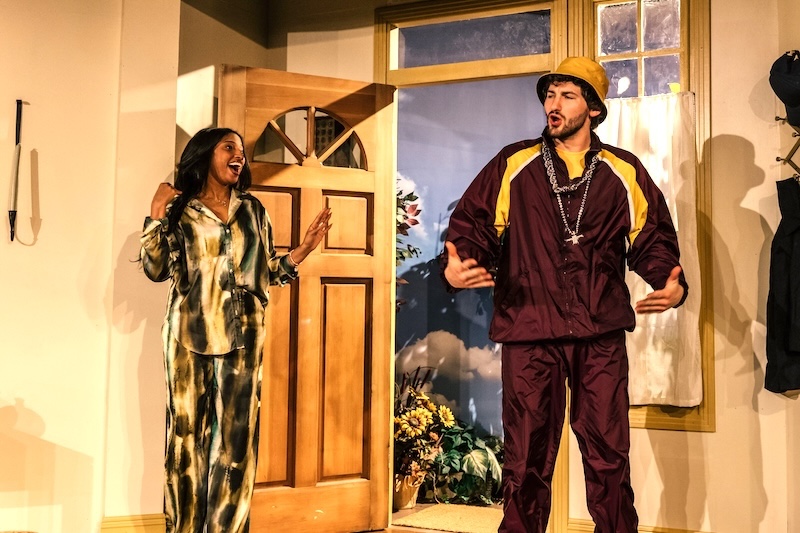
Jasmine Ashanti and Tyler Gaylord (Photo by Jeff Lorch)
Fairview, Jackie Sibblies Drury’s 2019 Pulitzer Prize winning play, begins with deceptive simplicity. It’s set in the nicely appointed middle class home (scenic design Mark Mendelson) of an African-American family. Beverly (Marie-Françoise Theodore), a frazzled mom, is preparing a dinner in celebration of her own mom’s birthday. Pausing for a vanity peak into the (Fourth Wall) mirror, she’s distracted by the playful shenanigans of her husband Dayton (Marco Martinez), and by the arrivals of her drama queen sister Jasmine (Jasmine Ashanti) and her intense teenage daughter Keisha (iesha m. daniels). The rest of the scene plays out like a well-executed American sitcom — cliched maybe, but still featuring character-driven humor, executed by an adept ensemble under Oz Scott’s direction.
This scene runs for 25 minutes, then ends abruptly when Beverly suddenly collapses on the floor. The proscenium goes dark, the tone radically shifts. A piped-in recording comes on — a voiceover consisting of four individuals (they sound young) discussing race — which begins when one of them poses the question “If you could choose, what race would you rather be?” The subsequent dialogue, which includes the opinions of some not-too-bright people, is rife with ignorant stereotype that touches on Asians, Latinos and ultimately Black Americans. Meanwhile, the prior sequence is re-enacted in dimmer light and sans speech from the actors.
If you’ve read the play, this voiceover dialogue makes for sharp, satiric commentary on the unconscious racism that pervades American culture. On the page, it’s funny and to the point. If you haven’t read it, or even if you’ve read it and are now hearing it spoken without the benefit of a face or body to connect to the words, it proceeds with some tedium for what seems like a very long time — another 25 minutes in fact.
In the play’s third segment, the lights come full on again and events pick up from where they left off, but with four new characters (Michael Guarasci, Gala Nikolic, Daisy Tichenor and Tyler Gaylord, all actors who participated in the voiceover). From here on out, the narrative detours from conventional drama in considerable ways; for example, two of these additional performers double as the same character, and though all but one of these actors are playing newly-introduced family members, none are African-American. Audience members who crave logic in their chronicle will find themselves puzzled, if not frustrated.
But – that’s part of the plan. Fairview isn’t about fulfilling the audience’s expectations; it’s about upending them. One of its themes is how foolish it is to predict what people will do or who they are based on their skin color or their race. The play’s other penultimate purpose seems to be to underscore how living as a person of color will always mean feeling that white eyes are upon you, always. That’s brought home in the play’s final riff with audience members participating in large numbers as the Fourth Wall falls away.
All of which makes the experience of Fairview a mixed bag. There’s no getting around that long stretch in the middle when disembodied voices chatter away, the import of their dialogue diminished by the anonymity and length of the conversation. Countering that negative, though, is the play’s discerning satire, performed by a surefooted ensemble with comic flair, with standout performances from Ashanti as the self-loving Jasmine and daniels as a bewildered teen in an unjust, upside down world, in the end doing her best to carve sense from it all.
Rogue Machine Theatre at the Matrix Theatre, 7657 Melrose Ave., West Hollywood. Fri.-Sat., 8 pm, Sun., 2 pm, Mon., 8 pm, dark Mon. March 16 and April 13; thru April 19. https://www.roguemachinetheatre.org/ Running time: approximately 90 minutes with no intermission.