
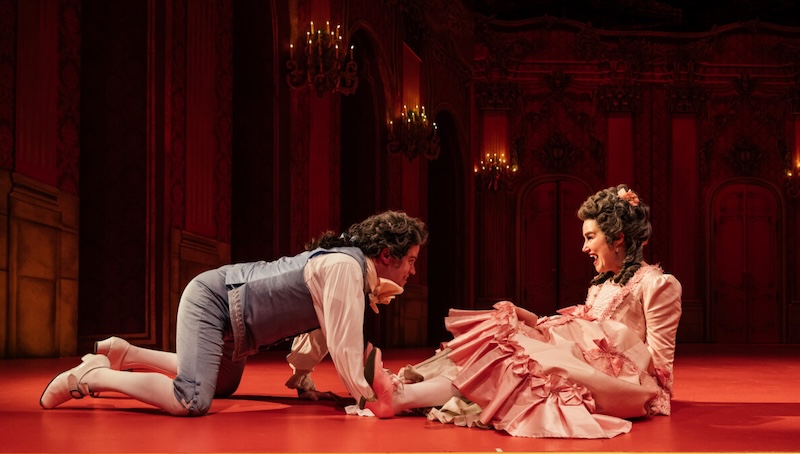


Sam Clemmett and Lauren Worsham in “Amadeus” at The Pasadena Playhouse (photo by Jeff Lorch)
Fame!
Amadeus, Hedda Gabler and Those Who Would Live Forever
 Asked by Carl Sagan what should be included on the Voyager spacecraft, launched in 1977 in order to show extraterrestrials the riches of human accomplishment, biologist and author Lewis Thomas famously replied, “I would send the complete works of Johann Sebastian Bach. But that would be boasting.”
Cosmic praise, indeed.
After his death in 1750, Bach’s works were rarely performed and almost forgotten. Church authorities found many of his compositions too experimental, and the general public agreed. Were it not for composer Felix Mendelssohn, decades later, whose grandmother gifted him a copy of the score to Bach’s St. John Passion in 1824, we would likely not even know of Bach. Mendelssohn conducted that passion in 1829, almost 80 years after Bach’s death. It was like an ember on a parched landscape of brittle-dry sagebrush. Suddenly, his music became an international fireball. It’s not that Bach had changed one note. It’s that European music culture had evolved.
In the world of fiction, were it not for Elena Sergeevna Shilovskaya-Bulgakova, the works of her husband, Russian author Mikhail Bulgakov, which now have cult celebrity status, would likely have been forgotten. Their comical, fantastical lampoons of Soviet society and its institutions were suppressed by dictator Joseph Stalin, his regime, and the continental-scale cadre of critics and politicians who marched in ideological lockstep with his soldiers. After Bulgakov’s death in 1940, his widow took Herculean pains to get his works to editors in the West. Fifty years later, sketches of his characters (from his seminal novel, The Master and Margarita) could be found painted onto the walls of buildings and subways in Moscow – expressions of devotion.
These are just two examples of artists struggling financially to make ends meet throughout their lives, whose eventual fame was not simply an inevitable outcome of their talent and self-discipline; it came partly by accidental circumstances, and partly from the lobbying of spouses and admirers. It was also a consequence of evolving artistic tastes in the cultures where they lived.
Bach was known to be morally virtuous, devoted to his wife and his children and, significantly for the caliber of his sacred works, to his God. Bulgakov’s character was, how to put it, more flawed.
This brings us to Peter Shaffer’s 1979 Broadway play Amadeus, as cheeky as it is brilliant, seemingly a product of its time, yet now endowed with weird and unsettling contemporary relevancies. More on that later.
Shaffer’s story was offered to larger-than-Broadway audiences in Miloš Forman’s 1984 film, and here director Darko Tresnjak has brought the play back to life in a new version at the Pasadena Playhouse in a production of seismic beauty and nimble wit.
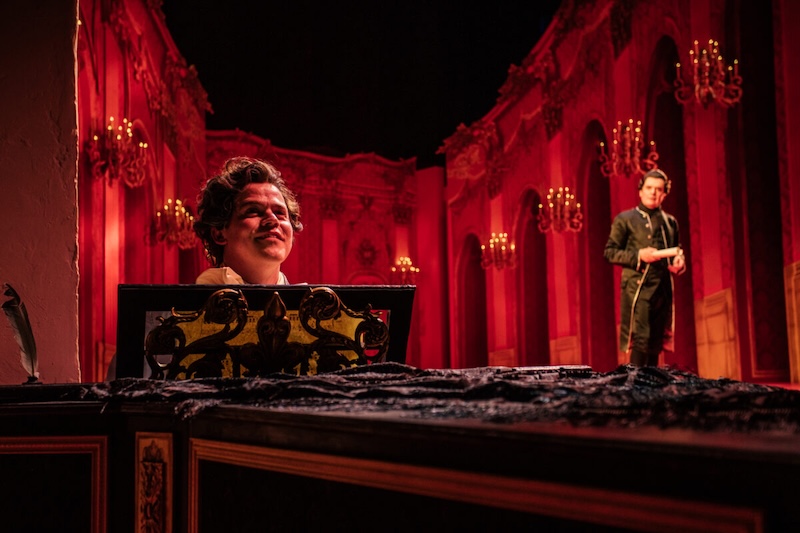
Sam Clemmett and Jefferson Mays (Photo by Jeff Lorch)
Upon entering the theater, the translucent proscenium scrim is decorated with musical notes on manuscript. The event unfolds on Alexander Dodge’s late Baroque interior set of the Vienna court of Joseph II (the gangly Matthew Patrick Davis, so tall that in one entrance, he almost squats to make his entrance through one of the double doors, while trying to maintain his royal composure. And yes, this is a deliberate, little joke). When Pablo Santiago’s lights permit, we’re served up a symmetrical palace with a string of chandeliers lining the right and left walls, and stage-wide steps across the front lip; these are places for some intimate liaisons.
Linda Cho’s sumptuous 18th century costumes arrived in partnership with L.A. Opera, with fastidiously researched Hair, Wig, and Makeup design by Will Vicari. This is a spectacle for eyes and ears. There’s a harpsichord tucked into the stage’s right corner, played briefly by Brent Schindele, and if they only had another million bucks or so, they could have brought in a live orchestra. Even so, Jane Shaw’s sound design has sufficient technical support to render Mozart’s recorded orchestral music with carefully considered tonal balances. When supplemented by the glorious live voices of bass Jared Andrew Bybee, and sopranos Alysha Fox and Michelle Allie Drever, the impact in this already century-old theater (more Spanish design than Viennese, but so what) is something transformative and ethereal. I found myself melting from sensorial bliss.
We meet court composer Antonio Salieri (Jefferson Mays), wheelchair bound on the last day of his life, so he can narrate, with dramatizations, his tense and hypocritical “support” of prodigy composer/keyboardist Wolgang Amadeus Mozart (Sam Clemmett). In the blink of an eye, Salieri emerges as a younger man, announcing that he’s no longer in his 70s, but a comparatively spry 31 (the actor is 60). Here, Mays delivers a small shrug, the subtext being, “and if you believe that. . .”

Jefferson Mays (Photo by Jeff Lorch)
This is a virtuosic physical performance supplemented by Mays’s piercing command of Shaffer’s baroque and ever-so-eloquent text. As a dramatist, Shaffer takes us through the psychic and emotional bumper car ride of Salieri’s perverse bond with the younger Mozart, but as a linguist, Shaffer’s profound understanding of, say, what makes Mozart’s Serenade for Winds sail through the heavens (we hear the music as he’s describing it) is about as beautifully articulated as can be found anywhere.
The play contains two conflicts. The first, and less important, is that of Viennese court composer Salieri and his petty jealousy of Mozart (Sam Clemmett, a perfectly amiable presence, despite his character’s obsequious, vainglorious and often obscene behavior), whom Salieri recognizes from the get-go as a superior musical talent.
The second conflict, and this is where things get interesting, is between Salieri and his God, who appears bearded and ghost-like, as though in an 18th century painting by Jacob Herryns, projected upon an upstage scrim and then slipping away into the cosmos like a mirage. To this God, Salieri, like Bach, has devoted his creative life and expects his just rewards – which to some extent, he receives: status and fame in his lifetime, and fortune. But Salieri’s God is not benevolent. He’s transactional and perhaps a jokester. And yet, devotion proffered to Him leads to rewards. Them’s the rules.
Does this, or does this not, sound something like our imperial presidency, which wasn’t even around when the play first appeared during the Carter administration? This particularly American parallel stems from a recent shift in our post-War approach to both political ethics and international relations, a predatory view which our current administration is elevating to the theological. It’s almost as though Shaffer, without realizing it, was warning of the destruction wrought by such a transactional approach to loyalty and its benefits, when “God” – even a self-appointed one – can be so moody, unreliable, and vindictive.
The other arena in this play’s new relevance is cultural rather than political. Salieri’s belief that an artist’s work should be aligned to a virtuous character has gained traction in the so-called progressive arts, along with the related belief that people with an allegedly corrupted character have no right to tell their stories.
You may recall the allegations against Star Trek actor George Takei of sexual assault by model/actor Scott Brunton, who months later recanted his accusation. In the meantime, Takei penned a Broadway musical (Allegiance) about his childhood experiences in a Japanese-American internment camp during World War II, and there were calls from our ever-so-enlightened theater community to boycott productions of his play, based on Brunton’s accusations.
The latest variation on this theme came from the Contemporary Theater Company in Rhode Island, which abruptly cancelled a production of Lauren Gunderson’s play, The Revolutionists, because her name showed up in the Epstein Files. The cancellation was so swift and reactive, the theater decided it wasn’t even worth the effort of speaking with Gunderson before cancelling her play. According to Gunderson, her now estranged husband had invited Epstein to their wedding without her knowledge, Epstein never showed up, she’s never met him and has had absolutely nothing to do with his tawdry enterprises. These cases are particularly egregious because their guilt-by-association accusations are unfounded.
But what about cases when the veracity of alleged corruption is murkier? Playwright Bertolt Brecht’s most famous works are morality plays, celebrating the plight of workers and the poor against factory owners and other captains of industry, when Brecht himself was something of libertine in his personal life. Ditto Molière, the national playwright of France, whose plays mock moral leaders and authority figures in his society. He had children out of wedlock and may have unknowingly married his own daughter. Do these people’s personal transgressions, however repellent, lessen the value of their plays? In the case of Molière, the Catholic church authorities, whom he had ridiculed in Tartuffe, said yes. Over the past decade, American theater has been settling onto the same view.
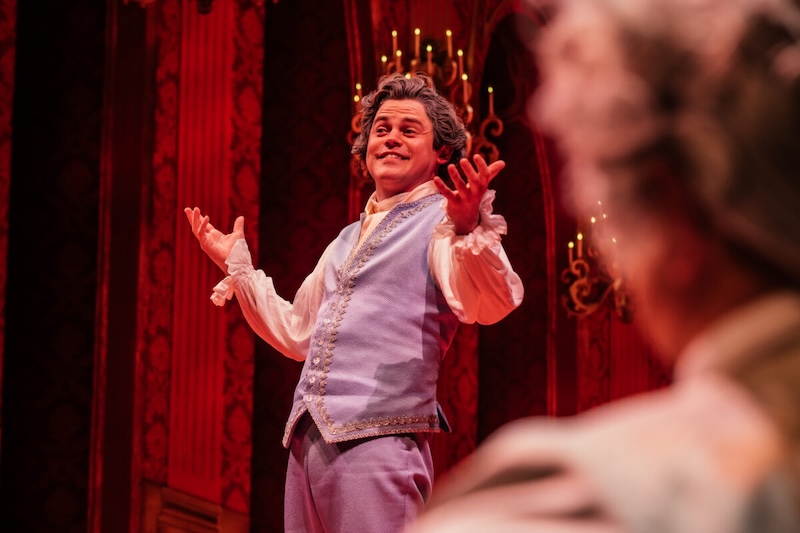
Sam Clemmett (Photo by Jeff Lorch)
Shaffer’s Mozart, a blend of research and invention, is a man-child, prancing around the stage, leaping into the arms of his elders, bedding his few, female students and those of the court composer Salieri. He’s not just a libertine; his bragging and conceit know no bounds, while his cat-and-mouse play with his young wife, Constanze (Lauren Worsham, in a delightful and textured performance), is as scatological and bawdy as it is puerile. And from this infantile person comes music so beautiful it would make God weep.
Mozart dreams up sublime musical progressions and combinations before scribbling them down. They tumble out of him, effortlessly. How could this infidel be the instrument for God’s music? What kind of joke is God playing? These are the questions that quite literally drive Salieri insane. His war is not with Mozart, but with God, with His betrayal of the inverse-Faustian bargain that Salieri thought they had both made. Their agreement was not a life of toying with the occult and relishing life’s endless pleasures in exchange for eternal damnation; their agreement was a life of moral virtue in exchange for eternal artistic recognition.
Salieri starts to see Mozart’s maddening presence at court as a betrayal and mockery of that contract. And so, Salieri starts to betray God in return: He clumsily tries to seduce Constanze in exchange for granting her destitute husband a position at court. He meets with her in private, like some junior varsity Jeffrey Epstein. Her disgust with him just makes things worse. Salieri’s aim is to destroy Mozart by using his influence to suffocate any opportunity that may come Mozart’s way, to literally starve him through abuse of power and a toxic work environment. Salieri waits for God’s punishment, and yet Salieri continues to rise at court.
And yet. And yet. Salieri’s eventual fall, by way of eternal humiliation, will come. Mays’s Salieri, on his dying day, gazes out into the audience, the ghosts of the future whom he has incarnated, his witnesses, and says to them, to us, that whenever we confront our own failures, we can pray to him, “the patron saint of mediocrity.”
Salieri was, however, a teacher of Beethoven and Schubert. He may not live on through his own music, but he certainly lives on through theirs. For the ghost of Salieri, with his grander aspirations, that’s probably cold comfort.
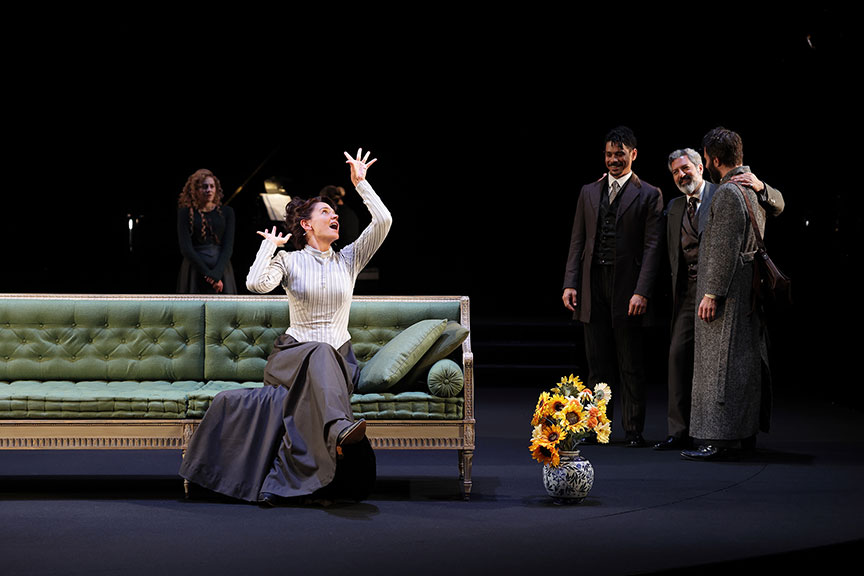
Celeste Arias, Katie Holmes, Charlie Barnett, Alfredo Narciso, and Alexander Hurt in “Hedda Gabler” at The Old Globe Theatre. (Photo by Rich Soublet II)
The day before viewing Amadeus, I’d been in San Diego to see director Barry Edelstein’s sumptuous production of Henrik Ibsen’s 1890 Hedda Gabler at The Old Globe Theatre, in a new 90-minute one-act version by Erin Cressida Wilson, commissioned by that theater. It features Katie Holmes in the title role. These two productions in succession led to a new realization, at least for me: that Amadeus is an echo of Hedda Gabler.
The quasi-child prodigy in Ibsen’s play is an aspiring academic named Eljert Lövborg (Alexander Hurt) whose intellect, like Mozart in Amadeus, reaches far beyond the rigid confines of the provincial Norwegian town where he lands. Lövborg, too, is or has been a libertine, and a recovering (for a while) alcoholic, whose writings envision new systems and shapes while imagining the future. This is all as intimidating to his local university peers as Mozart’s brazen musical inventions are to the barons and other aristocrats in the court of Joseph II. Jealousy.
Ibsen’s Hedda is the equivalent of Shaffer’s Salieri, but not because she has ambitions. To the contrary, she has none. Bored out of her mind, she’s newly wed at the age of 30 to a kind-hearted, self-absorbed scholar of medieval fabrics, George Tesman (Charlie Barnett). What the two characters (Salieri and Hedda) share are the plight of being boxed in, fully aware of their circumstantial and temperamental limitations. There are flames of brilliance in their midst, in the forms of Mozart and Lövborg, flickers being suffocated by their respective environments. Hedda’s toxic actions in the play are in response to that general sense of suffocation — by social expectations and the mediocrity in the air, not unlike Nora in Ibsen’s A Doll’s House.
In Wilson’s adaptation, Hedda describes her choice of husband. She was at an age when she had to marry, so she closed her eyes and pointed. Wherever her finger landed, that would do. Tesman spent most of their six-month honeymoon ignoring her, focused instead on his latest scholarly opus. And yet he cherishes her, or thinks he does, says he does. She couldn’t care less one way or another. The play opens upon their return from that honeymoon to a new home. Tesman’s relatives have made inordinate personal and financial sacrifices, including their retirement pensions, so the newlyweds can dwell there. Hedda picked that home on a whim, much as she picked her husband. She never really cared for the place, which they can barely afford. Their financial salvation, as well as Tesman’s sense of purpose, lies in a local professorship that he’s gunning for. He mentions it several times, clinging to hope. Problem is, Lövborg has returned from exile and might be aiming for the same job.
On the train from Redlands to San Diego, a young man in the same car as me was on his phone and suddenly started screaming in excitement, orgasmic: “Yes! Yes! YES!!!” Other passengers looked at him, perplexed. “I got it!” he responded to their stares, referring to a job offer for some IT company. “You don’t understand! It’s a six-figure salary! You don’t understand!”
There were a couple of fellows, retirees, across from me. One rolled his eyes, the other smiled sweetly at the new hire and said, softly, “congratulations.”
This young man was Tesman on the Metrolink, the center of his own universe. He spent the remainder of the ride speaking with somebody in Human Resources about how and when to start. Everybody on the train was a witness, however unwilling. Hedda Gabler is like a passenger on that train who, perhaps, missed her stop.
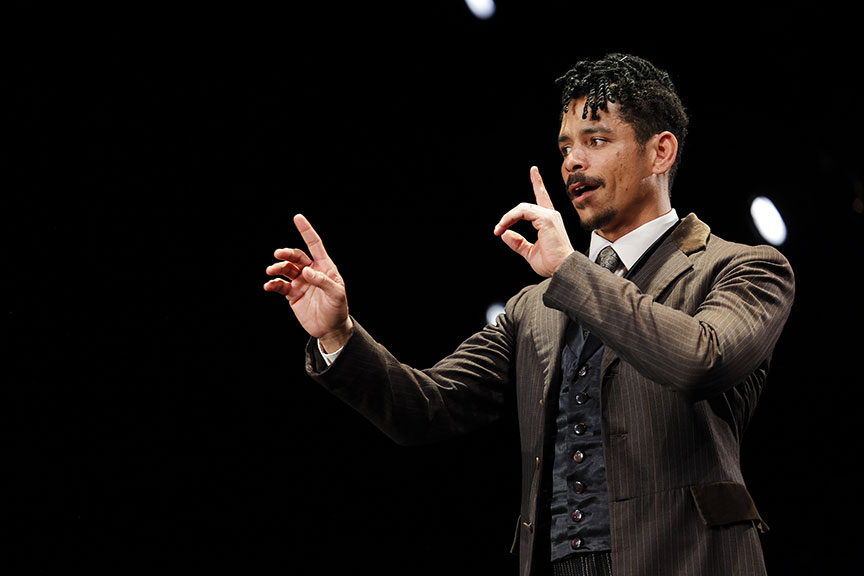
Charlie Barnett as Tesman (Photo by Rich Soublet II)
Her rage is not directed towards her husband. Her attitude towards him is indifference. Her rage is directed towards her God, who cursed her with a life devoid of purpose. Her petty jealousy, every bit as petty as Salieri’s towards Mozart, is directed at Lövborg’s mistress and devotee, Thea Elvsted (Celeste Arias), who is sneaking around behind her elderly husband’s back to help her source of inspiration, Lövborg, so as to protect him from the dangers of drinking, or to try to. Hedda’s purpose in this play, and in her life, is to destroy both of them, along with herself, as though to spite God in her pursuit of something, anything beautiful and eternal in this life. Even death, depending on how it’s handled, can be a thing of beauty, and is certainly eternal.
As in the case of Bach’s music, cultural attitudes towards Hedda Gabler have evolved over the decades. The play, and the title character, were initially met with abject hostility by the male drama critics of the late 1800s. What a monster. Who wants to watch a four-act play about somebody like that, they opined. The crime of her character is that she spurned obedience. Attitudes towards the character of Hedda Gabler have since grown more empathetic.
Underlying this entire play is the idea of cowardice. Everyone is so afraid of losing their job, their position, their marriage, their reputation. It’s going through life with such trepidation that Hedda can’t endure. She just wants to do something brave, and beautiful, and to encourage such bravery in others. This is currently the curse of our age at a time when authoritarianism is growing increasingly explicit — the cult of people placating, and remaining silent to protect their short-term interests, the hypocrisy and tedium of it. In my surveys of American theater, this is also the curse of our age, though not in these two productions, which prove an exception to that rule.
Wilson’s adaptation of the play is akin to Ingmar Bergman’s truncated adaptation of A Doll’s House. Like Bergman, Wilson serves up an outline of the play, a kind of Cliff Notes version, a distillation. Her language is sometimes American profane, with expressions such as “pissed off” and “fuck you.” The Norwegians have always been annoyed by Victorian-era British translations of Ibsen’s plays, which render them more ornate than in the original, arguing that Ibsen’s language was more earth-bound. Well, here, earth-bound is what we get. Aside from the issue of contemporary relevance, Wilson’s adaptation, to its credit, raises a larger issue of language itself becoming debased, pulling the play into our era.
Among this production’s many other virtues, including the fine ensemble, is the use of onstage pianist Korrie Yamoaka parked upstage at a grand piano, and accompanying entire scenes with Caroline Shaw’s beautiful score, with tonalities ranging from Avro Pärt to Edvard Grieg. The effect is conspicuously cinematic and ambient.
This same device, used also in Amadeus, was similarly employed with a live pianist by director Lee Breuer and his Mabou Mines’ 2003 version of A Doll’s House, which Breuer named Dollhouse. That production was far more conceptual than this one; it employed the Amazonian-tall Maude Mitchell as Nora, partnered with “small person” Mark Pavonelli as her husband Torvald (not unlike Tesman, as a character). In so doing, Breuer used the actors’ physicality to invert the image of patriarchy that was Ibsen’s primary target in that play. Almost literally, Breuer upended it so that all of its 19th century pieces fell out, and in so doing, the audience was obliged, if not compelled, to put then back together in the 21st century.
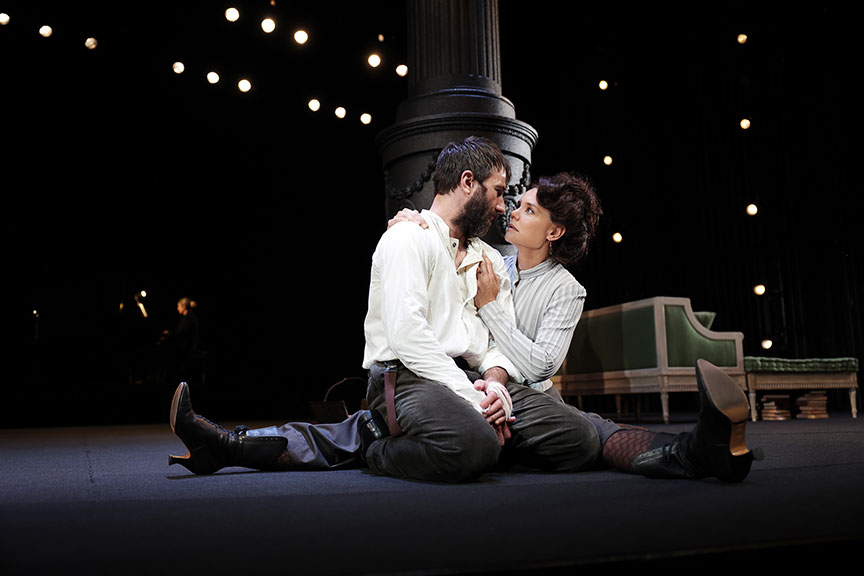
Alexander Hurt as Ejlert Lövborg and Katie Holmes as Hedda Gabler (Photo by Rich Soublet II)
Here director Edelstein takes no such liberties. Holmes’s Hedda is a classic version, performed with veracity and skill. She brings to Hedda a rich throated intensity coated in wry sarcasm, leading to a largely empathetic and often sardonic portrayal.
Actor Charlie Barnett wears Tesman’s obsequiousness on his sleeve. He has to. Wilson is not giving anybody four acts and three hours for these people to slowly reveal themselves, The poor guy gets 90-minutes from top to bottom, and he’s just fine.
Meanwhile, Alexander Hurt’s Lövborg is a lumbering presence, in pleasing counterpoint to the trope of the tortured genius-artist. The supporting players, such as Katie MacNichol’s trepidatious housekeeper, Berte; Alfedo Narciso’s predatory Judge Brack; and Saidah Arrika Ekulona’s Aunt Julie are all vivid and nuanced presences.
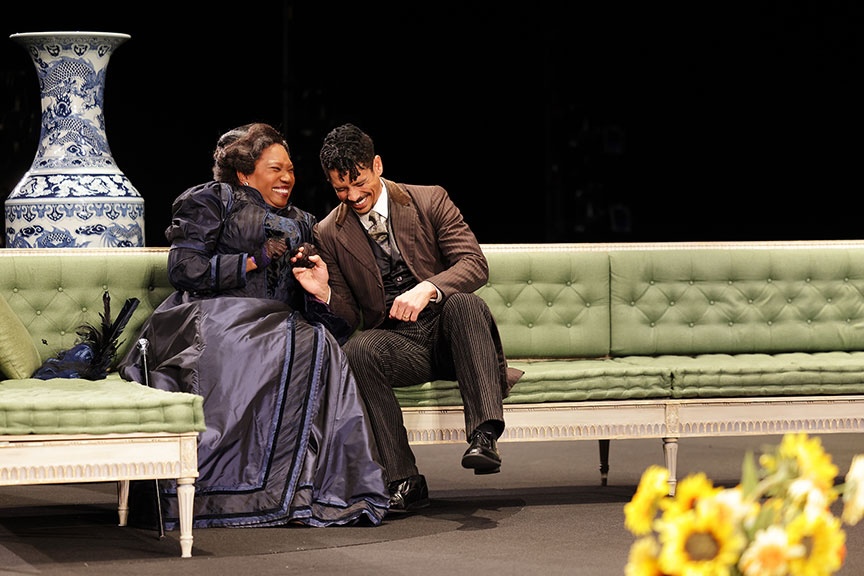
Saidah Arrika Ekulona as Aunt Julie and Charlie Barnett as George Tesman (Photo by Rich Soublet II)
The production’s sumptuousness derives from Mark Wendland’s scenic design. And by sumptuous, I don’t mean busy. To the contrary, Edelstein’s concept is to pare back this play to its essences, making it easier to draw contemporary parallels. This idea is embodied in Wendland’s interior set that hangs in space, anchored by an extremely long, narrow divan, offset by loomingly tall neo-classical urn that doubles as a fireplace. The room is expansive if not cavernous. The furniture is placed on a rotating stage, so that we’re given angles on this that shift from scene to scene. The design also permits two characters to interact seemingly miles apart, both seated on the same divan, until the action draws them together. Edelstein’s staging is choreographic and inexorably tied to the subtext. The craftsmanship in the staging, the set, and in David I. Reynoso’s costume design, is beyond reproach.
This is, nonetheless, more a survey of Ibsen’s play than a deeper investigation of it, specifically of what underlies Hedda’s diabolical behavior. Under other circumstances, I’d be whining about this, but not here. That’s because Edelstein’s production gets at what it’s aiming for and does so visually and musically as a kind of trance.
RECOMMENDED AMADEUS Pasadena Playhouse, 39 S. El Molino Ave., Pasadena. Fri.-Sat., 8 pm, Sat.-Sun., 2 pm, Wed., 8 pm, Thurs., 7 pm; thru March 15. www.pasadenaplayhouse.org
RECOMMENDED HEDDA GABLER The Old Globe Theatre, 1363 Old Globe Way, San Diego; check website for schedule; extended thru March 22. https://oldglobe.org