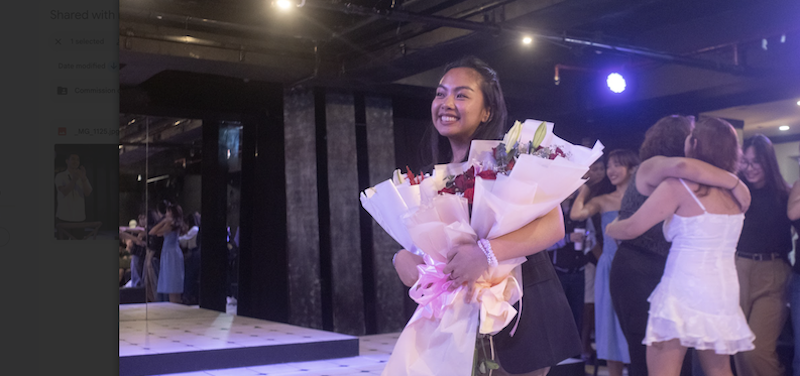
“First Love, Last Love” at Manila’s Playbook Club (Photo by Carl Chang)
Fifty Shades of Love
A Balmy Month of Theater in Manila
By Amanda L. Andrei
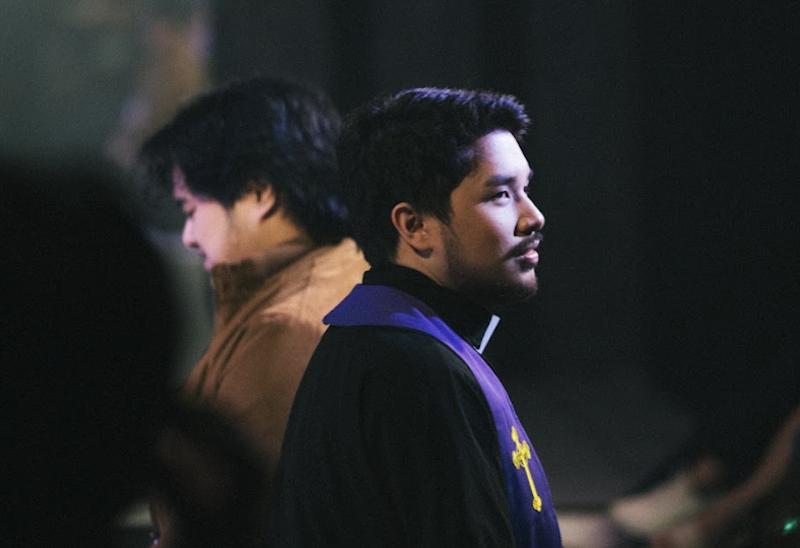
“First Love, Last Love” at Playbook Club (Photo by Earl Rafael)
“Filipinos love love.”
I’ve heard Filipino and Filipino American friends say this, often when an alluring story touches us, and we’re mulling over why. Such a statement shows we believe it’s in our culture to love and to enjoy love, but this statement often stops short to describe only romantic stories. After a month of theater in hot and rainy Manila, I extend this statement to consider a variety of Loves and ways to love, from crushes to family bonds to the sublime. When Filipinos love, they love hard.
Produced by a new theater company, Playbook Club, Rafael Jimenz’s twin bill of First Love, Last Love featured two futuristic one-acts about romantic relationships. In the tender two-hander Napapanahon (“Timely”), a young woman named Ruby (Erica Rafael) travels from the year 2032 twelve years into the past to 2023 in order to reunite with her high school boyfriend, Arthur (Los Akiyama). Under Cruz’s spirited direction, the two concoct a bittersweet chemistry. Rafael skillfully bears the weight of a dozen years’ memories, contrasting against Akiyama’s boyish charm and carefree guitar songs, until he learns the truth about a tragic event from the past, aka his current future.
The second play, Commission on Relationships, takes a darker view on a speculative Philippines where new laws require couples to register their relationships. The rationale? Attraction leads to love, which leads to babies, which leads to a greater strain on the environment and government resources. And as the writer Lau (Rafael Jimenez) and the teacher Luna (Dippy Arceo) discover, nothing kills romance like bureaucracy.
Zoë de Ocampo’s direction shines in expressionistic moments, such as Lau and Luna’s first physical intimacy, which moves like a slow contemporary dance (with elegant intimacy coordination from Missy Maramara). Other beautiful moments include Luna’s memory of a soured vacation with Lau which is simultaneously a confession to a priest (an attentive Cholo Ledesma), the three onstage in a pained trance (how Catholic), as well as Lau’s relatable frustration with Philippine bureaucracy, which explodes in a flurry of thrown paper documents.
These plays are intriguing and rich enough that they could expand into full-lengths. Regardless of their length, Jimenez, Cruz, and de Ocampo have the chops for creating visionary tomorrows, and it’s exciting to see where this company will go next.
The next romantic fix of the month came through a playwright named Eksena, whose Kapeng Barako Club: Extra Strong (barako is a Philippine coffee known for its intense, dark flavor). A devised and immersive adaptation of the popular play written in 2010 by Juan Ekis, this comic romp features six young friends in various stages of attraction to each other. While the original intimate play has been staged in coffee shops around metro Manila, director Karl Jingco gave it an interactive and more light-hearted turn in the Café Shylo showroom in Pasig City. Pre-show, I delighted in playing with handheld comic bubbles scribbled with Filipino love-related words, while I ordered an iced matcha latte at the bar (included in our tickets). The energetic ensemble engaged the audience with singing, call-and-response, and even inviting members up to don costumes and play along with the cast.
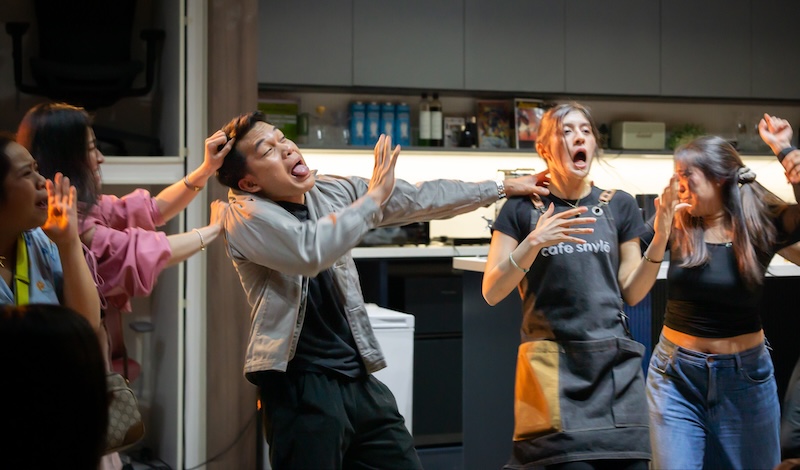
“Kapeng Barako Club” at the Café Shylo showroom in Pasig City (Photo courtesy Café Shylo)
“What does love taste like?” barista Shine (a bubbly Alexa P. SanDiego) asked the audience, comparing it to coffee as sweet or bitter. “If love were coffee, what kind of coffee would it be?” While the questions were on the nose, they were also stimulating and on theme, as if the characters and audience members were on a date with each other, nervous giggles and all. The laughter turned into gleeful howls, especially with Vanessa Alariao as customer Anna bouncing off the antics of her admirer Joel (a hilarious Edward Allen). And SanDiego capped off the friends’ shenanigans with a classic Filipino-in-love pastime: a full-bodied serenade that brought the whole cast and audience singing together.
With a shift from romantic love to familial love, Dalaga na si Maximo Oliveras: A Drag Musical Extravaganza written by Julia Icawat Enriquez and Mikaundre Gozum Santos dazzled audiences with its portrayal of chosen family among drag queens in Manila. Mixing drag show and musical genres (with original music from JJ Pimpinio), the J+Production and PETA Plus performance is a standalone continuation of the 2005 hit indie coming-of-age film Ang Pagdadalaga ni Maximo Oliveros (The Blossoming of Maximo Oliveros) and its 2013 adaptation Maxie: The Musicale.
Taking place in 2018, five years after the end of the film and musical adaptation, 17-year-old transwoman Maxie (Jamila Rivera) searches for new kin. Rivera’s Maxie is fresh-faced, earnest, and boldly holds her own against the quips and banters of the other queens, eventually finding her place with the House of Corazon and their matriarch, Mama Tars (the loving Jem Manicad). Director Melvin Lee and assistant director Meann Espinosa kept the audience laughing and applauding in rapid succession with the ensemble’s impressive athletic performances, musical numbers, and wit.
Video projections (designed by Jana Jimenez) wove social commentary amidst the sparkle and song, including archival news footage of the war on drugs and the 2014 murder of transwoman Jennifer Laude by a U.S. Marine, which sparked international outrage. Social media cameos from Philippine drag icons such as Luka Vega, Precious Paula Nicole, and Tita Baby advocated for one of the queens during an unfair arrest. And with the props and audience interactions, the hashtag #pantay (meaning “equal” in English) encouraged audience members to donate to PANTAY (Philippine Anti-Discrimination Alliance of Youth Leaders), an organization helping with legal cases within the queer community.
“Dalaga” in Tagalog can translate to “young woman,” or “maiden” (the English translation of the film title also captures the connotations of “blossoming” and flourishing). Twenty years after the debut of Maximo Oliveras on the big screen, adapted to a musical, and now her onstage sequel as “dalaga na” (“a young lady now”), it’s clear that Maxie is more than a beloved character. She’s a legend.
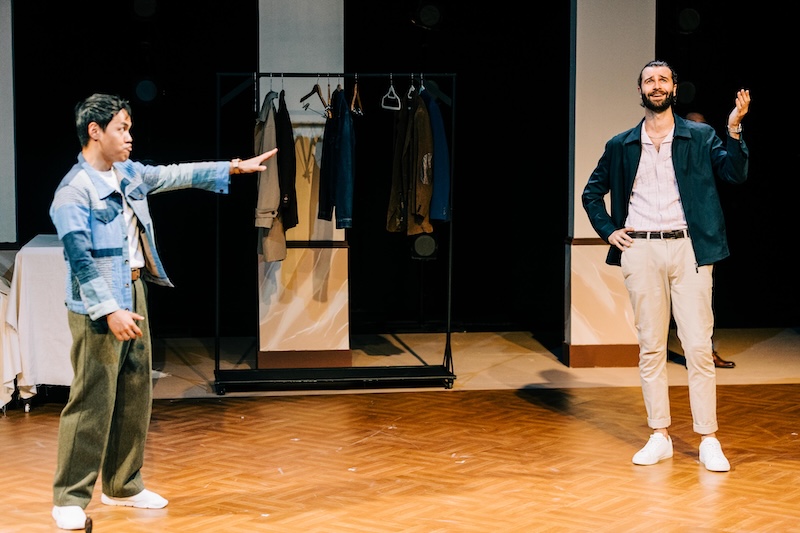
Yasmena Reza’s “Art” (Photo courtesy Repertory Phillipines)
Art by Yasmina Reza (translated from French by Christopher Hampton), the final show I attended of the month, might seem like an odd fit as seen through the lens of Filipino love and devotion. And indeed, the bones of this multinational show (a collaboration between artists based in London, Manila, and New York City) felt so Parisian, with Reza’s acute dialogue satirizing French cultural attitudes among critics, artists, and laypeople. Yet Repertory Philippines’s production of this satire sharpened my sense of love by presenting a world devoid of it: all the focused attention, none of the generosity or warmth.
When dermatologist Serge (Martin Sarreal) spends $200,000 on a painting that appears to be a blank white canvas, his long-time friend Marc (Freddy Sawyer) takes it personally. Believing that Serge has lost all sense of taste and therefore his values, Marc provokes his friend into arguments, likewise drawing in their indecisive companion Yvan (Brian Sy) into the quarrels. Art, rather than serving as a font of mystery and beauty, becomes an instrument to express superiority over each other.
Consequently, director Victor Lirio leads the three frenemies through various shades of neuroticism and narcissism, with excellent fight choreography from Maisie Carter punctuating their domineering behavior. Deputy stage manager Janix Bernardino also deserves a special shoutout on double duty as the maid assisting with set transitions and cleanup, highlighting the classism baked into the men’s snobbery. When affection turns inward—fixating on how a friend or beloved can validate oneself—this is love damaged.
Of the many ways to translate “I love you” into Filipino, “mahal kita” is most common. In addition to meaning love, mahal also means “expensive” and “precious”—it conveys not only value, but treasure. And “kita,” a dual pronoun that merges “I” and “you” together, can be considered as a linguistic reflection of a Filipino culture that merges the self and the other. As writer Edilberto N. Alegre notes, “kita” indicates “the one-ness of two.” When Filipinos speak of loving love, it comes from a desire to see and revel amidst this one-ness of two and a unity among others. Damaged love should be repaired, budding love should blossom. Treasure is always worth sharing.