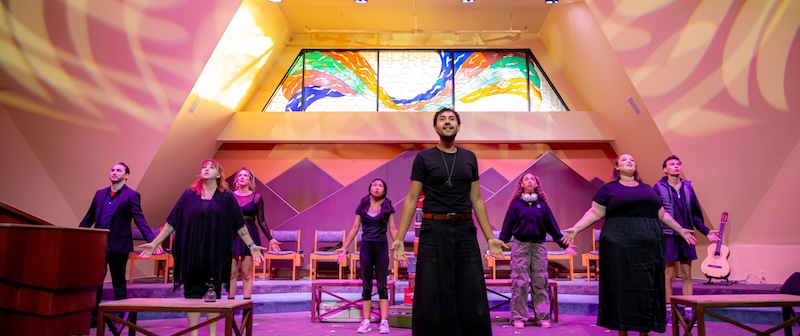
Members of the ensemble (Photo by Frances Gacad)
Reviewed by Socks Whitmore
The Wayward Artist
Through August 3, 2025
In 2018, the Wayward Artist opened their very first season with a sold-out run of Stephen Schwartz’s Godspell. Seven years later, the company has come full circle as they inaugurate their new artistic home at Irvine United Congregational Church with the same story reimagined.
Directed by Founding Artistic Director and IUCC pastor Craig Tyrl, the Wayward Artist’s 2025 production of Godspell is a musical retelling of the Gospel according to Matthew, a staging of an anthology of Biblical parables against “a backdrop of social change and spiritual awakening.” As the disciples, the ensemble takes turns playfully acting out different stories under the guidance of Jesus, who uses each parable to emphasize a teaching on faith and compassion.
First written by book-writer John-Michael Tebelak as his master’s thesis in 1970, Godspell is a product of the late 60’s and early 70s, embodying a discontent with the status quo, the desire for community, the drive for justice and equality and the search for greater meaning. This is why the show focuses primarily on the humanist teachings of Matthew while completely omitting topics like the resurrection. Recontextualized for the political unrest of 2025, many of the teachings bear relevance, and Tyrl’s direction aims to make connections between the ancient texts and today’s events.
In “The Tower of Babble,” an opening number often omitted from productions, the cast is dressed in all black while AI-generated videos of various philosophers bicker on what appears to be a Zoom call. Technology is clearly made the center of attention: the cast has their phones confiscated by their teacher, while a cacophony of digital tones plays over an animation of an AI digi-sphere. The artistic choices here are a bit confusing and underbaked: the images use a disjointed collection of various devices and angles; the opening voice over is difficult to understand due to an overly reverberant audio quality; the music is under-energized; and the whole scene is generally hard to follow. It’s not clear if the audience is meant to see AI as a tool, a distraction, or an existential threat.
In the third number, the cast changes onstage into colorful clothes and start to play with a lot more props. Many of the ensemble members don what appears to be an election campaign button, though upon closer inspection it is actually a colorful heart symbol with an equals sign for equality. During the Beatitudes, a clip montage shows folks of different walks (undocumented, disabled, homeless, queer) deserving of love, and during “All Good Gifts,” the screens displays a rainbow illustration. The recurring rainbow themes are the most obvious of several different strategies to weave inclusion and progressive ideals into the narrative. Though well-intentioned and occasionally poignant, in execution they sometimes come off a bit heavy handed and broad.
Tyrl’s modernist approach encompasses the infusion of numerous pop culture references into the parables. References to shows like Star Wars, Game of Thrones, Harry Potter, and The Lion King are employed to illuminate these stories, complete with acapella renditions of iconic musical themes. These cheeky creative choices makes the production especially unique (though audiences unfamiliar with Godspell or the Gospel of Matthew may find themselves a bit confused).
One of the most striking inclusions is placed between the “Learn Your Lessons Well” reprise and “Turn Back, O Man.” Viewers may recognize the infamously vulgar audio of a leaked clip from 2005 where Donald Trump makes a number of crude remarks about women. This moment stands out as the most politically brazen, closely followed by the use of hand puppets to represent the 2024 presidential candidates (Trump, Vance, Biden, and Harris). Yet, in spite of the dig on Trump, the sentiment appears neither Left nor Right; instead, the message seems to generally critique politicians and suggest that they “forswear thy foolish ways.”
Though IUCC’s sanctuary is less technically advanced than other theatrical stages, the recent upgrades to their system allow for some lovely lighting and shadow effects. With all the seating on the same level and the large pulpit on stage right blocking the action, finding a good view of the low stage can be a bit challenging. Sometimes the actors come into the aisles to engage the audience, as they do during a game of charades with Jesus. The vocalists perform well with the recorded instrumental tracks, though the clapping intro to “Light of the World” is a bit awkward. There are moments of fun choreography (Olivia Amigo), albeit the isolated use of ASL in “Day by Day” sticks out and makes one curious if any Deaf or hard-of-hearing artists were consulted.
The Wayward Artist team notes that audiences may worry that their new location will lead to their theatrical productions becoming less “edgy,” but this rendition of Godspell proves that they are willing to continue to take risks. Though the company does not identify as a Christian nonprofit or seek to proselytize its artists or audiences, Tyrl’s pursuit of full-time ministry with IUCC has intertwined with it around shared values of love, justice, and radical inclusion.
The Wayward Artist, Irvine United Congregational Church, 4915 Alton Parkway, Irvine. Thurs.-Sun., 8 pm; thru Aug. 3. thewaywardartist.org/godspell Runtime: one hour and 40 minutes with one intermission