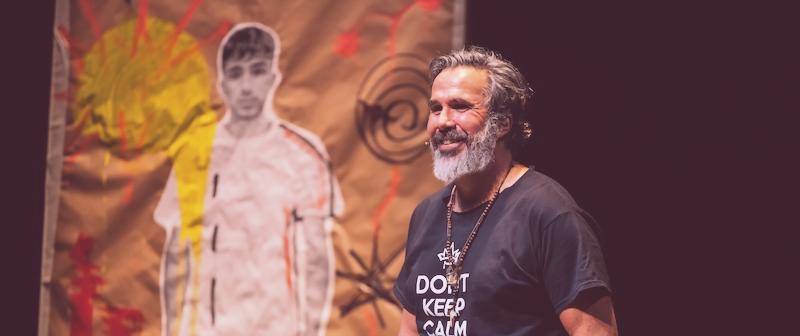
Manuel Oliver (Photo by Cameron Whitman)
Reviewed by Joel Beers
Kirk Douglas Theatre
Through November 2
RECOMMENDED
What’s most astonishing about GUAC, Manuel Oliver’s one person show co-written with James Clements, is how entertaining it is: funny, warm, irreverent, risqué at times, self-deprecating at others, and interactive, even encouraging the audience to use cell phones to film, photograph, and, in one remarkable moment, transport the play from inside the theater to the outside world.
It’s astonishing because this 100-minute play is also a nightmare — one lived by performer and co-writer Manuel Oliver since Valentine’s Day 2018, when his 17-year-old son Joaquin, nicknamed Guac, was murdered along with 16 others at Marjory Stoneman Douglas High School in Parkland, Florida.
Directed by Michael Cotey, GUAC, receiving its West Coast premiere, is about that horrific shooting; Oliver and his wife Patricia’s evolution from grief-stricken parents into activists; and a plea for audiences to join the fight against gun violence in America. But it’s also an act of creative defiance, rooted not in politics but in family — specifically, the bond between a father and a son. Oliver shows, powerfully and poignantly, that the connection didn’t end when four bullets tore into Joaquin’s body; it continues to evolve.
The play begins with Oliver entering quietly from the back of the theater, carrying a carton. Downstage, he lays out its contents: sunflower plants, paint canisters and brushes, a hammer. After blessing a sneezing audience member (unscripted), he delivers his first line: “When you lose a son, what do you do?”
For the next hundred minutes, he unravels the choices he’s made in answering that question.
He introduces his wife, daughter, and the family dog through a series of life-sized photographs, torn from a paper scrim and laid on the stage before finally revealing his son’s image, a portrait that remains in full view throughout the show. He recalls life as a successful Venezuelan restaurateur when he and Patricia decided to move somewhere safer to raise their two young children — ironically settling in the bucolic-sounding city of Parkland. He remembers washing dishes for $7.50 an hour under the table and the irony of the couple becoming U.S. citizens on Jan. 20, 2018 — Donald Trump’s first inauguration day.
Mostly, though, he celebrates magical moments with his son, whom he calls his best friend and guide in navigating a new country: movie dates drowned in buttered popcorn; coaching
Guac’s basketball team despite knowing nothing about the sport; the time Guac’s favorite guitarist, Slash, played the theme song from his favorite film and book, “The Godfather,” as father and son rocked out in the front row; and their devotion to the art of the air guitar — always stopping the car when “Freebird” came on.
These reminiscences culminate in a moving sequence as Oliver, a painter and visual artist (not an actor, he insists), adds color to his son’s image, while a recording of Frank Ocean’s “Moon River” — released the same day as the Parkland shooting — plays. The moment captures both the tenderness and ache of trying to preserve memory.
Then the tone shifts. We see Joaquin’s final night and day: his meticulous choosing of flowers to give his girlfriend the next day at school to celebrate Valentine’s Day; the chaos of the shooting; the rapid devolution of his father’s hope in the 12 hours he agonizes over his son’s fate — from hoping he just dropped his phone and is safe somewhere, to hoping he was on the other side of the school, to hoping he was injured but not too badly, to hoping his death was quick and painless.
From there, Oliver recounts how he and Patricia transformed pain into purpose — his climbing a crane near the White House in protest, their meeting privately with President Biden, and founding Change the Ref, a nonprofit that uses art, music, and disruptive actions to advocate for gun reform. (The organization has also created an installation in the theater’s lobby combining visual art, sculpture, and video.)
Though Oliver’s anger and frustration toward America’s gun culture is palpable, GUAC never feels like a political screed. His charisma, warmth, and humor ground the show in humanity. He’s not screaming at politicians or preaching to the converted. Instead, he’s inviting the disengaged — or semi-engaged — to join the fight, whether by buying a T-shirt or supporting any gun reform group they choose.
To those who might think he’s using his son’s death to push a political agenda: you’re right. But he’s also furthering Joaquin’s own activism, borne out in letters and retweets read toward the play’s end.
That’s also when Oliver answers his opening question. Holding a photo of Joaquin goofily playing air guitar, he admits he misses his son the activist — but he misses his son more. And the only thing a father can do after losing a son, he says, is continue their work. His work isn’t painting or protesting — it’s being a father to his son.
Based on this loving, celebratory, and urgently compelling memorial to his son — and the ongoing legacy it furthers — it’s clear that this work continues.
Kirk Douglas Theatre, 9820 Washington Blvd, Culver City; Tues.-Thurs., 7:30 p.m., Fri-Sat., 8 p.m., Sun., 1 p.m. Also Sun., Nov. 2 7 p.m. No show Halloween. Thru November 2. https://centertheatregroup.org/shows-tickets/douglas/202526/guac/ Running time: 100 minutes with no intermission.