
Homeward Bound
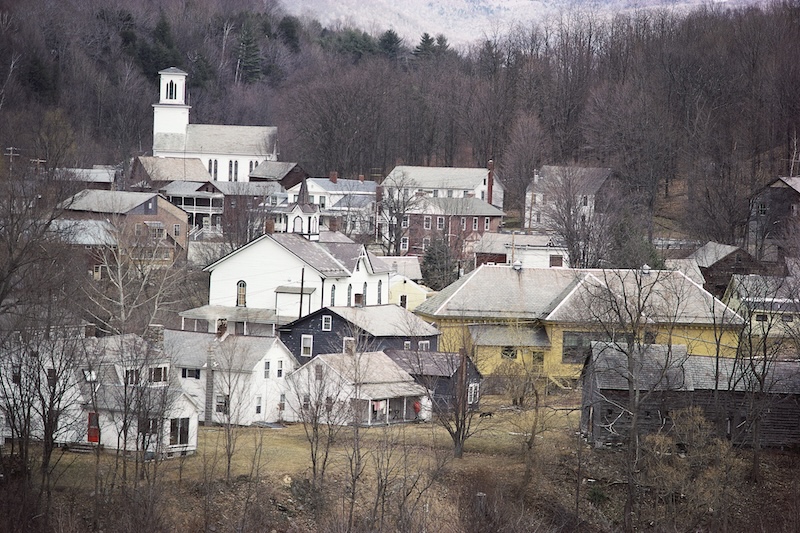
Group Rep’s Our Town
RECOMMENDED
For two of its three acts (performed with one intermission), Thornton Wilder’s 1938 Our Town concerns the comings and goings of ordinary people in an ordinary town, Grover’s Corners, New Hampshire, in the dawning years of the 20th century. Its amiable sensibility and frame of reference are ancestors of radio host Garrison Keillor’s A Prairie Home Companion, his long-running storytelling-variety show set in “Lake Woebegone,” Minnesota, “where all the women are strong, all the men good looking, and all the children above average.” That weekly show, distributed by Minnesota Public Radio from 1974 to 2016, featured a wry highlight — Keillor’s recitation of “News from Lake Woebegone,” which emerged as a master class in storytelling.
Our Town’s small town humanity paved the way for all that. It employs two dozen actors, which renders it financially unproduceable today, at least in its original form, for any theater that doesn’t have some kind of Actors’ Equity “company” exemption or that bypasses union actors. For decades, this classic has been a mainstay of high school and community theaters, often derided as sentimental by people who don’t know any better.
This is because it focuses on the courtship and eventual marriage of two cross-town families: Emily Webb (Faye Reynolds), the bright and curious daughter of the local newspaper editor (Fox Carney), and George Gibbs (Casey Alcoser), the comparatively dim-witted son of the town physician (Larry Toffler). In one scene, Mr. Gibbs reduces his son to tears of shame by pointing out that his mother no longer bothers to ask him to bring in the wood because he doesn’t — instead, preferring to do it herself while he’s off playing baseball.
George and Emily court, quasi-secretly at first, through their respective bedroom windows. He needs answers to high school homework questions – a request that places Emily in an ethical quandary. George’s act of supreme chivalry is to treat her to a strawberry soda at Morgan’s Drugstore, and Emily’s resistance crumbles in the face of such extravagant charm, even if George has to run home after the liaison to find the money to pay the bill. He offers to put up his watch as security, but there’s no need. Grover’s Corners runs as much on trust as it does on diligence.

Terror on the high seas: Foreground: Casey Alcoser and Faye Reynolds; Background: Larry Toffler, Kathi Chaplar, Christina Conte, Lew Snow, Fox Carney, Noah Dittmer (Photo by Doug Engalla)
This all sounds very sugary, and it’s not bereft of sweetness, hence the misinterpretation of the play being sentimental. There is, however, a town alcoholic whom nobody knows what do with, and who dies young. More important to the author than sweetness is his cosmic view, consistent with his 1943 play, The Skin of Our Teeth, which presents a similarly expansive parable of humanity through the millennia. Both plays received Pulitzer Prizes in their day. It’s fair to surmise that Wilder’s 10,000-mile high view is more important to him in Our Town than the play’s sugar, because an almost brooding austerity is the culminating view, arriving in Act 3 and transforming the play into something with a chill from the grave – presuming the director has the sensitivity and intelligence to recognize it as such. At Group Rep, director Mareli Mitchel-Shields hits that mark.
In Act 3, Emily has died in childbirth and, still tied spiritually and emotionally to the land of living, she nonetheless must join the town’s dead souls in the local cemetery. The art of dying is the art of letting go, and Emily resists this inevitability, having died so young, despite the warnings of her deceased cohorts, particularly her now humorless and world-weary mother-in-law (Kathi Chaplar). To let go of life, one must grow indifferent. Indifference is the opposite of living. To enter oblivion, one must also learn to forget, an idea likely influenced by Christina Rosetti’s 1850 poem that Wilder surely would have read. The poem is simply named, “Song”:
“When I am dead, my dearest,
Sing no sad songs for me;
Plant thou no roses at my head,
Nor shady cypress tree:
Be the green grass above me
With showers and dewdrops wet:
And if thou wilt, remember,
And if thou wilt, forget.
“I shall not see the shadows,
I shall not feel the rain;
I shall not hear the nightingale
Sing on as if in pain:
And dreaming through the twilight
That doth not rise nor set,
Haply I may remember,
And haply may forget.”
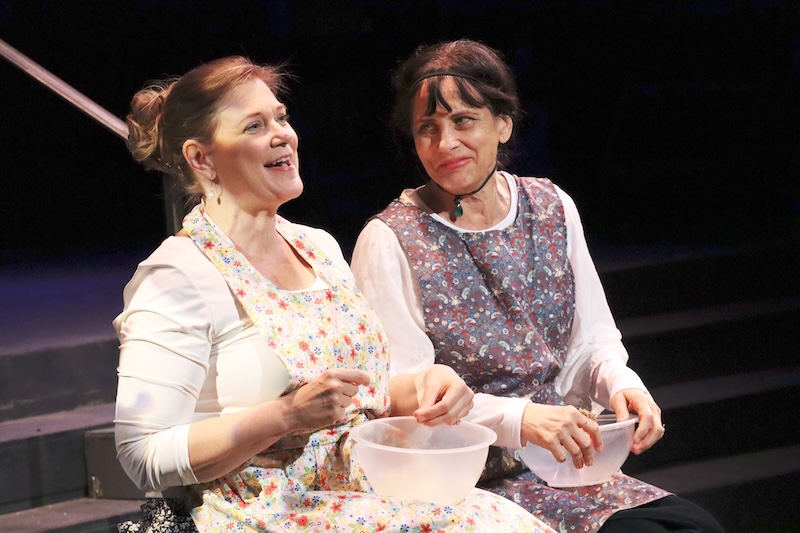
Mothers-in-law: Kathi Chaplar and Christina Conte (Photo by Doug Engalla)
In Our Town, with that distillation of life and death, of remembering and forgetting, comes a kind of Dickensian cautionary tale: While one is alive, for the love of life, pay attention to each other.
When the play was produced, just as World War II was flaring in Europe, the style of American new plays was to set them in living rooms and kitchens. Wilder, however, belonged to theater’s Brechtian, experimental wing, choosing instead to set his play on a bare stage in a theater, where all the theater’s equipment, its pulleys and ropes, were exposed.
Here, MJ Mitchel-Shields’ set design throws in a pair of rolling step pieces in order to provide some variety in elevation.
The play is narrated by a Stage Manager (Neil Thompson), who assumes the perspective of a cultural anthropologist and sometimes thanks the characters after they’ve completed a scene. Sometimes they nod or wave back in acknowledgement. Actors arrive from all corners of the stage, and through the audience.
Ramona Reeves’ era-specific costuming has one of the female dead souls in Act 3 wearing a suffragette wrap (“VOTES FOR WOMEN!”), suggesting in her design that there are some convictions one takes to the grave. Once deceased, one may not recall those convictions (she, and those parked around her, appear grim), though one is nonetheless rememberedfor them.
Characters in the play refer to people needing to go through life in pairs, in a world with zero gender fluidity – an existential pressure to marry (with the opposite gender) that similarly informed the plays of Tennessee Williams and William Inge, both gay mid-century playwrights. The void of sex education rendered Emily’s wedding night terrifying, she confides.
The ignorance and indoctrination (born of scripture) – there are churches of multiple denominations all over Grover’s Corners – are very much part of the ambiance that Wilder ensnares, here left untouched, thereby providing a snapshot of the high-pressure attitudes-gone-by that inform so much our current culture wars.
This is a lovely, unified, and dignified production populated by capable actors who look like the denizens of a small town rather than movie stars (a drawback in so many local theater productions). Director Mitchel-Shields has a keen eye for situating her massive cast around the room to enhance the focus of each scene and to avoid clutter. This skill is augmented by Kathi Chaplar’s musical direction – specifically of a chorus that hums the melody to Elder Joseph Brackett’s “Simple Gifts,” that Aaron Copeland incorporated into Martha Graham’s ballet, Appalachian Spring.
Mitchel-Shields’s production, faithful to Wilder’s intent and style, is remarkable for being both ambitious in scale while preserving mid-20th century essences, like an old photograph that sparks time-locked memories that somehow, at the same time, feel eternal. I’m guessing, from what we know of his correspondences, that’s precisely what Thornton Wilder would have wanted.
The Group Rep Theatre Main Stage, 10900 Burbank Blvd., N. Hollywood; Fri.-Sat., 8 pm, Sat.-Sun., 2 pm Sat., Dec. 6, 2 pm; thru Dec. 21. https://thegrouprep.com. Running time: two hours and 20 minutes with a 15-minute intermission.