



Marcia Cross and Matt Letscher (Photo by Jeff Lorch)
Reviewed by G. Bruce Smith
Ruskin Group Theatre
Through March 22
RECOMMENDED
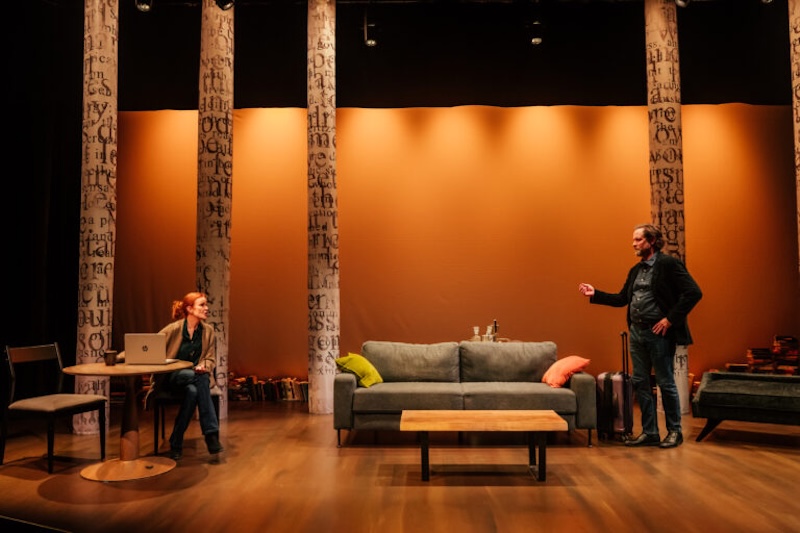
Marcia Cross and Matt Letscher (Photo by Jeff Lorch)
Honour, Ruskin Group Theatre’s debut play in its gorgeous new Kaplan Family Stage, is the kind of play you should read after you see it. That’s because it is filled with so many interesting ideas — on subjects ranging from love to passion to fidelity to the morality of writers vs. journalists — that it is almost impossible to absorb each of these ideas in one sitting.
That’s not to say that Honour – which, yes, is a very smart script by Joanna Murray-Smith — is not without emotional heft. Quite the opposite. But after being captivated by the action on stage, it would be understandable to want to go back and review the many concepts that come in hard and fast in the dialogue.
The set-up for Honour is well-worn: A successful man (Matt Letscher as George) in his early 50s leaves his devoted wife of 32 years for a younger woman. But what comes after that — from the viewpoint of four people — is what makes the story uniquely compelling.
The play opens in the tasteful living room (more later on scenic designer Stephanie Kerley Schwartz’s lovely work) of George Spencer’s home in London. He is being interviewed by a young attractive woman, Claudia (Ariana Afradi), who is contributing to a collection of interviews with “10 Great Thinkers.” George is a book author and writer with The Guardian newspaper. Claudia, herself an aspiring writer, is clearly enamored with George’s intelligence.
Meanwhile, it’s revealed that George has been (ostensibly) married happily to Honor (Marcia Cross) for more than three decades. (Honor, with no “u,” is the British spelling when it comes to a name.) They have a nice home, a daughter Sophie (Jude Elizabeth Mayer) in university, and a comfortable life together. However, we also learn that Honor had early success and critical acclaim with her first book published 30 years earlier. Since then, she has not published another work, and it’s clear that George’s career became Honor’s focus in the relationship.
When Claudia seduces George and he leaves Honor to live with her, we see the complex layers of emotional reactions to this life-changing event, particularly those of the three women.
Especially dynamic are the scenes between Claudia and Honor. Claudia, confident in her views, needles Honor about her decision to put her writing career aside for her husband. “Love gets suffocated by inequality,” she tells Honor. Claudia is often cruel in her remarks (in a couple cases, literally drawing gasps from the audience), contrasting what she sees as Honor’s pedestrian marriage to her passionate relationship with George. Yet, we learn that not all is as it seems with Claudia.
(Interestingly, Claudia wants to be an intellectual power couple with George, saying “I want to be brilliant together.” Arguably, such an ambition would be a head-scratching concept in the U.S., a country that is decidedly anti-intellectual.)
Claudia is clearly an intriguing and largely mysterious character. Yet, if there’s a weakness in the script, it is in the reasons behind Clauda’s actions. We don’t know why she is the way she is except for a reference to her wishing that her parents had been bookish. And she makes a sudden dramatic change near the end of the play, but it’s unclear what prompted it.
Sophie, meanwhile, is angry at her father, calling him weak and pathetic — but also at her mother for being too accepting of George’s betrayal. And though not sympathetic to Claudia, she nevertheless admires her for her sureness.
Clearly, it is Honor who has the biggest stakes in this sudden upending of her life, and her character arc is fascinating, and sometimes heartbreaking, to watch.
The entire cast is superb under the sensitive direction of Max Mayer, who has expertly guided his actors as they peel back the layers of Murray-Smith’s text. A special nod to Cross, who, in a nuanced performance, beautifully captures the many emotions Honor goes through as she makes her journey.
A note about the scenic design: Ruskin’s 80-seat Kaplan Family Stage (the main stage of two spaces) has high ceilings that has left room for designer Schwartz to create several striking, soaring columns with words and letters printed on them. In addition, upstage and on the sides of the stage are piles of books that complement the columns.
Ruskin Group Theatre, 2800 Airport Avenue, Santa Monica; Thurs.-Sat., 8 pm, Sun., 2 pm; thru March 22. ruskingrouptheatre.com. Running time: One hour, 40 minutes with no intermission.