


The certainty of Jake in “Right”: Mitch Rosander (Photo courtesy of the The Whitefire Theatre)
Inherit the Dearth
Darryl Vinyard’s Right and Jonathan Spector’s Eureka Day
 1564 was a pretty good year in a small corner of planet Earth. That was the year Shakespeare was born in England, and Galileo was born in Italy. Both men would come up with words and ideas that would outlive them by centuries. To do so, they observed the world around them, and they read about the world that preceded them.
Shakespeare’s plays conjured histories, real and imagined, for the purposes of revealing who we were, and who we are. Galileo, being a scientist and mathematician (an astronomer mainly, but also an inventor), measured stuff: the stars, the moon, the sun, and what is moving where, and why. In so doing, his purpose wasn’t so much to reveal who we are, but where we are. His empirical approach pre-dated him, as far back as the stoics, Aristotle, Epicurus and Roger Bacon. They were all practitioners of the scientific method long before that term was even invented: Come up with a theory, then prove it with evidence, with rigorous, measurable evidence. If somebody else can come with a contravening theory to knock the first theory off its perch, based on changing conditions or a new perspective, offer the proof and the new theory will take over. There’s some illusion that a proven scientific theory is fixed. It was never such. This is why discrediting science and scientists because their theories evolve is such a fool’s errand. Yet there’s plenty of that going on right now.
After years of observing the motion of extra-terrestrial bodies through a telescope that he invented, Galileo concluded that our eyes are deceiving us: That the Earth is not at the center things, static, as imperial as a throne around which all else orbited. No, we’d gotten that all backwards; our home, and all of us upon it, are spinning around the sun in a wobbly sort of way. The sun is not actually rising or setting as it has always appeared and disappeared, with such regularity. Rather, we are spinning in circles around the star that gives us life, Galileo asserted. And he used mathematics to prove it.
The Catholic Church did not like Galileo’s theory. They thought God had been quite clear on this, that we had been created in His image, and therefore, we were at the center of things. Galileo had also scribbled out a couple of articles that insulted Pope Urban VIII, or so the Pope imagined. And so, after the Roman Inquisition of 1615, Galileo was placed under house arrest for the remainder of his days.
Shakespeare played it comparatively safe. He never insulted his patron, Queen Elizabeth I. And in his plays, the English never lose the war, which, in history they did, frequently. That was cunning of Shakespeare. It could be argued that he capitulated, but it didn’t seem to do him any harm reputationally. In the department of diplomacy, he was the Kier Starmer of the Elizabethan era. He annoyed courtiers and competitors, but he muddled through.
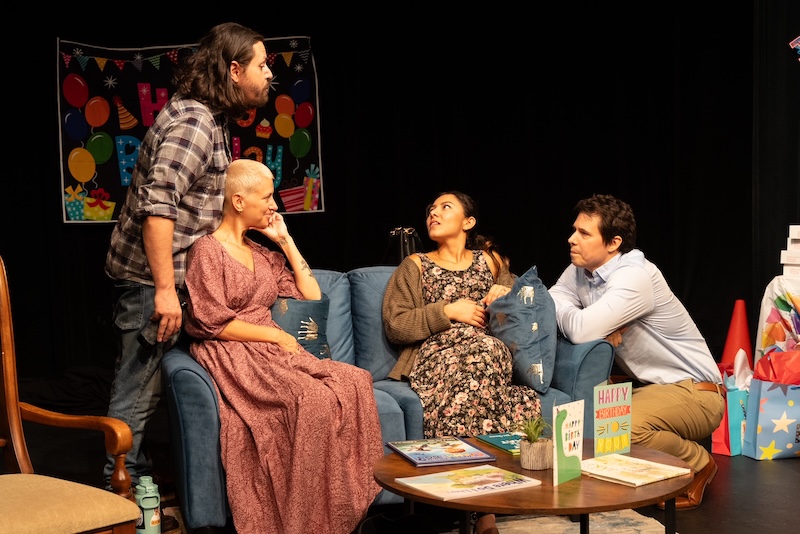
Mitch Rosander, Sara Maraffino, Gloria Ines and Eric Keitel in “Right” (Photo courtesy of The Whitefire Theatre)
I mention all of this because of two plays about science, art, and truth-seeking, performing concurrently on different sides of the San Fernando Valley: The world premiere of Darryl Vinyard’s Right (Whitefire Theatre in Sherman Oaks) and the California return of Jonathan Spector’s Eureka Day (Pasadena Playhouse). They’re both about people squabbling over the efficacy and safety of vaccines for children. In Right, the disease is the measles; in Eureka Day, it’s the mumps. The plays set very different tones for discussions of much the same issues: vaccines, and our culture’s diminishing respect for science, and scientists; for experts and for expertise.
The New York Times recently posted an essay by Dr. Jay Bhattacharya, the new director of the National Institutes of Health, underscoring the point-of-view, amplified by the current administration, that scientists aren’t to be trusted, for all the mistakes they’ve made. Replied Erik Frederiksen from Asheville, North Carolina in the comments:
Your smartphone is built from sand, oil and rocks. Sand for glass and chips, oil for the plastic and the right shiny rocks for rare earth minerals and palladium. It has Einstein in it, without special and general relativity, the nice lady who tells you where to go will get you lost. It has quantum physics built into it. Science and some engineering, technology, marketing and design. And still you have people pulling out their smartphones and sending out tweets and posting on internet threads that scientists don’t know what they are talking about. Try giving a bunch of congressmen some sand, oil and rocks and ask them to make a smartphone. Monkeys would type Shakespeare before you got the phone.
Right is an extended family squabble, set in a living room, where two brothers and their wives gather around the detritus of a birthday party for one brother’s 5-year-old. Almost nobody showed up to the party, kind of heartbreaking, because the boy’s parents never vaccinated their kid. This wasn’t an oversight. It was a choice. The family squabble is over whether that unvaccinated child will be permitted by his uncle and aunt (the other pair in the room) to be around their yet to be born child. The proposed remedy — kindly get your child vaccinated — sets off a firestorm of recriminations lashing into cemented walls of certainty, and propelled by the blended fuel of science and pseudo-science.
In Eureka Day, the same request, demand, get your kids vaccinated, comes from the City of Berkeley Department of Public Health Department, which has identified one child from the Eureka Day private elementary school as having mumps. (Almost all of the action unfolds in the Berkeley, California school library.) The mandate is that all children receive a mumps vaccination before they’re allowed back on school grounds. Five members of what’s essentially a P.T.A., that goes by the name of the Executive Committee ponder how to grapple with this order, how to discuss it among the parents (clients, really) who feel that they know what’s best for their kids. Unlike Right, Eureka Day possesses a satirical edge, lampooning the “enlightened” denizens of the Bay Area and their ever-so-inclusive and sensitive lingo (“Thank you, I feel heard.”), which masks some toxic righteousness, selfishness and self-absorption.

Rick Holmes and Mia Barron in “Eureka Day” at the Pasadena Playhouse (Photo by Jeff Lorch)
Though an ensemble piece, the dramatic tension keeps returning to the character of Board President Suzanne (the ever-so-persuasive and textured Mia Barron, whose principles seem to wobble, until the momentum turns against her ultimate position, on which she doubles down). Suzanne heads up the anti-vax squad on the Committee and does so with a pained bombast stemming from a harrowing experience she had with a vaccine. To rationalize her position, clearly at odds with public health, she invokes any number of dubious studies.
This couldn’t be more topical, recalling Monday’s announcement by the Federal Drug Administration’s Marty Makary, Health and Human Services director Robert F. Kennedy Jr., and the President of the United States, all invoking a connection between Tylenol taken by pregnant women and autism in their newborns. (Pregnant women have been routinely taking Tylenol to ease the multitudinous aches and pains of pregnancy. Trump suggested that, instead, they should cut back on the Tylenol and “tough it out.” The question remains: Why are they doing this? Is it merely a diversion? Do they believe in their position, that this is truly in the interest of public health? Or if it’s just politics, who do they imagine it serves? Are they merely trying to demonstrate their importance?)
That same night, PBS aired its Newshour (hardly a bastion of reckless reporting), in which the Chief Science Officer for the Autism Science Foundation, Alycia Halliday, and Jennifer Nuzzo, an epidemiologist with the Brown University School of Public Health, both savaged as “reckless” and “irresponsible” the “cherry-picked” studies with statistically small samples cited by the Trump administration, some allegedly compiled in an AI summary, and one by John Hopkins University that didn’t even measure Tylenol exposure during pregnancy, but only at birth. Meanwhile, the two experts cited far more comprehensive studies, with much larger samples, demonstrating no credible connection between Tylenol taken by pregnant women and autism in their children. Yet here it is, that connection, being announced at the top levels of government as science-based fact. All of this echoes RFK, Jr.’s invocations of a connection between vaccinations and autism, a topic that surfaces in both plays.
In Eureka Day, during a live-stream discussion with the parents, run by the school principal (Rick Holmes), we see the chat comments scrolling on a wall behind the Executive Committee, the digressions from the topic at hand, and the escalating insults, punctuated by perfectly timed emojis. This all emerges as a portrait of language and civility unravelling, along with the society and its ability to discern fact from fiction. It’s a top-flight production directed by Teddy Bergman. Stage Raw’s review is here.
Right is comparatively earnest event, as directed by Bryan Rasmussen. It derives from the family-drama school of Sam Shepard, where sibling rivalries and recriminations come to the fore. One brother, Jake (Mitch Rosander) is a building contractor who never went to college and is thriving financially. Still, the chip on his shoulder, and that of his wife, Aubrey (Sara Maraffino), is as large and heavy as a slab of cement chiseled out from one of the driveways that he poured. The pair are wealthy bundles of resentment that they’re not sufficiently respected.
Meanwhile, Jake’s “elite” sibling, Carter (Eric Keitel) and his spouse Jenna (Gloria Ines) are drowning in debt from the cost of their respective college diplomas. He’s now an elementary school teacher; she graduated with a degree in journalism and now works as an office manager for a middle school. This is far from a hearty endorsement of the value of higher education, which Carter’s brother and sister-in-law rub in their faces, recalling a line from Eudora Welty’s short story “Petrified Man”: “If you’re so smart, why aren’t you rich?”
Carter kowtows to his brother, infuriating Carter’s wife, the outwardly clipped Jenna, who would prefer to have a husband who will stand up for the common sense of their position, protecting their unborn child. As portrayed by Ines, Jenna is a monument to certainty, yet she meets her match in Maraffino’s crop-haired Aubrey, who’s comparatively agile, emotionally, until push comes to shove and her child is relegated to pariah status by her in-laws. Meanwhile, Rosander’s Mitch is plausibly stoic, sometimes striking a pose of defiance like a statue of Goliath.
There’s no satire here; rather we’re offered two pairs of opposites that grow increasingly exasperated with each other’s intransigence. As did I. There are revelations, backstories, but no changes by the characters, no realizations, no adjustments or moments of enlightenment. A confession, which the play contains, is not a change. Here, it’s a rationalization for not changing.
The culminating image in the play is blood spilled onto the floor. The blood we share, as family, as country. Spilled.
Playwright Vinyard’s point is this snapshot of where the nation is at right now. The intractable divide within a family, within a country. I’d almost believe in the poetry of that if not for Charlie Kirk’s memorial, and the speech delivered by his widow, forgiving the killer of her husband. If anybody had the right to be intractable, two weeks after her spouse was gunned down, it was Erika Kirk, speaking at a MAGA memorial. Instead, she choked out the words that she forgave the man who had decimated her family. She needed to forgive. To “love” (her word) as an antidote to the hatred visited upon her. It could have been Gandhi speaking, or Dr. Martin Luther King, or Christ. Thousands of people in that audience rose to their feet in support of just that sentiment. To forgive. To love. The stunning surprise of it: The purity of emotion. That is the stuff of great moments in life, and the stuff of great plays.
We see the sun rising and the sun setting and we presume that we’re at the center of it all. But as Galileo proved, what we think we know, what we see, is not always the case. If Vinyard can allow his play even that degree of ambivalence among any of his characters, I’m almost certain it will be a better play. Given the author’s intelligence, his powers of observation and innate poeticism, it deserves to be.
RIGHT The Whitefire Theatre, 13500 Ventura Blvd., Studio City; see website for schedule; thru Oct. 18. www.whitefiretheatre.com.
EUREKA DAY Pasadena Playhouse, 39 S. El Molino Ave., Pasadena. Wed., Fri.-Sat., 8 pm, Thurs., 7 pm, Sat.-Sun., 2 pm; thru Oct. 5. www.pasadenaplayhouse.org