

Carl J. Johnson as Professor Melnitz, and Julianna Robinson as Professor Samantha Albert in “Tune In” at Theatre of NOTE (photo by Jeff Lorch)
L.A. Theater History Keeps Rhyming: Legacies from UCLA and Theatre of NOTE
Carlos Lacámara’s Tune In
 Tune In, by Carlos Lacámara, is a good, smart new play given an intoxicatingly fine production that’s directed by Dana Schwartz at Theatre of NOTE. The world of the play is academia in the 1960s, where a young female professor of psychiatry, Samantha or “Sam” (Julianna Robinson, perpetually stylish in a performance that traverses at least four emotional layers) is an advocate for pharmaceuticals (L.S.D. in particular) to treat morbid depression and anxiety. The use of that recreational drug-of-choice in the ‘60s is at odds, as a treatment, with the Jungian and Freudian couch-treatments advocated by Sam’s all-male colleagues. The collective constitutes a kind of neurotic, patriarchal rats’ nest of idiosyncrasies and perversions that recall the warm-and-fuzzies in Edward Albee’s Who’s Afraid of Virginia Woolf?
At stake is Sam’s research grant, for which she’s desperate, professionally and personally. The pending funds are being flitted around by her male competitors (Brendan Broms, Anthony DeCarlo and Ron Morehouse, all thoroughly persuasive), at the fictious Hobbes University. Also at stake is Sam’s own torment as she grapples with the living memory of her own mother’s (Scout Gutzmerson) demise. Meanwhile, her teaching assistant (the fine Philip Hoff) is, himself, lost in space. But that’s another story.
Shaunte Williams’s era-precise costumes and Dana Schwartz’s library-based set also deserve recognition.
Here is my colleague, Martín Hernández’s excellent assessment of the production posted in Stage Raw.
My purpose here is to expand on a fleeting reference in the play, and how the history of Los Angeles theater, perhaps the most invisible history never recorded, keeps rhyming.
The first rhyme starts years ago, in the late 1970s when playwright Lacámara was an acting student at UCLA. I know this because he was in a play of mine when I was a graduate playwright there. That play also featured a very young Tim Robbins in the title role. Robbins was, at the time, forging a new company of UCLA students called The Actors’ Gang, with fellow student Richard Olivier (Laurence Olivier’s son).
Side note, shortly after we had all graduated, I recall attending the Gang’s production of Ubu the King, in which Robbins played the title role and which Richard Olivier directed. It was staged in a very grubby and now demolished theater on Santa Monica Boulevard called The Pilot Theatre. It was a dust-coated, grimy hall with about 50 seats, absolutely fitting for Alfred Jarry’s nihilistic play. Four rows beneath me, in the front row, sat the regal Sir Laurence, in a suit, tie and cloak no less, there to support his son.
Also at UCLA as a professor emeritus of theater, was a man named William Wolf Melnitz, a German émigré and theater scholar with a shock of silver hair and a thick Teutonic dialect. Professor Melnitz was born in 1900, so he must, at the time, have been in his late 70s.
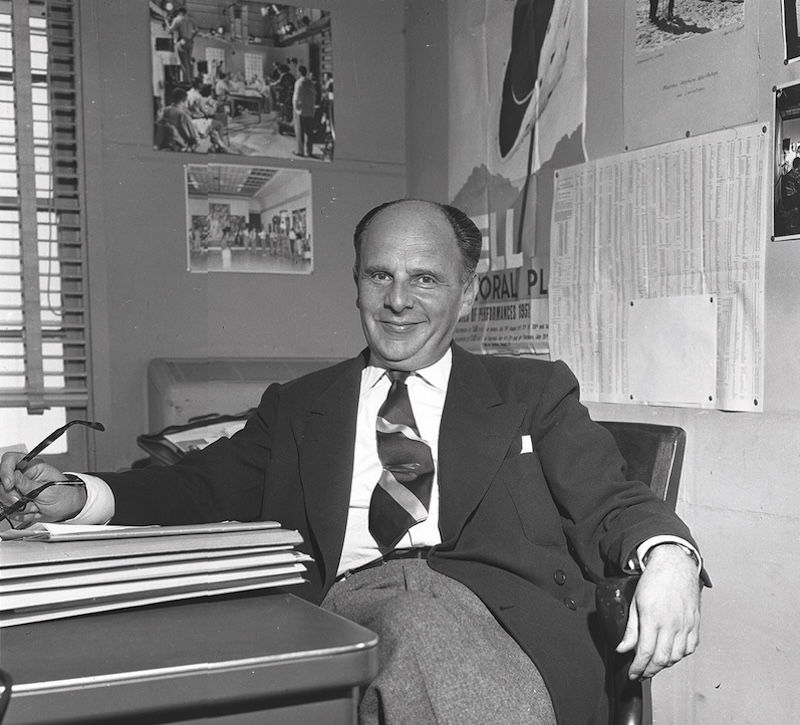
Professor William Wolf Melnitz (Photo courtesy of UCLA archives)
This is pertinent because in Lacámara’s play, a pivotal character who holds, or seems to hold, the key to Sam’s fortunes is a senior professor, a German émigré no less, who spends most of his time holed up in his office watching soap operas. He’s a crusty, mercurial engaging and completely endearing character, played to the hilt by Carl J. Johnson. His name is Melnitz. I have not discussed this with Lacámara, but given that he was at UCLA at the time that Professor Melnitz was strutting the halls and the quads of the university that we both attended, I find it hard to believe that this portrayal of his character Melnitz is anything but an homage, and a loving one at that.
As a young man, William Wolf Melnitz studied theater at the universities of Cologne and Berlin. Between 1921 and 1939, in association with theater icon Max Reinhardt, he directed and produced more than 150 plays, becoming the leading director in Germany, Austria and Switzerland’s most prominent theaters. In December of 1939, Melnitz emigrated to the United States, settled in New York, and there married Ruth Nathonsohn. Reinhardt asked for his help forming a European-style American repertory company, which did not work out. (If you know anything about American theater, you can easily imagine why, and why not.)
In early 1941, Melnitz and his wife moved to Los Angeles, where he took a job teaching German at UCLA. Seven years later, in 1948, Melnitz joined the spanking new theater department at UCLA.
When I was there in 1979, there was a building named after him housing the film department: Melnitz Hall.
Two memories: He was a guest speaker in one of my playwriting classes, where he spent two hours simply reading from the plays and poems of Bertolt Brecht.
(With his enthusiasm for communist-leaning Brecht, it’s evident why he fled Germany in 1939. So did Brecht, at about the same time. They both eventually landed in the sanctuary city of Los Angeles, which Brecht hated. I doubt Melnitz felt the same given his longevity here.)
When Melnitz read Brecht’s words in English, they were beautiful, but when he reverted to German, the man was transformed. His eyes glazed over, his faced flushed with love from the soaring glory of the words, flecks of spittle punctuated Brecht’s consonants. He was unstoppable. I doubt many of us understood the literal German meaning of those words, yet from Melnitz, we all understood what those words signified.
Second memory: Some undergraduate woman was walking across the Murphy Sculpture Garden and encountered the silver-haired Melnitz, shuffling across the same quad. She was trying to find Melnitz Hall, so she asked him, “Excuse me, sir . . . Do you know where Melnitz is? His posture shifted from a slight stoop to the vertical stance of a haughty rooster. And then, with a gleam in his eye and in his thick German dialect, he crowed: “Rhright here!”
I’m currently working on a biography of the Mark Taper Forum’s founding artistic director, Gordon Davidson, which is also, in part, a biography of Los Angeles theater. Trying to sort out some discrepancies among public records, Gordon’s memoirs, and interviews with his colleagues, I was on the phone last night with his widow, Judi Davidson.
She was recalling the year 1964, when Gordon Davidson and she (eight months pregnant with their first child) first came to Los Angeles from New York. He’d been hired as an assistant to director John Houseman, who, among his many, many enterprises in theater and film, had just resigned as director of The Theatre Group, an L.A.-based company of professional actors working during their film/tv hiatus season (the spring) on keeping their skills sharp on the stage. (Houseman was working on his final production there, King Lear, with Gordon as his assistant.) The Theatre Group was housed on the campus of UCLA but was not part of its theater department, but rather of what’s now called UCLA Extension. Even with that arrangement, Judi noted, and though it was run by a man named Dr. Abott Kaplan, she kept referencing the company’s guiding principles being shaped by “the guy who ran the UCLA Theater Department at the time, Bill Melnitz.”
Sometimes it feels as though history is like laundry in a dryer, it just keeps spinning and reappearing.

Julianna Robinson and Alina Phelan: “Tune In” at Theatre of NOTE (photo by Jeff Lorch)
Carl J. Johnson, portrays Melnitz in Lacámara’s play. I love this actor. And I don’t believe I could love anyone who doesn’t. His portrayal of Melnitz comes marbled in textures containing a short fuse, a quick wit, an underlying kindness offset by irrefutable practicality. Moreover, I don’t know if Johnson ever met Melnitz, but there’s a twinkle in his eye that Melnitz possessed, a characterization blending weariness and curiosity. His excitement over those soap operas that he watches in his office matches the real Melnitz’s adoration of poems by Bertolt Brecht, as if Johnson were restoring him to life from the ether of history.
In any discussion of L.A. theater and its storied legacies, one cannot ignore Theatre of NOTE, which emerged in 1981 at the now-demolished Attic Theatre, soon moved downtown, and has since traversed Hollywood with venues on Kenmore Avenue (brought down during the Sylmar earthquake) to its current, long-standing storefront location at 1157 Cahuenga Boulevard, just north of Sunset Boulevard.
Final note, in the history of L.A. theater, as one cannot ignore Carl J. Johnson, the same is true of Alina Phelan, who I’ve seen prancing this same stage in productions over the years. In this play, she portrays Carla, hair in a bob, the department secretary (that’s what they called them in the 1960s), a flighty, slightly neurotic compatriot to Samantha with an undertow of competitiveness that feeds directly into the patriarchal agendas of the place. Her interpretation is slightly comical and ultimately vicious. These are qualities, in this combination, I’ve never before seen in Phelan.
That’s what it means to be an actor.
“TUNE IN” by Carlos Lacámara, directed by Dana Schwartz. Theatre of NOTE, 1517 N. Cahuenga Blvd., Hollywood; Fri.-Sat., 8 pm; Sun., 2 pm; Mon., 8 pm; thru Sept. 7. theatreofnote.com