
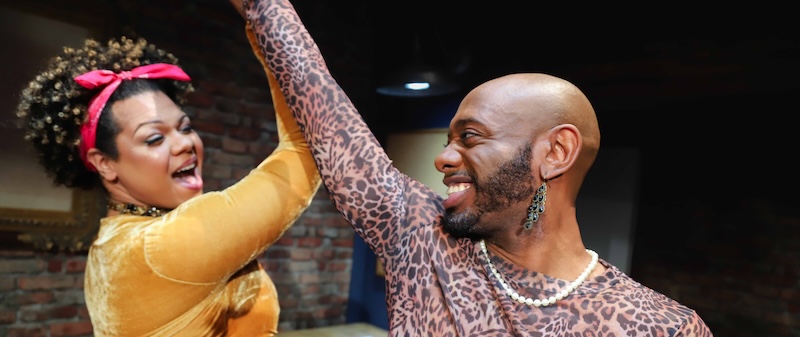

Xoe Sazzle and Clifton J. Adams (Photo by Ken Sawyer)
Reviewed by Steven Vargas
The Road Theatre Company
Through March 1
RECOMMENDED
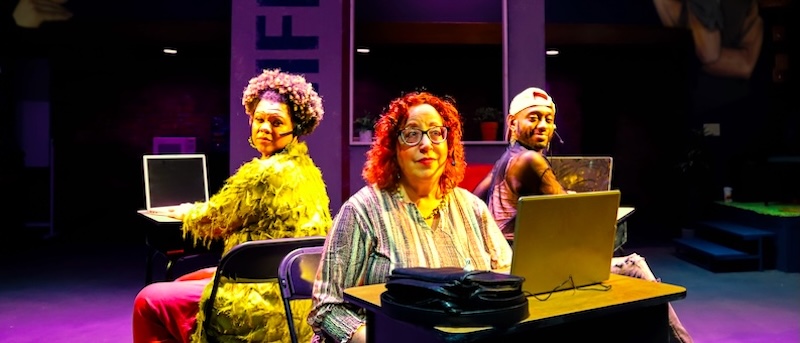
Xoë Sazzle, Amy Tolsky and Clifton J. Adams (Photo by Ken Sawyer)
When someone accidentally says or does something harmful to another at Lifeline, a suicide hotline for the LGBTQ+ community, the protocol is to say, “Whoops” (I didn’t realize I made a mistake), “Wow, (I’m learning), and “Sorry” (I apologize for hurting you). These feel like an appropriate catch-all for mishaps that could occur during difficult discussions at a hotline. But what happens when the phrase isn’t strong enough to alleviate the pain of something greater, like the death of a loved one?
Lifeline by Robert Axelrod follows four new volunteers at a hotline of the same name and searches for answers to this question as the characters expose their truths. The story begins on orientation day where the leaders of this nonprofit, Jen (Brittany Visser) and Drew (Tommy Dickie), welcome the newcomers: Sarah Beth (Naomi Rubin), a stickler for political correctness who constantly reminds everyone of her trans fiancé, Kai (Clifton J. Adams; a Beyoncé-loving Black gay man with a femme gender expression; Maya (Xoe Sazzle), an Afro-Latina trans woman who discovered her identity later in life; and Patti (Amy Tolsky), a White mother whose son recently died. As their training commences, the differing perspectives among the group challenge each person to rethink their understanding of the people who make up the LGBTQ+ community. The play, making its world premiere with The Road Theatre Company after participating in The Road’s 15th Annual Summer Playwrights Festival, is a heart-wrenching investigation of what it means to feel safe and loved, whether it be with one’s blood family or one chosen and fostered at a hotline center.
The production, directed by Ken Sawyer, is set in the round with part of the audience on stage. It opens with an invitation to the audience members to provide rules (or guidelines) for the learning sessions. The audience even takes part in learning the phone answering etiquette, reciting the phrase, “Lifeline. This is [your name]. I’m so glad you called.” This intimate setting is designed to allow audience participants to feel comfortable reacting alongside the characters on stage as if they are in the training themselves. Working in the round presents a series of constraints, such as potentially losing sight of an actor’s performance, but the communal feeling of the work makes those short, obstructed moments worth it.
Axelrod’s writing packs a punch, especially when characters monologue about an impactful moment in their lives. Kai and Maya have the strongest soliloquies. Adams and Sazzle’s performances take viewers out of the center, aided by a sharp lighting design by Matthew Richter and projection design by Nicholas Santiago. The lights shift, spotlighting a particular corner or aisle in the theater as the projections transform the space into Pulse Nightclub or a quaint café. Maya speaks of the day she realized she didn’t want to keep living without being her full, authentic self while reporting on a shooting. Meanwhile, Kai tells the story of a meet-cute gone unfulfilled and the fear of never feeling loved the same way again. Their stories are incredibly detailed and turn the smallest moments into bigger lessons.
Axelrod has a distinct way of illustrating the impact of death and the realities of how life goes on. Through objects, including a ringing phone and college acceptance (and rejection) letters, he delivers the somber reality that those still alive must contend with. Although the owners of these phones and letters may be gone, the phone still rings and mail still arrives. These objects operate as echoes of the life and breath of those deceased. Axelrod sprinkles these details and objects throughout Lifeline, adding weight to seemingly simple objects in the space.
Overall, the work is strong. The play covers a series of difficult topics, from police brutality to gender expression, with wit and levity. Axelrod doesn’t linger too long on these topics and doesn’t make it commandeer the work. Instead, he uses them to reveal more about each character, creating teachable moments. Despite this, one character, Jen, never develops fully enough to make her final moments with Patti as impactful as they might be. Although we see her grapple with their unexpected connection at the beginning, her own internal monologue isn’t revealed, and her tears feel unexpected.
Patti ultimately becomes the central character of Lifeline, and Amy Tolsky’s performance gives her heartbreaking story justice. Tolsky channels the life of someone mourning and makes bold choices, demonstrating that it doesn’t require a boisterous wail to communicate pain. Sometimes, it is better delivered with a whisper.
Lifeline is not just smart in its ability to cover sensitive topics with humor — it also allows the characters to breathe between the tension and show their humanity. Moments that happen outside of the tragedy they are privy to in their occupation—the laughs and unexpected connections — are revealed. Axelrod’s writing and Sawyer’s direction expose a strong heartbeat within the play that spotlights the individuals who make up the LGBTQ+ community. Although she’s still learning the correct terms, Patti’s heart makes her belong. After learning about her life and grief, her presence on stage gives heavier weight to the final words of the play as she prepares for her first caller. The phone rings. “Lifeline,” she says. “This is Patti. I’m so glad you called.”
NoHo Senior Arts Colony, 10747 Magnolia Blvd., North Hollywood. Fri.-Sat., 8 pm, Sun., 2 pm; thru Nov. 15. Runtime: 95 minutes, with no intermission. https://roadtheatre.org/event/lifeline/