
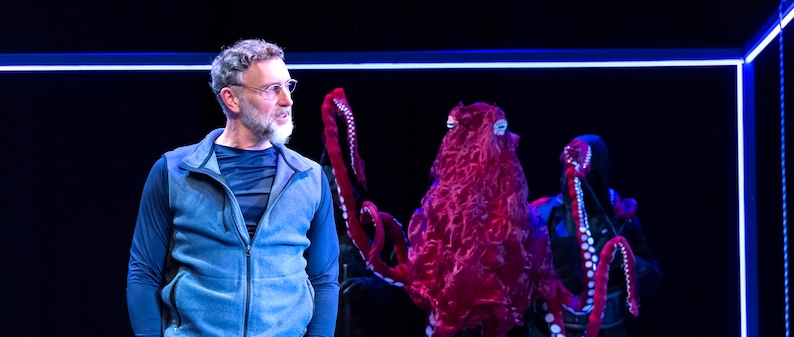

Tim Cummings (Photo by Brian Hashimoto)
Reviewed by F. Kathleen Foley
Boston Court
Thru March 29
RECOMMENDED
It’s quite an occasion when three strong-minded women, all artistic directors of prominent local theater companies, pool their aesthetic resources to produce a world premiere play.
The women in question are Jen Kays of Circle X Theatre Co., Jessica Hanna of Outside in Theatre, and Jessica Kubzansky of Boston Court. The play that results is Weston Gaylord’s Octopus’s Garden, a world premiere at the Boston Court, directed by Kubzansky.
The collaboration itself is groundbreaking. Kays, Hanna and Kubzansky are a Band of Sisters whose mandate, both individually and now, collectively, is championing new work.
Their current offering is an intriguing oddity packed with big ideas that occasionally bursts its seams but is nonetheless a gripping meditation on what it means to be human.
Lars (Tim Cummings) and Tara (Kacie Rogers) are cephalopod researchers who share a laboratory and a common goal — systematizing the thought processes and intelligence of octopuses. Lars has devoted his life to the study of these fascinating creatures, who have three hearts, a decentralized nervous system and possibly, given further analysis, the capacity for advanced thought. Subdued and analytical, Lars is devoted to scientific rigor and pursues his research step by tiny step, whereas the passionate and much-younger Tara frequently foregoes protocol in pursuit of that one big breakthrough.
That discovery, when it comes, is so huge that it has implications far beyond their field of research. Working on a hunch, Tara lowers a rigged up musical instrument into the tank occupied by Sylvia, a giant Pacific octopus that Lars encountered while scuba diving and brought back to the lab. When Tara later listens to the “music” that Sylvia has made with the device, the composition is of such soaring, celestial magnitude that it reduces its listeners — including Lucas (Vincent R. Williams), a young composer who has been brought into the lab for his musical input — to helpless tears and euphoria.
But this “miracle” comes with a startling downside that will devastate Lucas’s promising career and lock Lars and Tara in a bitter dispute. Should this music, with its unforeseen and potentially globe-altering ramifications, be unleashed upon an unexpecting world, or should it be locked away as too dangerous for human ears?
The play examines the moral equivocations of right-minded researchers sidetracked by ambition and scientific zeal. The unfortunate Lucas is the helpless bystander who is merely in the wrong place at the wrong time. More complicated are the typically well-meaning Tara and Lars, who are reduced to ethical shortcuts that don’t stop short of blackmail.
The play’s preponderance of scientific detail and philosophical exchanges could stand an edit or two, but the masterful Kubzansky attacks Gaylord’s sprawling canvas with the same painterly eye she displayed in the Boston Court’s recent production of The Night of the Iguana. Also painterly is the perfect symbiosis of François-Pierre Couture’s set and Karen D. Lawrence’s lighting, which include hanging frosted glass rectangles containing ever-shifting colored lights — a striking visual element that creates the disorienting and surreal effect requisite to the play.
Williams and Cummings (coincidentally, himself a lifelong cephalopod enthusiast) are fine in their portrayals but are somewhat overshadowed by Rogers, whose recent performances in Berta, Berta and Furlough’s Paradise establish her as one of the most dynamic young actors on the theatrical scene. Devoid of artifice or actorly tricks, she is engaging and achingly real.
And when it comes to dynamic performances, the most winning of the evening is Sylvia herself, a huge red octopus puppet designed and directed by Emory Royston and manipulated by three nimble puppeteers, Zachary Bones, Perry Daniel, and Danielle McPhaul. Her mystical presence not only makes us question the ethics of incarcerating such a creature in a research facility, but also raises the issue of why octopuses are still marketed as food. Indeed, considering their amazing intelligence and human-like attributes, consuming them seems alarmingly akin to cannibalism.
That may be the most important takeaway from Gaylord’s special play, which boldly crosses the species barrier and leaves us wondering: What exactly constitutes a human, and just how special are we in the scheme of this extraordinary cosmos?
Boston Court, 70 N. Mentor Ave., Pasadena, thru March 29; check website for schedule. https://bostoncourtpasadena.org/events/octopus/ Running time: two hours and 15 minutes with an intermission.