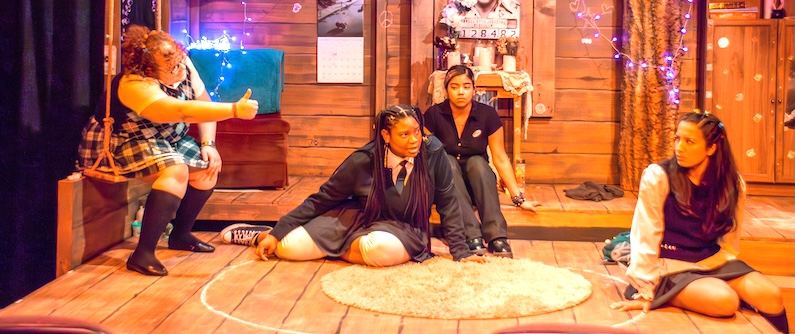

Ryan Hollon, and Jenilee Flowers, Alejandra Peñaloza and Sam Farfán (Photo by Diana Kaufmann)
Reviewed by Joel Beers
Garage Theatre
Through April 4
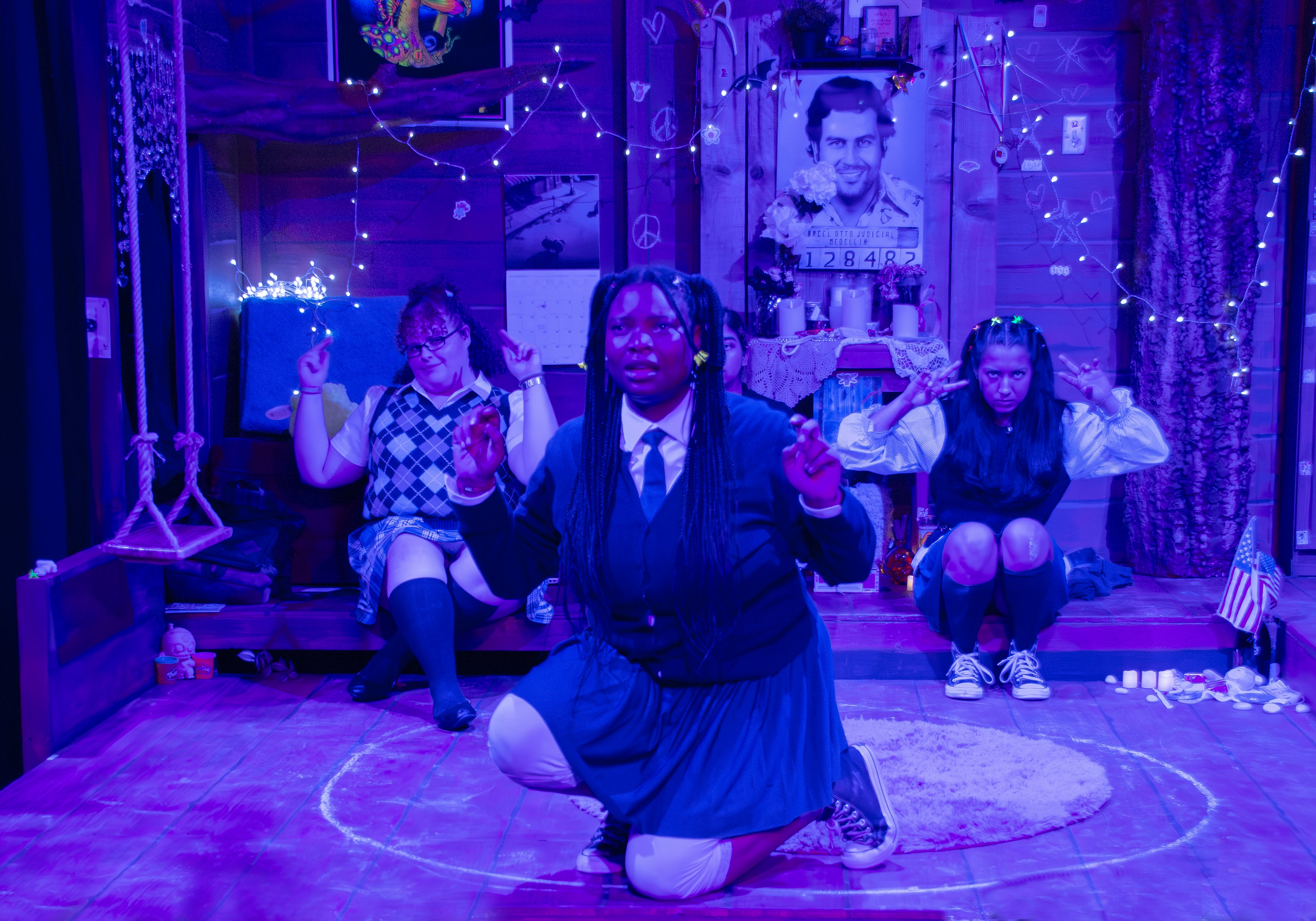
Ryan Hollon, and Jenilee Flowers, Alejandra Peñaloza and Sam Farfán (Photo by Diana Kaufmann)
Alexis Scheer’s 2018 play, Our Dear Dead Drug Lord, might at first seem like another story about teenage misfits searching for a place to belong. featuring as it does four high school girls full of gossip, boy problems, and the everyday dramas of high school life.
Except it isn’t — unless that teen tale includes the veneration of Pablo Escobar, ritualistic attempts to summon his spirit involving cocaine, a homemade Ouija board, incantations and a living sacrifice, and a possible immaculate conception leading to a horrifying on-stage atrocity.
Set in 2008 Miami, as the prospect of the nation’s first Black president looms, the play opens with three members of a high-school club devoted to studying dead world leaders meeting in an expansive backyard treehouse after their club has been banned from campus. For years, the club studied figures like John F. Kennedy and Gandhi, but its new focus on more controversial leaders — Hitler, Stalin, and now Escobar — has led to its on-campus ban.
Now, the trio await the arrival of a prospective new member; if accepted, the club will have a quorum and can attempt to summon Escobar’s spirit. Why they want to do this isn’t immediately clear, but as the play unfolds, it becomes apparent that the summoning is also a kind of exorcism for one girl shattered by the death of her younger sister.
The first ritual ends in confusion — maybe Escobar’s presence is felt, or maybe it’s hallucinated — but when the newest member suddenly screams “Dad,” the other girls begin to wonder if she might be the drug lord’s illegitimate daughter, and concoct a story: that her mother fled Cuba while pregnant and is now in witness protection after providing information to U.S. intelligence.
As the play progresses, we learn more about each of the characters, all but one of whom are dealing with the trauma of lost family members. The darkness retreats as the play explores the complexities of teens dealing with loss, sexual identity, and the transition into adulthood. These girls are charming and funny, politically aware and goofy, kind and considerate — but they are also combative, vindictive, jealous, and competitive.
But the darkness returns in full force during the climactic second ritual, which involves another horrifying sacrifice, and the play concludes on an unpredictable note of female empowerment, making it as shocking as it is darkly funny.
Director Skylar Alexis skillfully blends the play’s tones of magical realism, teen angst, and silliness. Actors Sam Farfán, Alejandra Peñaloza, Ryan Hollon, and Jenilee Flowers navigate the fantastical and realistic worlds with strong performances, while Anneliese Nendel-Flores and Joshua Sandoval make memorable appearances at the play’s end, even in smaller roles.
But the play’s bizarre tonal shifts don’t always mesh, and dramatic tension becomes obscured by character exploration. Still, the takeaway for most audience members will likely be the play’s unsettling yet empowering depiction of teenage girls asserting agency in a world that often ignores them. It’s a message that echoes Me Too–like solidarity, but is delivered with an uncompromising intensity — aggressive, challenging, and disturbingly proactive — that lingers long after the curtain falls.
The Garage Theatre. 251 E. 7th Street, Long Beach; 1363 Old Globe Way, San Diego; Thurs.-Sat., 8 pm; Thru April 4. Garagetheatre.org. Running time: 90 minutes with no intermission.