
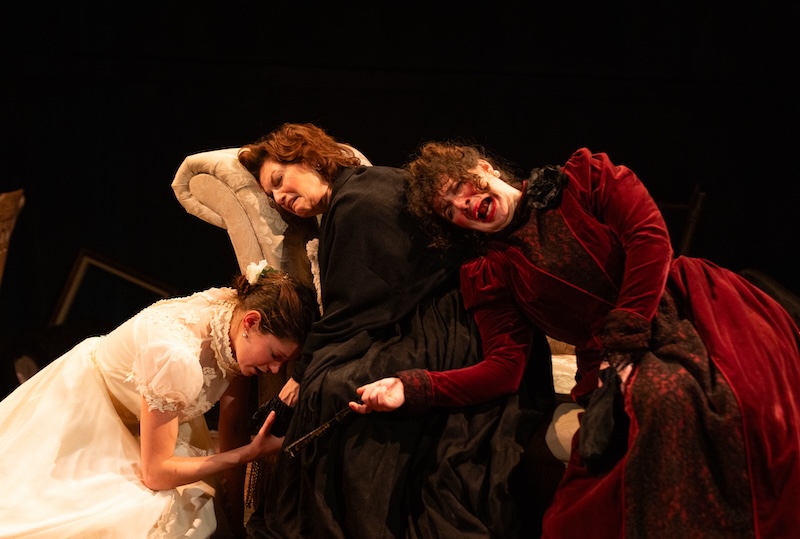


Maya Shoham, Mary Bacon, Alexandra Pearl (Photo by Bronwen Sharp)
Ivanov and Spare Parts
If You Can Make It Here: A Coupla Shows in NYC

Saw four shows over a four-day visit to New York last week. I’ll write here about the two that I enjoyed. Of that pair, one was in previews, so perhaps you’ll forgive or indulge my take on these experiences that’s more ruminative than critical.
The preview of Anton Chekhov’s Ivanov (translated by Paul Schmidt), was presented by a newish company called New American Ensemble, at the West End Theatre on 86th Street. At the risk of sounding sentimental, or even maudlin, it was a bit like going home, presuming that “home” was ever a pleasant place.
Home, for me, is Chekhov. I was weaned on the guy’s writings. And Ivanov is an early, slightly clumsy preview of his greater works to come. But none of that matters compared to the way New American Ensemble brought the play to life with a humor that spilled over into farce and then back to un-tempered earnestness. All of these careening tones were masterfully blended by director Michael DeFilippis.
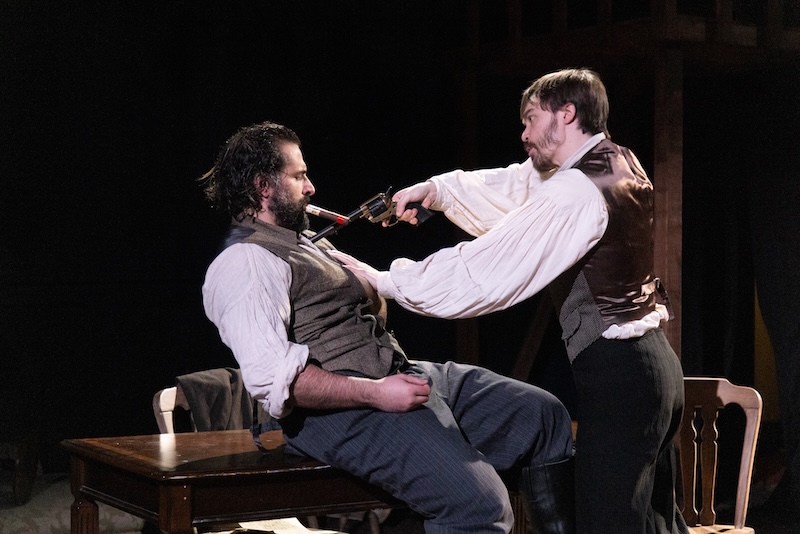
Ivanov has simply had enough of Borkin’s clowning – left to right: Mike Labbadia and Zachary Desmond (Photo by Bronwen Sharp)
To access the theater, one has to climb up several flights of a stairwell, one of two that borders a cavern between them. This is the same architecture as in the Masonic Temple in Glendale, California. (It might have been designed by the same architect.) I remember visiting that Masonic Temple through the 1990s, when what was then a fledgling classical repertory company called A Noise Within was similarly staging any number of theater classics on the building’s 99-seat upper-tier stage. The ambition of A Noise Within was to sustain a classical repertory and eventually to pay actors on some kind of professional scale. (New American Ensemble has similar and even more expansive aims.) A Noise Within’s Masonic Temple days are now history (though the building is still there), yet the company continues to thrive as a classical rep company, staging classics some 35-years later in a custom-built mid-size venue in Pasadena.
I write this because New American Ensemble is findings its footing in a very different climate. Those steps, to climb to the theater space, are now more precarious —allegorically speaking.
DeFilippis leapt onto the stage after the curtain call to explain how the “commercial model” of doing theater no longer works, and that his company’s purpose is paying actors to invest time (months, if not longer) exploring a text, and unearthing the depths of emotion, and comedy, and turmoil that exist within the lines and between them, rather than boxing them into a four-week (or less) rehearsal prison. It’s a “patron supported” model used in ballet and opera, and in some theaters in Europe, but not in the United States. New American Ensemble aims to change that.
Going home. More nostalgia. The year is 2006. The setting is the Ralph Freud Playhouse on the UCLA campus. UCLA Live, administered by an impresario named David Sefton, is presenting an upending of Henrik Iben’s A Doll’s House conceived and staged by Lee Breuer of Mabou Mines. It’s called Dollhouse, and sometimes A Mabou Mines Dollhouse.
Two aspects of this production remain enshrined in memory. The first is Ning Yu’s live piano accompaniment throughout the production of various works by Edvard Grieg. The other is Nora, an Amazonian presence portrayed by a then-35-year-old actress named Maude Mitchell. I say Amazonian because Nora’s husband, and unwitting rival named Torvald, is played by a “short person” (Mark Povinelli) who I recall at one point leapt into the arms of his wife. This was Breuer’s way of physically upending the patriarchy that was the target of Ibsen’s social critique. I loved this production so much, I used to play it on video at Cal State for students being introduced to all of theater’s possibilities. So Maude Mitchell, too, or that image of her, is enshrined in memory.
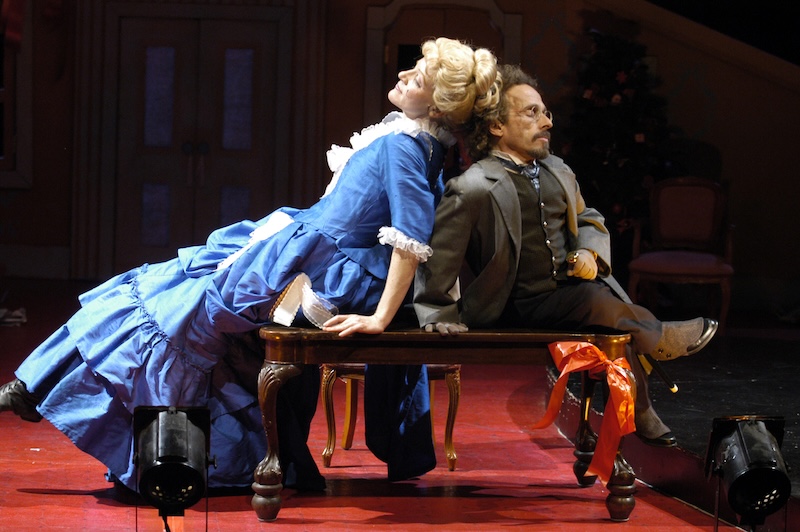
Maude Mitchell and Mark Povinelli in “Mabout Mines Dollhouse” (2006) Photo courtesy of Emerson Arts
Thirty years later, at the West End Theatre on 86th Street in New York City, I’m watching a remarkable performance in a production of Ivanov: A woman with scarf and shawl named Avdotya Nazarovna (described in Paul Schmidt’s translation of the play as “an old woman with no known occupation) is squabbling with a partner over a card game. When she gets really angry, her voice turns guttural, as though she’s spitting bullets. At intermission, I check the program. Who is this actress? You probably guessed: Maude Mitchell.
Going home. This is just magical.
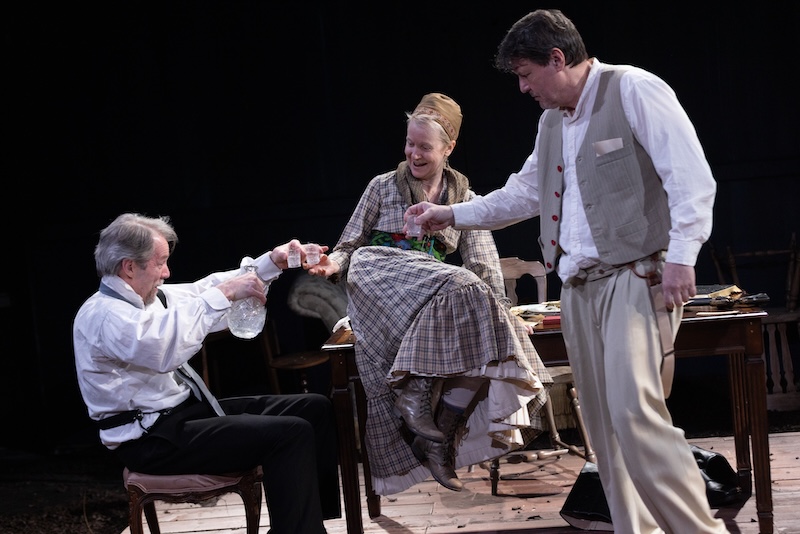
Paul Niebank, Maude Mitchell, and Ilia Volok (Photo by Bronwen Sharp)
Ivanov is the study of a young man (Zachary Desmond) who compares himself to Hamlet, assuming incorrectly that Hamlet has no purpose in life. Unlike Hamlet, who is driven by curiosity, contempt and ultimately by revenge, Ivanov lacks all purpose and some humanity. His Jewish wife Anna, (Quinn Jackson), dying of tuberculosis, begs her estranged spouse to stay home in the evenings, which he refuses, because he can’t bear being with her, or with his peers, or with himself. This he points out repeatedly. The looming question is, why? Why is everything around and within him so unbearable and tedious?
The answer to this lies less in the text than in this production’s visceral dynamics. Ivanov is living in a kind of clown show of reprobates (including himself) that long ago he ceased to find amusing. It’s not really political or social corruption that so disenchants him, it’s more a kind of ennui. We can speculate that living in a world such as ours, in 2026, could be, is, a source of estrangement for upcoming generations who are flailing around for some sanity, let alone purpose. But here, when Borkin (Mike Labbadia) opens the play with a practical joke, popping up out of the blue, and making Ivanov leap in fright, before Borkin bursts out laughing, it’s evident that these kinds of games have been going on for some time. The looming Borkin, like a Brooklyn fishmonger, keeps hugging him, while Ivanov recoils in disgust, and Borkin just won’t stop. It’s a symptom of a larger disease, of life itself, that Ivanov finds so repellent.
There are some gorgeous comedic turns by the magnetic Ukrainian actor Ilia Volok, and an ever-so-tender performance by Maya Shoham as Ivanov’s mistress, Sasha.
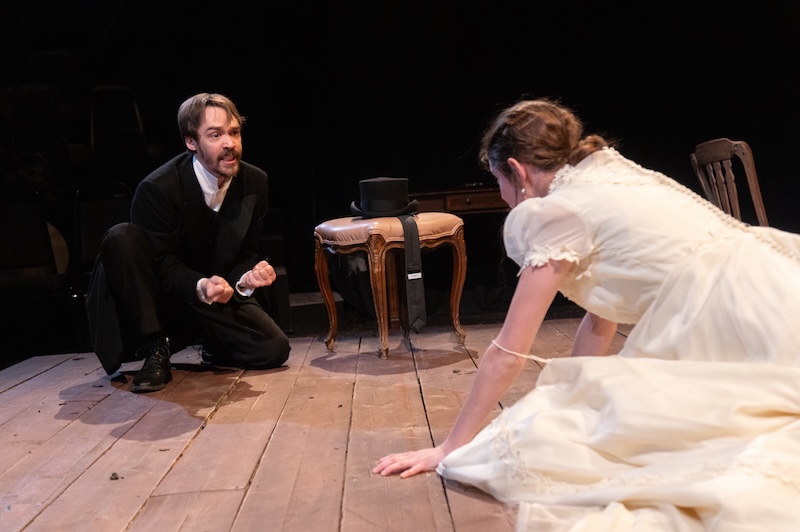
Ivanov and his mistress, Sasha: Zachary Desmond and Maya Shoham (Photo by Bronwen Sharp)
Chekhov is trying out the form of Comi-tragedy, and the burlesque is, in one scene, as over-wrought as Ivanov’s winging. None of this bothered me, preview performance aside, thanks to the compensating effects of an ensemble and director and designers (Ashley Basile, set; Stan Mathabane, sound; Sarah Woods, lighting; and Adeline Santello, costumes) who had all done their homework and were determined to simply let this play rip, for what it was, and is.
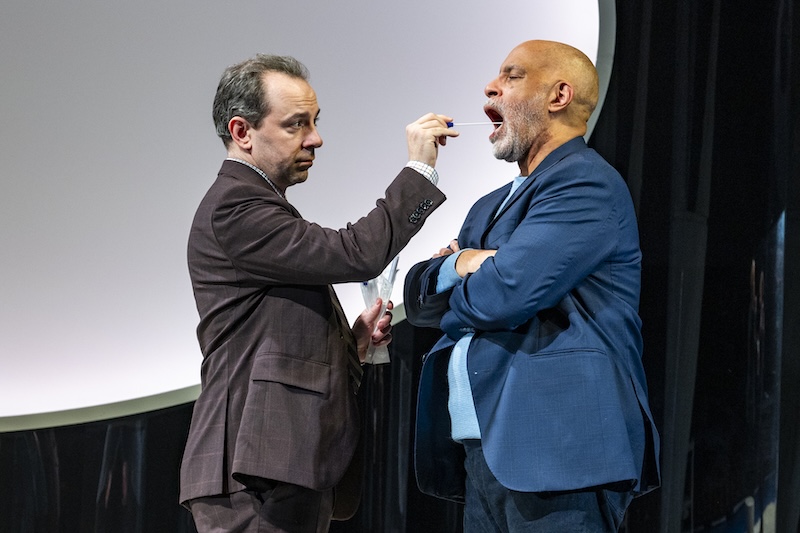
Rob McClure and Michael Genet in “Spare Parts” (Photo by Russ Rowland)
Over on 42nd Street, on Theater Row’s Theater 3, is David J. Glass’s new play Spare Parts, slightly tropey, deeply provocative and sleekly directed by Michael Herwitz. Glass (Love and Science) is both a playwright and an M.D. who has studied the biology of aging, and this is what he writes about here.
Futuristic, and yet not, it imagines billionaire Zeit Smith (Michael Genet) and his apprentice, Ivan (Jonny-James Kajoba) soliciting help from researchers at Columbia University — Professor Caffey (Rob McClure) and his young research assistant Matt Walker (Jeffrey Jordan). Zeit has high blood pressure and other infirmities of age, and he’s seeking (and is willing to pay $1 million/year salaries) to researchers who will goose along some research on risky blood plasma transfusions that could infuse a younger person’s blood into an aging person and thereby reduce the biological age of the older person. (The risk is that the same process could artificially age the younger subject.)
The play opens as a kind of interview, in which the cautious Professor Coffey and young Matt are applying for the high paying job. Zeit takes to Matt right away, less so to Professor Coffey, who keeps expressing concern that the research is untested on humans. The Professor’s reservations become tedious for Zeit, though Matt speaks up, sort of, on his behalf.
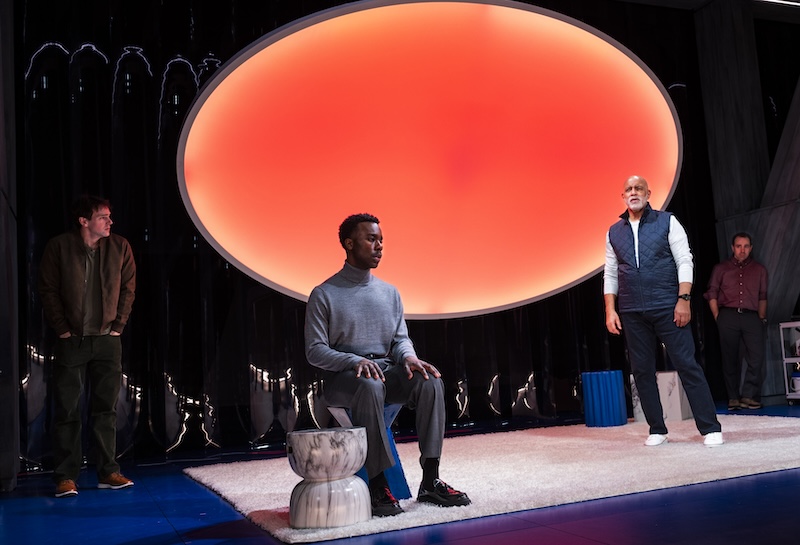
Matt Walker, Jonny-James Kajoba, Michael Genet and Rob McClure in “Spare Parts” (Photo by Russ Rowland)
There are two pinnacles to this play, which make it sizzle. And they both concern ethics rather than biology. The first comes in a dialogue about NYU’s research funding having been cut by the feds, and how Zeit finds the Professor’s dedication to research fueled by government rather than private funding to be quaint to the point of absurdity. The professor’s counterargument is that government funding is used for research that benefits the public, whereas Zeit’s million dollar salaries have the aim of benefiting one billionaire.
As an indicator of the play’s timeliness, the New York Times posted an article the same week I saw the play about Harvard researchers studying aging, and the quagmires they found themselves in. (“You are receiving this email because one, or more, of your projects have been terminated per notice from the federal funding agency.”)
This leads directly to the second pinnacle, which is the play’s grasp of how the super-rich are, in this play, vampires, sucking the blood of those beholden to them. That is depicted on the stage, in a scene of blood plasma exchange, and captures the despondency of this cultural moment when guardrails and regulations are becoming detached from institutions designed to protect the public from the rapacious greed of those who already possess the lion’s share of global resources.
There is the “altruism of selfishness” counter argument (not expressed in this play) positing that one man’s selfish designs ultimately help everyone; that’s simply not where this play’s heart is beating.
The performances are excellent, with McClure’s Professor Coffey standing out as a figure of aging, wounded defiance. He’s being thrown to the wolves and yet he retains his dignity, until he chooses not to.
Scott Penner’s set features a looming suspended oval (a mechanical eye) underscoring (or overscoring in this case) the intrusive high-tech ambience of Glass’s play, while Ryan Gamblin’s sound design includes the kind of Law and Order ching-ching transitions that have become part of regional theater’s language over the past several decades.
To describe the play’s plot turns, and there are a few, would be a disservice for those yet to experience this play first-hand. Suffice it to say, this is a worthy, thoughtful play that indulges in some formulaic cliches yet has so much to recommend it, I can’t imagine it not travelling across the U.S. and abroad. It deserves to.
IVANOV, by Anton Chekhov, translated by Paul Schmidt and presented by the New American Ensemble at the West End Theatre, 263 W. 86th Street, New York; opens Thursday, March 19, 7 pm; Tues.-Fri., 7 pm; Sat., 2 & 7:30 pm; Sun., 5 pm; through April 9. Running time: 2 hours and 30 minutes with one intermission. https://newamericanensemble.org
SPARE PARTS, by David J. Glass, Theater Row (Theater 3), 410 W. 42nd Street, New York; Tues.-Sun., 7:30 pm; mats Sat.-Sun., 2 pm; through April 10. Running time: 90 minutes no intermission. https://sparepartsplay.com